
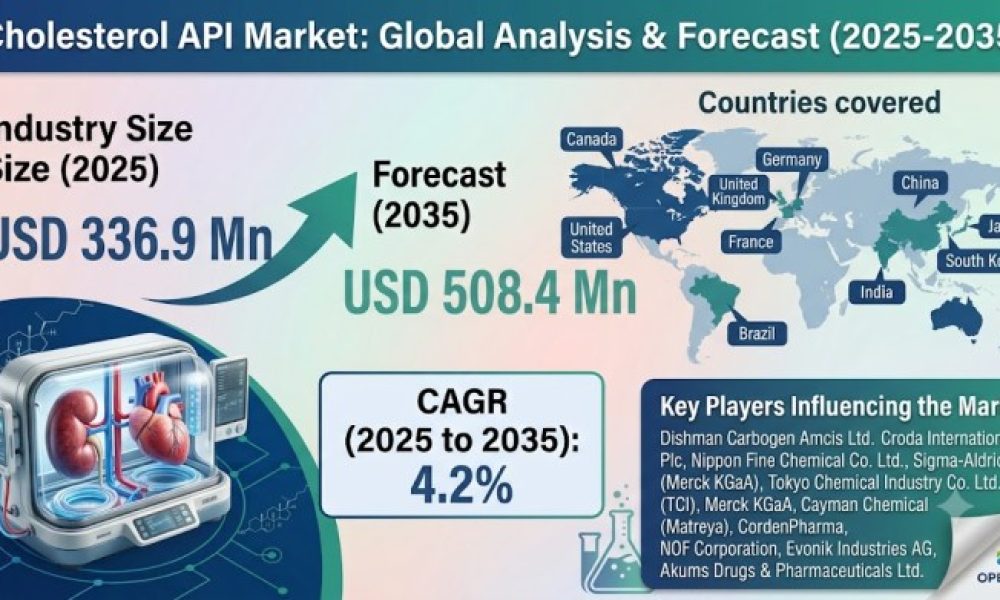
Newark, Del. — The global cholesterol active pharmaceutical ingredient (API) market is projected to increase from USD 336.9 million in 2025 to USD 508.4 million by 2035, expanding at a compound annual growth rate (CAGR) of 4.2%, according to Future Market Insights (FMI). Demand is being supported by the use of cholesterol in lipid-based drug delivery systems, including lipid nanoparticles used in RNA therapeutics and vaccine formulations.
As pharmaceutical and biotechnology companies develop advanced drug delivery platforms, API buyers are placing greater emphasis on purity, batch consistency, manufacturing controls and traceability. FMI expects animal-derived cholesterol to remain the leading source segment, with a projected 52.4% market share in 2025. Good Manufacturing Practice (GMP)-compliant cholesterol APIs are forecast to account for 68.5% of the manufacturing-process segment.
👉 Get Detailed Market Forecasts, Competitive Benchmarking, and Pricing Trends:
https://www.futuremarketinsights.com/reports/sample/rep-gb-15406
Why the Cholesterol API Market Is Growing
Cholesterol is an important component in certain lipid-based formulations, including lipid nanoparticles designed to deliver nucleic acids and other therapeutic payloads. Its role in these delivery systems has increased its relevance to pharmaceutical manufacturers developing RNA-based medicines and other advanced therapeutics.
The market’s development is also tied to quality requirements. Pharmaceutical buyers need consistent raw materials, validated production processes and documentation that supports regulated manufacturing. Suppliers capable of meeting these requirements may be better positioned to serve customers developing injectable medicines and biologics.
At the same time, sourcing strategies are evolving. Animal-derived cholesterol benefits from established pharmaceutical use, while plant-derived and synthetic alternatives offer additional sourcing options for buyers evaluating supply-chain resilience, animal-origin considerations and formulation requirements.
Where Growth Is Fastest
FMI’s country outlook identifies the United States as the fastest-growing country market in its published forecast, followed by Japan and the United Kingdom.
- United States — 4.5% CAGR: Pharmaceutical research, biotechnology investment and demand for lipid-based formulations are expected to support market expansion.
- Japan — 4.3% CAGR: Established pharmaceutical capabilities and research into advanced drug delivery systems are projected to sustain demand.
- United Kingdom — 4.0% CAGR: Biopharmaceutical development and research into vaccine and gene-therapy technologies are expected to support growth.
- European Union — 3.9% CAGR: Pharmaceutical manufacturing and regulatory requirements for high-purity materials are expected to underpin demand.
- South Korea — 4.1% CAGR: Biotechnology development and interest in lipid-based formulations are projected to support the market.
The United States leads the listed country forecasts, while Japan and the United Kingdom also show growth opportunities for suppliers serving pharmaceutical and biotechnology customers.
What Leads the Market
FMI’s 2025 estimates identify two leading segments in the cholesterol API market:
- Animal-derived cholesterol — 52.4%: Established supply chains and pharmaceutical use support its leading position, although buyers continue to assess sourcing and traceability requirements.
- GMP-compliant cholesterol APIs — 68.5%: Regulated pharmaceutical applications require controlled manufacturing, reliable documentation and consistent batch quality.
Other source categories include plant-derived cholesterol, projected to account for 28.3% of the market, and synthetic cholesterol, forecast to represent 19.3%.
These alternatives give pharmaceutical buyers additional sourcing options. Their commercial suitability depends on purity specifications, formulation performance, regulatory requirements and total supply cost.
The Hurdle: Purification Costs and Supply-Chain Control
Cholesterol API producers face challenges associated with extraction, purification or synthesis, alongside the costs of maintaining quality systems and regulatory compliance. These requirements can raise production expenses, particularly for materials intended for regulated pharmaceutical applications.
Animal-derived sourcing can also expose manufacturers to supply-chain variability and increased scrutiny of origin and traceability. Plant-derived and synthetic alternatives may diversify supply, but their adoption depends on manufacturing economics, quality consistency and suitability for individual formulations.
For buyers, supplier qualification involves more than comparing prices. Documentation, batch reproducibility, impurity profiles, change-control procedures and dependable delivery can all influence sourcing decisions.
👉 Access the Complete Report in PDF Format:
https://www.futuremarketinsights.com/reports/brochure/rep-gb-15406
Industry Investment and Competitive Landscape
Competition spans specialist lipid suppliers, API manufacturers and companies serving pharmaceutical and biotechnology formulation programs. FMI identifies the following companies among the participants in the market:
- Dishman Carbogen Amcis Ltd.
- Croda International Plc
- Merck KGaA
- Nippon Fine Chemical Co., Ltd.
- Sigma-Aldrich
- Tokyo Chemical Industry Co., Ltd. (TCI)
- Cayman Chemical
- CordenPharma
- NOF Corporation
- Evonik Industries AG
- Akums Drugs & Pharmaceuticals Ltd.
The market’s competitive priorities include high-purity production, GMP-compliant manufacturing capacity, sourcing reliability and technical support for formulation customers. Suppliers that can meet demanding quality specifications while maintaining consistent supply may be better placed to serve advanced drug-delivery programs.
FMI also identifies growing interest in plant-derived and synthetic cholesterol as manufacturers evaluate alternatives to animal-origin materials. However, the commercial outlook for each source will depend on customer qualification, production costs and the requirements of the intended pharmaceutical application.
Analyst Perspective
Anurag Sharma, Associate Vice President at Future Market Insights, said: “Cholesterol API demand is likely to favor suppliers with GMP depth and dependable sourcing control. Pharmaceutical buyers are expected to choose high-purity cholesterol inputs as RNA vaccines and biologics place greater pressure on formulation consistency.”
What This Means for API Suppliers and Pharmaceutical Buyers
For suppliers, the forecast highlights the importance of investing in purification capability, quality assurance and traceable sourcing. Producers that support regulated manufacturing requirements and provide consistent material specifications may be better positioned to build long-term relationships with pharmaceutical and biotechnology customers.
For buyers, the choice between animal-derived, plant-derived and synthetic cholesterol involves balancing quality requirements, formulation performance, supply reliability and cost. GMP compliance and supplier documentation are particularly important where materials are intended for regulated drug manufacturing.
The projected market expansion points to continued demand for cholesterol used in lipid-based delivery systems. Suppliers will need to demonstrate dependable manufacturing and sourcing practices as pharmaceutical companies scale their development and production programs.
Read the full report: https://www.futuremarketinsights.com/reports/cholesterol-api-market
Report Scope
Future Market Insights’ Cholesterol API Market report covers the 2025–2035 forecast period and analyzes the market by:
- Source: Animal-derived, plant-derived and synthetic cholesterol.
- Manufacturing process: GMP and non-GMP.
- End use: RNA vaccines, monoclonal antibodies and other applications.
- Regions: North America, Latin America, Western Europe, Eastern Europe, South Asia and Pacific, East Asia, and the Middle East and Africa.
- Countries covered: United States, Canada, Germany, United Kingdom, France, Japan, China, India, South Korea and Brazil, among others.
About Future Market Insights
Future Market Insights, Inc. (FMI) is an ESOMAR-certified market research and consulting firm headquartered in Delaware, USA, with offices in the United Kingdom, the United Arab Emirates and India. FMI delivers syndicated and custom research across food and beverage, healthcare, chemicals, technology, packaging, consumer goods and industrial sectors.
Media Contact
Future Market Insights, Inc.
Phone: +1-347-918-3531



