
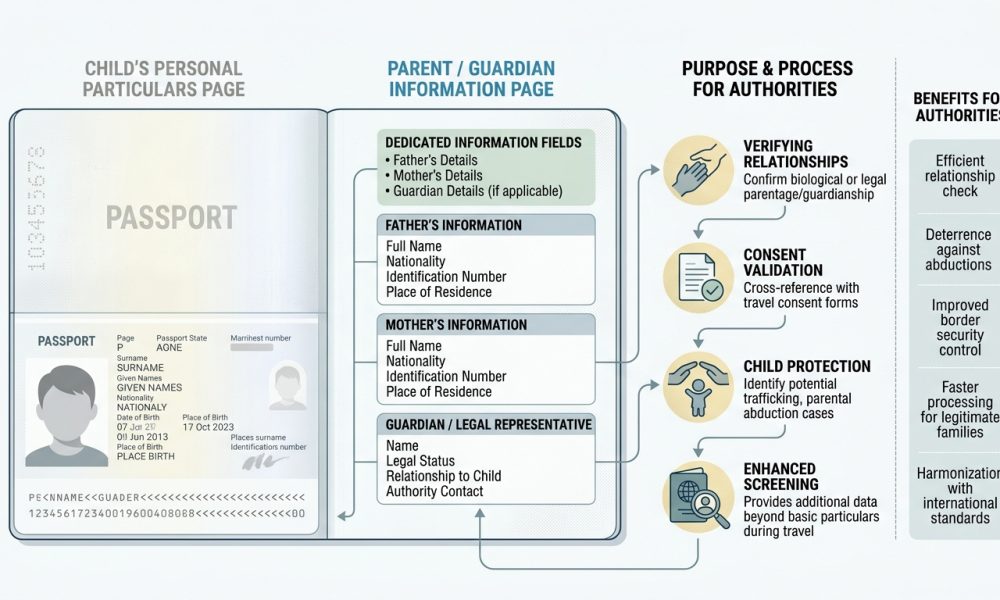
Dedicated sections can record parental or guardian details, giving authorities additional Information beyond a young traveler’s photograph and personal particulars.
WASHINGTON, DC, October 13, 2026 – Children’s passports issued by different governments can include specialized sections identifying parents, legal guardians, or other family relationships, providing additional Information that may help immigration authorities review travel documents for minors crossing international borders.
Although a passport primarily establishes its holder’s identity and nationality, some governments include parental Information on dedicated pages or in administrative observation sections, reflecting national documentation practices that link children’s identity records to legally recognized family relationships.
These details can help authorities interpret family circumstances, especially when children travel with adults whose surnames differ. Still, they do not independently establish custody, permission to travel, or unrestricted authority to remove a minor internationally.
For American families examining foreign passports, pursuing second citizenship, or preparing children for overseas travel, understanding how parental Information is recorded provides valuable insight into the relationship between passport Identification, civil registration, and international child Protection procedures.
Parent Information Pages Serve an Additional Identification Purpose
The principal biographical page of a modern passport normally displays the holder’s photograph, full name, nationality, date of birth, document number, and expiration date, allowing authorities to identify the traveler through internationally recognized documentary Information.
However, some passport authorities supplement these details with Information identifying parents or legal guardians, recognizing that identifying minors administratively can involve family relationships not apparent from the child’s photograph or name.
Dedicated family-information sections may contain fields identifying a mother, father, or recognized guardian. However, their exact location, terminology, and contents depend on the issuing country’s passport design and applicable administrative rules.
Unlike standard personal Information fields, these sections provide supplementary Background Information, allowing authorized officials to review recorded family connections without assuming the passport represents a complete statement of current parental rights.
India Provides a Documented Example of Parental Identification
India maintains passport procedures that recognize parental names, with government guidance on how to record information about fathers, mothers, and legal guardians under different family circumstances.
The Indian Ministry of External Affairs’ Passport Seva guidance explains that applicants may provide the name of a father, mother, or legal guardian, with specific provisions governing situations where one parent’s name is excluded from a minor’s passport.
These procedures accommodate unmarried parents, single-parent custody, children born outside marriage, adoption, and other situations where the family Information in an official document requires particular legal consideration.
The Indian example shows that parental fields can serve an administrative Identification function while still being subject to government rules that recognize differences in parentage, guardianship, and the supporting documentation available for individual applications.
Parent Information May Appear Outside the Main Identity Page
Some passport designs place parental Information within a separate section rather than alongside the holder’s photograph, allowing the principal data page to concentrate on standardized identity Information used during international document examination.
These additional fields may appear on observation pages, designated family-information areas, or other government-authorized sections, depending on the passport generation and the issuing country’s established design.
A traveler examining such a passport should distinguish Information printed by the issuing authority from handwritten annotations, unofficial markings, or additions made after issuance without the government’s authorization.
The presence of parental Information does not make the entire passport a family certificate, because the document’s primary function remains Identification and proof of nationality within the scope established by applicable passport legislation.
Parental Names Can Help Immigration Officers Identify Relationships
When a child’s passport identifies a parent, an immigration officer may compare that name with the Identification presented by an accompanying adult, providing an additional reference during routine document examination.
This can help when parents and children have different surnames because of marriage, divorce, remarriage, adoption, or cultural naming conventions that don’t follow identical family-name arrangements.
The Information may also help with preliminary questioning when a child travels with only one parent. However, authorities may require separate documents before recognizing that adult’s legal authority to undertake the journey.
A printed parental name should therefore be treated as potentially useful supporting evidence rather than conclusive proof of current custody, parental consent, or the absence of restrictions affecting international travel.
Family Information Connects Passports With Civil Registration Records
Passport authorities commonly rely on civil registration documents when establishing a minor’s identity, including birth certificates and adoption records that identify relationships relevant to nationality and parental responsibility.
Where a government prints parental Information inside passports, those details may reflect Information provided during the Application process or drawn from legally recognized civil records.
This connection helps explain why a child’s passport may include Information beyond what is typically needed to identify an adult traveler, especially when the government requires evidence of parental involvement before issuing it.
Nevertheless, civil registration Information and passport Information can serve different legal purposes, making separate documents necessary when authorities must establish current guardianship, legal parentage, or permission for a particular journey.
American Children’s Passports Use a Different Approach
United States passports generally do not include dedicated printed fields identifying both parents on the principal biographical Information page, even though parental identity and consent are important parts of the Application process.
American passport authorities instead review supporting records, including birth certificates, adoption decrees, guardianship documents, and relevant court orders, before determining whether the child meets issuance requirements.
The United States Department of State’s official child passport instructions explain that children younger than sixteen generally must apply in person, with both parents or legal guardians approving issuance unless applicable legal exceptions establish another permitted arrangement.
Consequently, an American child’s passport can be valid without displaying parental names, while government Application records separately establish the documentation and consent considered during the original issuance procedure.
Passport Issuance Consent Is Not International Travel Consent
One key distinction is between parental permission to issue a passport and permission for a child to undertake a specific international journey.
A parent may consent to issuing a travel document without authorizing every future departure, especially when custody agreements, court orders, or national laws assign separate responsibilities for international travel.
The same distinction applies when a foreign passport lists printed parental names, because those details do not necessarily show that another parent approved the itinerary or that current legal restrictions permit departure.
Families must therefore determine whether their destination or departure country requires additional documentation, even when the child’s passport was properly issued with the participation of the relevant parents.
Custody and Guardianship Can Change After Passport Issuance
Family circumstances may change substantially during a passport’s validity period, including divorce, adoption, remarriage, parental death, or court decisions that transfer legal responsibility to another adult.
A passport issued before those changes may continue to display Information that accurately reflected the original Application but no longer reflects the child’s full current legal circumstances.
Immigration authorities may therefore request court orders, adoption records, or guardianship documentation when the passport and standard Identification documents alone cannot establish the accompanying adult’s authority.
Parents and guardians should obtain updated official documents when required rather than assuming historical parental Information determines present custody rights or independently authorizes international travel.
Single-Parent Families May Require Different Passport Procedures
Passport systems that record parental names must account for children raised by one parent, including circumstances where another parent’s identity is unknown, legal responsibility has ended, or relevant Information is unavailable.
Indian passport guidance recognizes several such circumstances and provides procedures for recording or excluding particular parental details, subject to the supporting declarations and legal evidence required for the Application.
These arrangements show why parental Information pages cannot be interpreted the same way in every case, especially when a blank field reflects an authorized administrative decision rather than missing or defective documentation.
Immigration officers should assess the document according to the issuing country’s requirements rather than assuming a missing mother’s or father’s name automatically indicates an irregularity.
Adoption Can Affect the Names Recorded Inside Passports
Adopted children may have passports issued before or after formal adoption proceedings, creating situations where parental details in an older document differ from the child’s current legally recognized family relationships.
Governments may offer procedures to update passport Information after adoption, particularly when the adoption changes the child’s surname, legal parentage, nationality, or other identity details.
An adoption decree may therefore be necessary to establish the current legal relationship, even if an existing passport lists biological parents or former guardians whose responsibilities have since changed.
Families should follow the issuing authority’s procedures for replacement or correction rather than altering parental fields themselves or relying on unofficial explanations for discrepancies.
Children Traveling With One Parent May Face Additional Checks
International journeys involving a child accompanied by only one parent may require additional documents, particularly where foreign governments maintain procedures intended to prevent unauthorized removal or unlawful international retention.
The United States Department of State advises travelers that some countries require signed or notarized permission from a non-traveling parent, while others may recognize evidence establishing sole legal custody.
These conditions can apply regardless of whether the child’s passport displays parental names, because identifying a parent and establishing authorization for international travel are legally different questions.
Parents should verify the rules of both departure and destination jurisdictions, especially when custody arrangements or the child’s nationality create obligations not apparent from ordinary passport Information.
Traveling With Grandparents Creates Separate Considerations
Children traveling with grandparents, relatives, teachers, or family friends may need additional evidence identifying the adults responsible for the journey and showing that the appropriate parents have granted permission.
A passport containing parental Information can help identify individuals who may hold relevant authority, but it does not independently establish that the accompanying adult received permission from them.
Some governments require written consent that identifies the child, accompanying adult, destination, and travel dates, while others set different documentation procedures based on nationality and family circumstances.
Families organizing these trips should prepare supporting records before departure and avoid assuming that ordinary passport validity resolves every question concerning the child’s supervision or authorization.
Different Surnames Do Not Necessarily Indicate a Problem
Parents and children often have different surnames because of legitimate family arrangements, including marriage, divorce, adoption, cultural naming systems, and decisions about retaining or changing personal names.
When a passport includes parental Information, those details may clarify the relationship, but foreign officials can still request supporting records if they need additional verification.
Birth certificates, marriage records, adoption decrees, and legally recognized name-change documents can provide evidence explaining the connection between individuals whose identity documents contain different surnames.
The objective is to accurately establish the relevant legal relationship rather than treat surname differences as evidence of improper travel or an irregular passport.
Electronic Passport Chips Serve a Different Purpose
Modern biometric passports contain electronic identity Information and security features designed to support document Authentication, but reading the chip does not automatically reveal every family relationship or administrative detail printed elsewhere.
Electronic passport records commonly include the holder’s biographical identity, facial photograph, and digital security Information, while the treatment of additional data depends on the issuing government’s implementation.
A smartphone Application that successfully reads a child’s passport chip therefore cannot automatically establish parental consent, custody rights, or the legal authority of an accompanying adult.
Physical parental-information fields and electronically stored passport data should be understood as separate components of identity documentation, with different purposes and limitations during immigration examinations.
Printed Family Information Raises Privacy Questions
Recording parental names in children’s passports raises privacy concerns because those details may become visible whenever airlines, hotels, border authorities, or other organizations review the document.
Governments must balance the administrative usefulness of family Information against the risk of disclosing sensitive relationships, particularly when adoption, family separation, or other circumstances affect the child’s privacy.
These considerations also explain why not every issuing authority includes parental details in the passport, even when it collects equivalent Information during the Application process.
Appropriate government procedures for correcting or updating family Information can help maintain documentary accuracy while respecting the legal circumstances governing a child’s identity.
Dual Citizenship Can Introduce Different Passport Formats
Children with multiple nationalities may hold passports issued under different administrative systems, so one document may show parental Information while another includes only the child’s principal biographical details.
The difference does not necessarily indicate inconsistency or fraud, because each passport authority follows its own legislation and document design when determining which supplementary Information should appear.
Dual-national families must also consider nationality-specific entry and departure requirements, particularly when a country requires its own citizens to use national passports to cross its borders.
Parents should coordinate documentation before departure, ensuring family records, citizenship evidence, and any required consent documents match the child’s legal circumstances.
International Relocation Requires More Than Passport Information
Families seeking residence abroad may need comprehensive documentation establishing parentage, guardianship, nationality, and consent because immigration applications often raise legal questions beyond ordinary temporary visitor admission.
A child’s passport can establish identity and citizenship, while birth certificates, adoption orders, or guardianship records may demonstrate eligibility for dependent residence permissions and other family-based immigration benefits.
Professional international mobility advisers, including Amicus International Consulting, emphasize lawful identity documentation, accurate family records, and compliance with applicable immigration requirements when assisting families with cross-border relocation and second citizenship planning.
These considerations matter most when family members have different nationalities or when government authorities require certified records, translations, or legally recognized evidence of parental responsibility.
Passport Information Should Be Reviewed Before International Travel
Parents and guardians should review children’s passports before departure to confirm that personal Information remains accurate and that any printed parental or guardian details match the issuing authority’s records.
If family circumstances have changed, travelers should determine whether they need a passport replacement, an official correction, or an additional supporting document before an international journey.
They should also review the destination’s requirements for parental consent, custody documents, certified records, and translations, especially when a child travels with only one parent or another accompanying adult.
Preparation can reduce avoidable immigration delays and ensure you can demonstrate legitimate family relationships and travel authority when officials request supporting evidence.
Parent Information Pages Are Helpful but Not Conclusive
Dedicated parental-information sections show how some governments supplement children’s passport identity details with family records, providing additional context that can help officials review the Application without turning the passport into a comprehensive custody document.
A parent’s name can help explain a relationship. Still, it cannot independently establish current guardianship, permission to travel, or the absence of restrictions imposed by family courts or immigration legislation.
For American families, dual-national children, and international travelers, the essential distinction is between identifying a recorded parent and proving that an adult possesses the legal authority required for a particular journey.
Ultimately, children’s international travel depends on accurate identity documents, lawful family records, and compliance with applicable immigration and consent requirements, rather than relying exclusively on parental Information printed inside a passport.




