
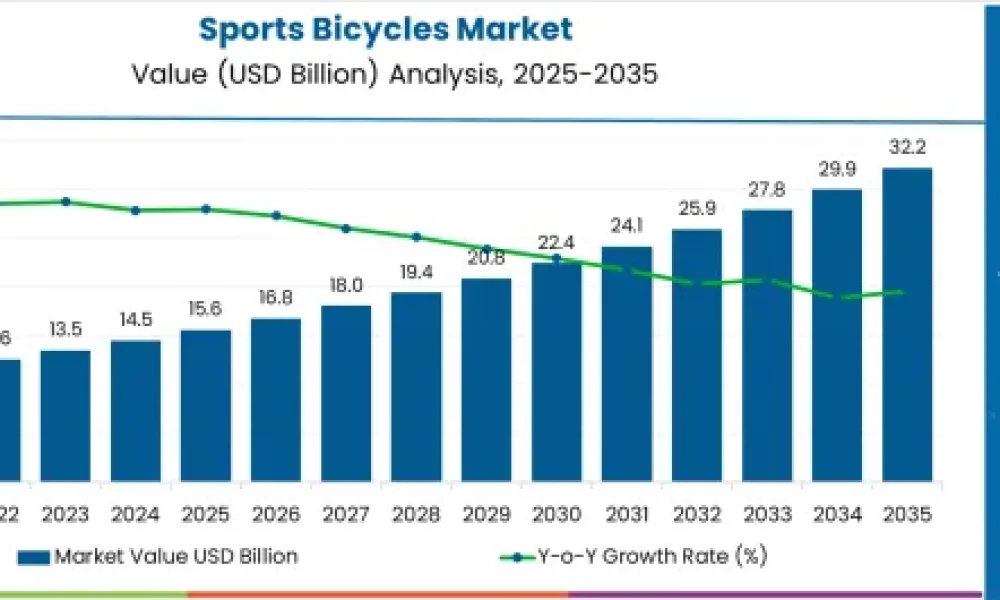
The global sports bicycles market is projected to grow from an estimated USD 15.6 billion in 2025 to USD 32.2 billion by 2035, registering a compound annual growth rate (CAGR) of 7.5% over the forecast period. The outlook reflects rising participation in fitness and recreational cycling, increased adoption of electric-assist bicycles, and expanding urban cycling infrastructure across major regions.
The forecast, covering North America, Europe, Asia-Pacific, Latin America, and the Middle East & Africa, indicates that market expansion will be strongest in the early phase from 2025 to 2030, followed by steady growth as demand matures in developed economies and accelerates in emerging markets.
Explore comprehensive market trends, regional outlooks, and competitive intelligence – Get a Sample Copy Now
Market Growth Trajectory: 2025 to 2035
Between 2025 and 2030, the sports bicycles market is expected to grow from USD 15.6 billion to USD 22.4 billion, adding USD 6.8 billion in new value at a CAGR of 8.6%. This phase is driven by rising interest in outdoor sports, increased health awareness, and the growing use of bicycles for commuting. Demand is also supported by technological innovations, including electric-assist systems and lightweight frame materials.
From 2030 to 2035, the market is projected to expand further to USD 32.2 billion, adding USD 9.8 billion at a CAGR of 6.7%. While growth moderates as markets mature in North America and Western Europe, demand remains robust due to rising disposable incomes, urbanization, and sustainability initiatives in Asia-Pacific and other emerging regions.
Electric Bicycles Lead by Technology Segment
Electric sports bicycles are expected to account for 48.7% of total market revenue by 2025, making them the leading technology segment. Their growth is attributed to increased consumer preference for electric assist in long-distance riding, hilly terrains, and urban commuting.
Advancements in battery systems, regenerative braking, and lightweight motors have improved usability and accessibility. As recreational and commuting needs converge, electric sports bicycles are being adopted across a broad demographic base.
Mountain Bicycles Dominate Product Demand
Mountain bicycles are projected to represent 44.6% of market revenue by 2025, emerging as the leading product category. Their popularity is driven by versatility, durability, and suitability for both off-road and urban riding.
Ongoing innovations in suspension systems, gear configurations, and frame geometry have enhanced performance and comfort, reinforcing mountain bicycles as a core segment for both enthusiasts and casual riders.
Men Segment Remains the Largest End-User Group
By end user, men are anticipated to hold 53.2% of the sports bicycles market in 2025. Higher participation rates in adventure and competitive cycling, combined with greater spending on performance models and accessories, support this dominance.
Manufacturers continue to offer a wide range of men-specific designs, sizes, and performance-oriented features, contributing to sustained demand across premium and mid-range categories.
Regional Outlook: Asia-Pacific Leads Growth Rates
- Asia-Pacific is expected to record the fastest growth, supported by strong momentum in China and India. China is forecast to grow at a CAGR of 10.1% through 2035, driven by urbanization, rising health consciousness, and government initiatives supporting green mobility. Growing disposable incomes are also increasing demand for premium bicycles in major cities.
- India is projected to grow at a CAGR of 9.4%, supported by a rising middle class, expanding urban population, government-backed cycling infrastructure, and increasing youth participation in fitness activities.
- In Europe, Germany is expected to grow at 8.6% CAGR, supported by established cycling infrastructure, sustainability-focused policies, and strong demand for premium models. The United Kingdom is projected to grow at 7.1%, driven by government support for cycling and increasing interest in outdoor fitness.
- The United States is forecast to grow at a CAGR of 6.4% through 2035, supported by rising participation in fitness activities, expanding urban cycling infrastructure, and growing demand for eco-friendly transportation options.
Technology Integration and Manufacturing Complexity
The market’s technological evolution is increasing manufacturing and integration complexity. Electronic shifting systems require battery management, wireless communication protocols, and software integration. Suspension systems for mountain bicycles demand coordination between frame and suspension designers to optimize geometry, travel, and damping.
Additional integration challenges include power meters, GPS navigation, and connectivity features that provide performance data and maintenance alerts. These systems must operate reliably under temperature extremes, moisture exposure, and mechanical stress.
Quality, Safety, and Regulatory Considerations
Manufacturers are implementing advanced quality control procedures, including fatigue testing, impact resistance validation, and environmental exposure simulations. Safety certification standards vary across international markets, affecting product approvals and liability management.
Recall procedures have become increasingly critical, requiring coordination among regulatory agencies, dealers, and consumers across global distribution networks.
Competitive Landscape
Leading companies in the global sports bicycles market include Bianchi, Cannondale Bicycle Corporation, CUBE Bikes, Giant Manufacturing Co., Ltd., GT Bicycles, Merida Industry Co., Ltd., Scott Sports SA, Specialized Bicycle Components, Inc., Trek Bicycle Corporation, and Canyon Bicycles GmbH.
These companies maintain broad product portfolios spanning road, mountain, hybrid, and electric bicycles. Industry competition is increasingly shaped by innovation in lightweight materials, aerodynamic designs, electronic integration, and direct-to-consumer distribution models.
Market Scope and Segmentation
The market is segmented by technology (electric and traditional), product (mountain, cyclo-cross, road racing, and track racing), end user (men, women, and kids), and sales channel (online and offline). Regional coverage includes North America, Europe, Asia-Pacific, Latin America, and the Middle East & Africa.
Demand dynamics are driven by fitness trends, sustainability priorities, and continued advancements in bicycle technology, positioning the sports bicycles market for sustained long-term growth.
Have a specific Requirements and Need Assistant on Report Pricing or Limited Budget please contact us – [email protected]
About Future Market Insights (FMI)
Future Market Insights, Inc. (FMI) is an ESOMAR-certified, ISO 9001:2015 market research and consulting organization, trusted by Fortune 500 clients and global enterprises. With operations in the U.S., UK, India, and Dubai, FMI provides data-backed insights and strategic intelligence across 30+ industries and 1200 markets worldwide
Why Choose FMI: https://www.futuremarketinsights.com/why-fmi



