
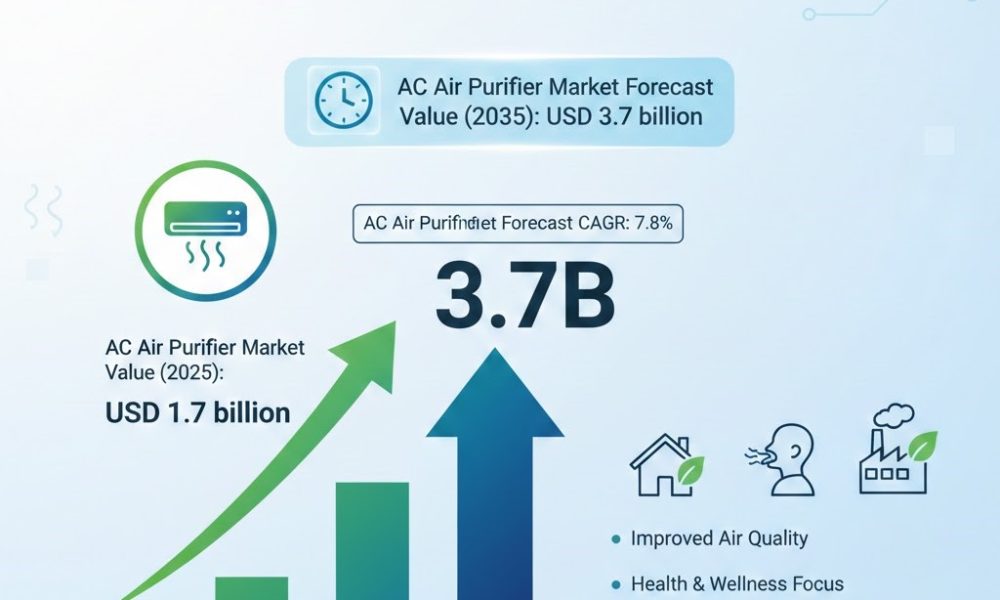
The global AC air purifier market is on a steady growth trajectory, supported by rising urban pollution, heightened health awareness, and rapid advances in filtration and smart home technologies. The market is estimated at USD 1.7 billion in 2025 and is projected to reach USD 3.7 billion by 2035, expanding at a compound annual growth rate (CAGR) of 7.8% over the forecast period.
This growth reflects a sustained shift toward indoor air quality management across residential, commercial, and healthcare environments. Increasing time spent indoors, stricter air quality regulations, and the growing prevalence of respiratory disorders are accelerating demand for air purification solutions integrated with air conditioning systems.
Gain access to detailed segment-wise analysis and forecast statistics – Request the Sample Report Today
Market Overview: Size, Growth Outlook, and Key Drivers
The AC air purifier market shows a clear upward trend. From 2025 to 2029, the market is expected to grow from USD 1.2 billion to USD 1.7 billion, driven by early adoption in urban households and offices. Moderate acceleration is projected between 2029 and 2031, when market value reaches USD 2.0 billion, reflecting increased uptake of smart connectivity, HEPA filtration, and UV-C technology.
Between 2031 and 2035, growth is expected to intensify, lifting the market to USD 3.7 billion. This sharper expansion is attributed to rising urbanization, tightening air quality standards, and increasing penetration of air purifiers in emerging economies. Consumers are placing greater emphasis on environmental health, energy efficiency, and real-time air quality monitoring.
Key growth regions include North America, Asia-Pacific, and Europe. China leads with a projected CAGR of 10.5%, followed by India at 9.8%. France is forecast to grow at 8.2%, the United Kingdom at 7.4%, and the United States at 6.6%.
Segment Performance: Portable Units and HEPA Filters Lead
- Portable air purifiers are projected to account for 57.4% of total market revenue in 2025, reflecting their dominance in both residential and small commercial applications. Their ease of installation, mobility, and plug-and-play functionality have made them the preferred choice for urban households, offices, and healthcare settings. Users value the ability to relocate units based on seasonal needs or room usage patterns.
- HEPA filters are expected to represent 37.8% of total revenue in 2025. Their proven efficiency in capturing fine particulates and allergens has positioned them as the preferred filtration technology across residential, educational, and healthcare environments. HEPA-based systems are often selected for their ability to trap particles as small as 0.3 microns, and for compatibility with activated carbon filters and UV sterilization modules.
- The medium room coverage segment, serving spaces between 500 and 1,000 square feet, is forecast to contribute 41.6% of total revenue in 2025. Demand is being driven by installations in medium-sized living rooms, bedrooms, and workspaces, where consumers seek a balance between coverage efficiency, energy consumption, and affordability.
Technology and Product Trends
Technological innovation remains central to market expansion. Advances in filtration systems, ultraviolet sterilization, ionization, and real-time air quality sensors are improving purification performance and user experience. Smart features such as Wi-Fi connectivity, mobile app controls, and sensor-based automation are increasingly standard, particularly in residential and small-office segments.
Integration with smart home ecosystems and the development of multi-functional units that combine cooling, dehumidification, and purification are reshaping product design. Consumers are also favoring modular and adaptable systems that align with evolving lifestyle preferences and space constraints.
Regulatory and Operational Challenges
Manufacturers face certification and compliance complexities when aligning products with multiple regulatory frameworks. Clean Air Delivery Rate (CADR) requirements differ from California’s ozone emissions testing and European energy efficiency directives. Engineering teams must balance filtration performance with power consumption limits, while quality assurance departments monitor electrical safety, electromagnetic compatibility, and ozone emissions.
Retailers and distributors encounter supply chain and labeling challenges due to varying certification requirements across regions. HVAC contractors integrating air purifiers with existing air conditioning systems must coordinate electrical requirements, ductwork modifications, and control system integration while complying with local building codes.
Regional Growth Patterns
- China’s market expansion is being driven by rising pollution levels in major cities, government initiatives to improve air quality, and increasing disposable income.
- India’s growth reflects severe urban air pollution, a growing middle class, and rising awareness of indoor air quality.
- Europe, France and the UK are seeing steady adoption due to health awareness, regulatory support, and demand for energy-efficient appliances.
- United States, growth is supported by technological innovation, smart purifier adoption, and increased focus on health-focused indoor environments.
Competitive Landscape
The market features a mix of global appliance leaders and specialized air purification companies. Key players include Dyson Ltd., Honeywell International Inc., Sharp Corporation, Daikin Industries Ltd., Blueair AB, Whirlpool Corporation, LG Electronics Inc., SharkNinja Inc., Versuni Holding N.V., WINIX Inc., AprilAire Inc., Medify Air LLC, Krug & Priester Inc., Airocide Europe, and AIRTH Technologies.
Leading manufacturers are focusing on HEPA filtration, activated carbon filters, UV-C sterilization, and AI-driven air monitoring systems. Hybrid AC-integrated air purifiers that cool, dehumidify, and purify air simultaneously are gaining traction in urban households and office environments.
Market Outlook
The AC air purifier market is expected to continue expanding through 2035 as urbanization, regulatory pressure, and consumer health awareness converge. While high initial costs and ongoing maintenance requirements remain barriers, ongoing innovation in filtration efficiency, smart features, and energy conservation is expected to support long-term scalability and adoption across global markets.
Have a specific Requirements and Need Assistant on Report Pricing or Limited Budget please contact us – [email protected]
About Future Market Insights (FMI)
Future Market Insights, Inc. (FMI) is an ESOMAR-certified, ISO 9001:2015 market research and consulting organization, trusted by Fortune 500 clients and global enterprises. With operations in the U.S., UK, India, and Dubai, FMI provides data-backed insights and strategic intelligence across 30+ industries and 1200 markets worldwide
Why Choose FMI: https://www.futuremarketinsights.com/why-fmi



