
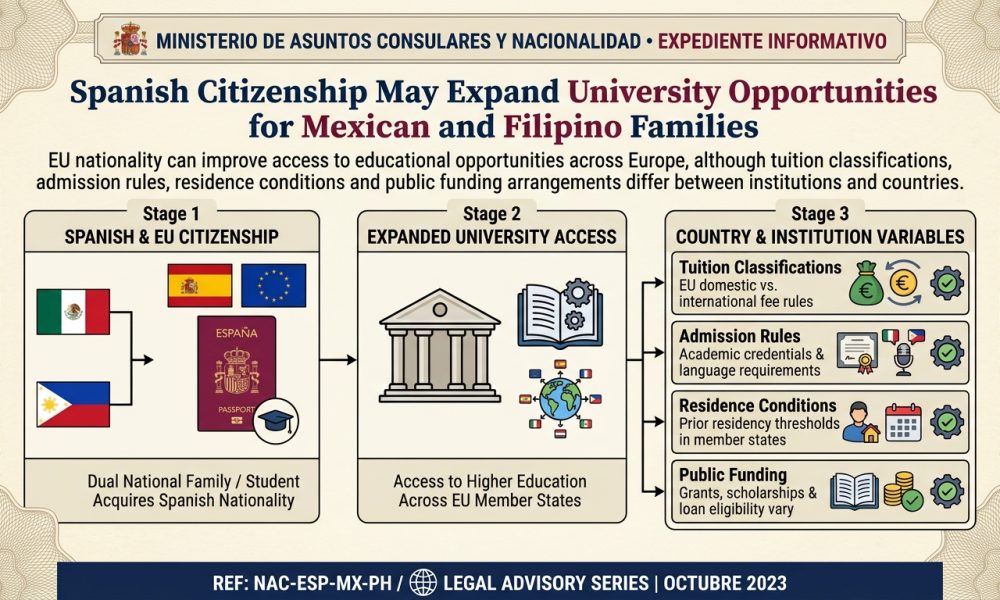
EU nationality can strengthen university access for qualifying Mexican and Filipino families. At the same time, admission standards, tuition classifications, student residence conditions, and maintenance funding remain governed by specific institutional and national rules.
WASHINGTON, D.C., November 24, 2026
Mexican and Filipino families whose members acquire Spanish citizenship can explore university opportunities across the European Union under rules that generally protect equal treatment in admission and tuition. However,h the resulting advantages depend on each student’s individual legal status and academic qualifications.
The distinction matters for households comparing European education with programs in North America or Asia, because EU citizenship can remove ordinary immigration barriers without guaranteeing a university place, subsidized living expenses, or admission to a particular competitive degree.
Spanish Nationality Changes the Education Framework
A person who lawfully becomes Spanish also becomes a European Union citizen, gaining rights connected with movement and equal treatment that can make enrollment in another member state’s university fundamentally different from applying solely as a non-EU national.
Those rights flow from nationality itself rather than the physical passport booklet. Yet, students ordinarily need reliable Spanish identity documents to demonstrate their status when universities, public authorities and financial-aid offices assess applications and arrange registration.
For Mexican or Filipino families, Spain’s shortened naturalization threshold may fit into a long-term education plan. Still, two years of qualifying residence only creates an opportunity to apply and does not guarantee immediate citizenship.
Two-Year Eligibility Is Not Automatic Naturalization
Spanish law permits qualifying nationals by origin of Ibero-American countries and the Philippines to request citizenship after two years of legal, continuous residence immediately preceding the application, provided they meet additional integration, good-conduct and documentation requirements.
Government processing, the required nationality declarations, and Civil Registry registration remain separate steps, so it is unwise to choose a university start date based on the assumption that a passport will arrive exactly on the second residence anniversary.
Students should seek written guidance on the nationality recorded in their immigration files, particularly where Mexican and Philippine citizenship coexist or where one nationality was acquired through naturalization rather than held from birth.
EU Students Generally Receive Equal Tuition Treatment
European Union guidance states that an EU citizen studying in another member country must generally receive the same treatment as its nationals concerning university course fees, a potentially meaningful difference from rates charged to many international students.
That principle does not mean every university is free or that all programs charge identical amounts, because tuition policies, public funding arrangements and permitted fees differ substantially among countries, institutions and types of degrees.
A student comparing a public university in Germany with a specialized program in the Netherlands should therefore examine the actual applicable fee schedule rather than assume Spanish citizenship produces one universal European tuition price.
Admission Remains Competitive and Qualification-Based
A family reviewing several university offers should compare not only admission probability but also the exact recognition decision for earlier schooling, since an application accepted for preliminary review may still fail a mandatory subject or language requirement before enrollment.
Universities may evaluate previous schooling, academic performance, subject prerequisites, application deadlines, and language proficiency, and EU nationality does not exempt a student from the same objective academic criteria applied to domestic applicants for the same course.
Mexican or Philippine school records may need official evaluation, translation, or subject equivalency determinations, especially when applicants enter programs with strict prerequisites or transfer from education systems with different grading and examination structures.
Families should request admission requirements from the specific institution before paying for authentication services, because an otherwise valid foreign diploma may still require additional assessment to confirm the holder meets a program’s entry standards.
English-Language Degrees Require Their Own Checks
Although European institutions offer numerous courses taught in English, applicants should verify the program language, accepted proficiency tests, and any separate local-language expectations for placements, professional licensing, or practical training outside the classroom.
Filipino applicants may bring extensive English-language education, while Mexican applicants may possess Spanish-language qualifications. Still, neither background automatically substitutes for an examination or certificate the admitting university expressly requires under its published policy.
Maintenance Grants Have Different Eligibility Rules
One practical risk arises when parents assume that eligibility for a reduced tuition classification also produces automatic access to subsidized accommodation, because national maintenance systems often examine residence connections and employment histories not captured by the university fee decision.
EU equal-treatment protections for tuition do not automatically require a host country to give every newly arrived EU student the same grants or loans for living expenses that it provides to established residents.
Directive 2004/38 permits specified limits on maintenance assistance before permanent residence, subject to exceptions involving workers, self-employed people, people retaining that status and qualifying family members, making personal circumstances central to funding eligibility.
Students who expect government support should distinguish course-fee grants from rent assistance, maintenance loans, and scholarships, check residence history and employment status, and avoid including an unconfirmed financial award in the household budget.
Five Years of Residence Can Change Funding Rights
An EU citizen who acquires permanent residence after five years of continuous lawful residence in a host country can gain stronger equal-treatment rights concerning student maintenance assistance. However,h national grant systems still apply their lawful general eligibility conditions.
The five-year rule should not be casually confused with Spain’s two-year nationality pathway, since the former concerns residence in the destination state. Meanwhile, the latter addresses eligibility to request Spanish citizenship through a different legal framework.
Study Residence Requires Practical Preparation
Students should keep university acceptance letters, insurance confirmations, and financial records in an accessible format, since administrative registration may be required after arrival and missing evidence can disrupt an otherwise well-organized course timetable during the first academic term.
EU students can generally stay in another member state for up to three months with valid Identification, while longer stays may require enrollment, sufficient resources, and comprehensive sickness insurance under the applicable rules.
Host countries may request registration after three months and supporting evidence of the student’s circumstances, so completing university admission does not necessarily complete the administrative obligations that accompany an extended period of residence away from Spain.
Families should confirm reliable housing, comprehensive health insurance and sufficient documented funding before departure, recognizing that the freedom to study does not guarantee a dormitory room, government-sponsored medical care or exemption from ordinary living expenses.
Healthcare Planning Matters for Students Abroad
A European Health Insurance Card can help an eligible insured person receive medically necessary state-provided care during a temporary stay. Still, it is not universal insurance for every new Spanish citizen or every permanent relocation.
Students intending to live abroad should ask their competent insurance institution which coverage applies during the course, since the country responsible for healthcare may differ depending on work, residence, and other circumstances.
Erasmus+ Is Not an Automatic Scholarship
Erasmus+ can support qualifying study exchanges and traineeships. Still, participation depends on the institutions, applicable program conditions, and selection procedures rather than simply having an EU passport or being admitted to a university.
An undergraduate seeking an exchange semester should consult the home institution’s international office, while someone pursuing an entire degree abroad should investigate that university’s ordinary admission and tuition policies as a separate pathway.
The United Kingdom Is a Separate Education Market
Families comparing an Irish university with a British institution should remember that Ireland remains an EU member and follows applicable EU equal-treatment rules. In contrast, British admissions and fee classifications operate under distinct post-Brexit domestic arrangements and statutory exceptions.
Brexit ended the United Kingdom’s general participation in EU free movement for new arrivals, so a Spanish passport alone does not provide unrestricted British student residence or guarantee home-fee classification at universities in England or elsewhere.
A November 2026 Reuters report on EU-UK youth mobility and tuition discussions described ongoing negotiations over youth mobility and tuition arrangements, illustrating why families should distinguish proposals and negotiations from binding admissions, immigration or fee rules already in force.
British universities may apply international tuition categories and immigration requirements to students without qualifying domestic status, so families considering London, Edinburgh or other British destinations should independently verify current institutional rules before making potentially expensive and difficult-to-reverse financial commitments.
Children Need Their Own Nationality Documentation
A parent’s successful Spanish naturalization does not automatically make every child Spanish, because some children may need a separate nationality-by-option procedure. In contrast, others qualify through different provisions depending on their ages and family histories.
Parents comparing tuition classifications should verify the student’s citizenship and registration rather than assume that the mother’s or father’s Spanish passport gives the child all corresponding European Union rights for university enrollment.
Family Relocation Can Support Educational Stability
A younger sibling may have a different nationality or residence status than an older student, requiring separate planning for school attendance, parental consent, healthcare, and local registration rather than assuming a single shared Spanish connection.
A household planning school years before university should examine language instruction, recognition of secondary qualifications and suitable residence arrangements, since moving at a critical academic stage can create adjustment costs alongside longer-term opportunities.
Where one parent works in another EU country, the family’s circumstances may influence residence arrangements and particular education-support entitlements, requiring an individualized assessment rather than assuming identical treatment for employed and economically inactive households.
Universities May Request Authentic Civil Records
Students with several citizenships or lawful surname changes should preserve birth certificates, examination transcripts and official identity links, because academic institutions and public agencies may need to reconcile differently formatted records produced across several countries.
Readers considering Amicus International Consulting’s new identity services should distinguish legitimate privacy planning from attempts to present invented qualifications, conceal material nationality history, or substitute fabricated documents for authentic, independently verifiable academic records.
American Dual Nationals Have Separate Duties
Families whose children also hold American citizenship should review United States travel and reporting responsibilities, since obtaining Spanish nationality does not automatically terminate earlier citizenship or relieve a person of obligations owed to another government.
The U.S. State Department’s dual-nationality guidance explains that American citizens must use American passports when entering and leaving the United States, a practical consideration for students traveling between European campuses and American relatives.
Education Budgets Must Include Hidden Costs
An apparently low tuition charge may also conceal compulsory laboratory materials, examinations, professional placements or transportation between teaching sites, making direct contact with the relevant faculty more dependable than a broad comparison of national average university fees.
Even where Spanish citizenship results in the same tuition rate charged to local students, accommodation, transportation, student fees, health coverage and credential recognition can make the final cost substantially higher than the advertised annual course charge.
Families should compare total expenses over the full degree, including inflation and currency movements, while assessing whether part-time work is realistic alongside academic demands and compatible with the student’s residence and insurance circumstances.
Scholarships Follow Their Own Selection Criteria
University scholarships may depend on academic achievement, financial need, residence history or particular research interests, and acquiring EU citizenship does not remove the ordinary competitive selection rules or automatically create entitlement to institutional awards.
Applicants should verify each funding program’s definition of eligible residence and nationality, especially where eligibility is assessed on a particular date before enrollment rather than the student’s citizenship status at graduation or a later academic milestone.
Professional Degrees Introduce Additional Complexity
Cross-border internships require particular attention because the placement’s location, employer, and regulated activities can trigger additional training conditions, and students should seek confirmation from the university before assuming every foreign clinical or professional placement counts toward graduation.
Medical, legal, and engineering programs may involve regulated professional pathways, supervised placements, and local language requirements, so it’s important to distinguish acceptance into a degree from eventual authorization to practice in that jurisdiction.
A graduate with a Spanish passport but a professional qualification from the Philippines or Mexico may still need to complete a recognition process. In contrast, le future graduates should confirm whether their chosen course meets local licensing standards.
A European Passport Is a Planning Tool
Families exploring Amicus International Consulting’s second passport services can compare long-term education and mobility objectives. Still, no private adviser can guarantee naturalization, university admission, or financial assistance, as these depend on applicable government and institutional criteria.
A sound plan should begin with lawful citizenship eligibility, continue through accurate civil registration, and then address specific degree requirements, financial resources, living arrangements, and documentation for every family member pursuing studies abroad.
Educational Opportunity Depends on Preparation
Parents should revisit the family’s timeline whenever a citizenship application, civil re-registration, or academic qualification assessment is delayed, because the prudent alternative may involve postponing enrollment, applying under an alternative category, or selecting a different institution entirely.
For eligible former Mexican and Filipino nationals, Spanish citizenship can create meaningful educational advantages through EU mobility and equal tuition treatment, while still requiring scrutiny of local admission and funding requirements.
The key distinction is that European nationality can broaden realistic university options. However, a successful education strategy still depends on academic readiness, reliable records, affordable housing, verifiable scholarship eligibility, properly assessed qualifications, realistic language preparation, and a clear understanding of student rights.




