
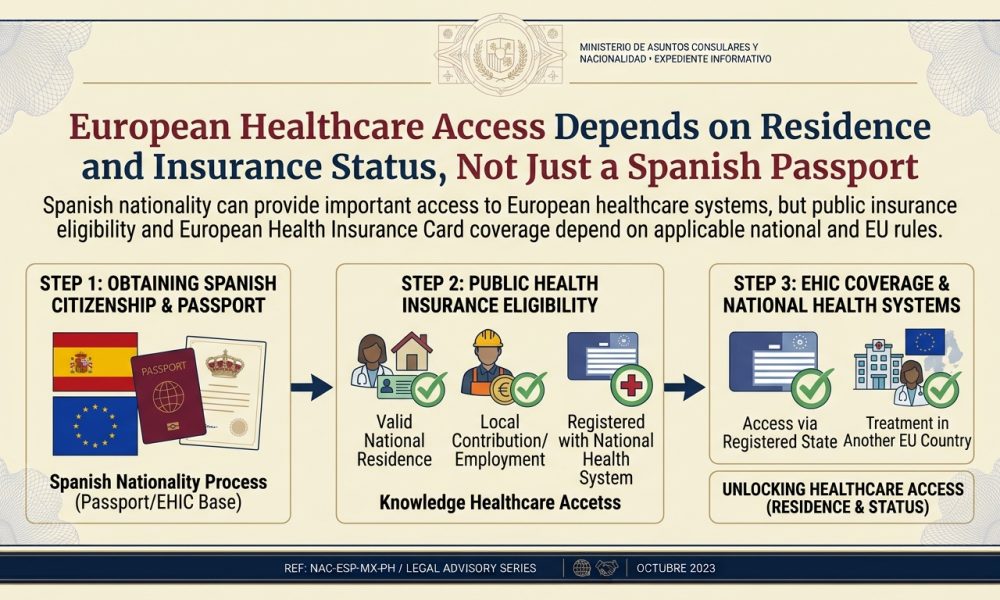
Spanish nationality can support European mobility and access to healthcare arrangements. Still, actual public insurance eligibility, European Health Insurance Card use, and cross-border treatment depend on residence, coverage, and the rules of the country responsible for care.
WASHINGTON, D.C., November 24, 2026
Mexican and Filipino nationals who become Spanish citizens acquire important European Union mobility rights, yet access to publicly financed medical treatment remains tied to their insurance and residence circumstances, including the responsible public institution and verified enrollment, rather than the mere possession of a newly issued Spanish passport.
That distinction matters for retiring couples, internationally employed professionals and families relocating between member states, because treatment available during a short visit can differ substantially from the healthcare arrangements required when establishing a permanent home elsewhere in Europe.
EU Citizenship Does Not Automatically Create Insurance
European citizenship allows qualifying individuals to move under Union law, but determining which country finances healthcare generally requires examining employment, social insurance, pension entitlements, and habitual residence rather than treating nationality as a universal medical insurance policy.
A Spanish citizen moving from Madrid to Paris may need to establish eligibility for French healthcare. At the same time, le someone working in Germany and living elsewhere can face cross-border coordination provisions that differ from those governing a financially independent retiree.
Spain’s nationality-by-residence route may be available after two years of qualifying legal residence for eligible Mexican and Filipino nationals by origin. However, obtaining citizenship does not automatically settle subsequent healthcare entitlement in every European country.
The European Health Insurance Card Has a Defined Purpose
Check eligibility before departure with the insurer that covers the traveler, because a Spanish citizen registered with a different country’s statutory system may receive documentation from that country instead of Spain, depending on the applicable coordination rules.
The European Health Insurance Card, commonly called EHIC, confirms an eligible person’s coverage for medically necessary, state-provided care during a temporary stay in participating European countries, under the same conditions and costs as insured residents there.
The relevant public health insurance institution issues the card, not simply handing it to every Spanish passport holder, and someone without qualifying insurance cannot reliably obtain coverage merely by presenting proof of Spanish nationality.
Its geographic reach includes EU member states, as well as Iceland, Liechtenstein, Norway, Switzerland, and the United Kingdom, under applicable arrangements. However, the treatment rules and patient contributions depend on the country where services are delivered.
Temporary Treatment Is Different From Planned Care
EHIC can help an insured visitor obtain treatment that becomes medically necessary during an otherwise temporary journey, with the nature of the condition and expected stay considered when determining whether treatment can reasonably wait until returning home.
It does not ordinarily fund a trip undertaken specifically to obtain scheduled medical treatment, and patients considering cross-border planned procedures should investigate prior authorization mechanisms and reimbursement rules instead of relying on tourist healthcare arrangements.
For certain planned treatments, an S2 authorization may be relevant when the competent insurance institution approves care in another country, showing why a specialist appointment scheduled in advance requires different administrative preparation than an unexpected illness abroad.
EHIC Is Not a Replacement for Travel Insurance
The European Commission repeatedly cautions that EHIC does not replace travel insurance because the public coordination card does not automatically cover private treatment, emergency repatriation, lost belongings, or other travel-related costs during international journeys.
A traveler receiving medically necessary care may still owe copayments or other charges imposed on locally insured patients, so EHIC should never be interpreted as a universal guarantee of completely free medical services.
Families should consider supplementary coverage for medical evacuation and other travel risks, particularly when visiting remote regions, participating in outdoor activities, or accompanying relatives who may need help returning home after a serious incident.
Living Abroad Requires a Different Coverage Assessment
People relocating permanently should request written clarification about when existing coverage ends and new coverage begins, since a gap between employment, municipal registration and insurance enrollment may leave them exposed to substantial bills during a vulnerable transition.
Moving one’s habitual residence to another Member State can change which health institution is responsible, and a temporary-stay card should not be sufficient documentation for permanent settlement when the person needs comprehensive healthcare Protection.
Economically inactive EU citizens who remain in a host country beyond three months generally must meet applicable sufficient-resources and comprehensive sickness insurance conditions, making an actual coverage plan important before ending existing policies or relocating permanently.
The European Commission’s free movement guidance distinguishes circumstances where an EHIC may evidence relevant coverage from situations where economically inactive people genuinely relocate, which often require other proof and a different institutional arrangement.
Workers Usually Enter the Host Country’s System
A Spanish citizen taking a regular job in another EU member state generally falls under the social security rules that apply to that employment. However, cross-border workers, posted workers, and individuals employed in several countries may require special determinations.
Payroll deductions or enrollment documentation can establish the route into local healthcare. Still, newly hired professionals should verify the effective coverage date and whether spouses or children need separate registration before assuming a family doctor’s services are available.
A Filipino-born Spanish nurse employed in France or Mexican-born Spanish engineer working in Germany should therefore coordinate employment and insurance registration with the relevant host institution rather than rely indefinitely on documentation issued previously in Spain.
Self-Employed Residents Have Additional Duties
Self-employed citizens may be able to establish healthcare coverage through the country’s applicable contribution system, yet business registration, income reporting and social security payments can be necessary before the relevant institution confirms entitlement to treatment.
A person working remotely for a company in another jurisdiction should not assume that holding Spanish citizenship makes the applicable social insurance country obvious, because employment location, contractual status and coordination rules may produce different outcomes.
Pensioners May Qualify for an S1 Certificate
An S1 does not create retirement income or substitute for a qualifying insurance relationship, and retirees receiving several pensions should determine which participating country is competent before submitting forms that may not match their individual contribution records.
An S1 document can allow eligible pensioners insured by one participating country’s system to register healthcare in another country of residence. In contrast, applicable social security coordination rules determine the country responsible for costs.
A retiree with a qualifying Spanish pension who moves to another European member state may need to request the S1 from the responsible Spanish institution, then complete registration with the healthcare authority in the destination country.
Someone receiving only a Mexican or Philippine pension should not assume entitlement to an S1 from Spain without establishing the necessary insurance or pension rights, because a Spanish passport alone does not create qualifying contribution history.
Medicare Does Not Become European Insurance
American dual nationals considering Spanish retirement should separately review United States Medicare rules, since ordinary Medicare coverage is generally limited outside the United States and includes only narrow exceptions for specified circumstances involving treatment abroad.
The U.S. government’s Medicare travel coverage guidance explains these limitations and notes that certain supplemental insurance policies may cover foreign emergency treatment, making planning essential for Americans who expect extended stays in Europe
A Mexican American or Filipino American retiree who later acquires Spanish citizenship should not assume that Medicare, an American supplemental policy, and European statutory insurance are interchangeable programs providing identical treatment anywhere the person chooses to live.
Spanish Healthcare Rights Require Individual Assessment
Spain’s public healthcare arrangements incorporate residence, entitlement recognition, and rules on cost-sharing responsibilities, so Spanish nationality matters. Still, it should not replace verification of current enrollment and regional health-card procedures.
A March 2026 report by The Local on Spain’s healthcare-access changes discussed government measures addressing access for certain foreign residents, demonstrating that eligibility debates concern actual residence and coverage arrangements rather than passport nationality alone.
That reporting should not be mistaken for a blanket promise that every person acquiring Spanish nationality becomes insured across the entire Union, because entitlement in a different host country must still be examined under its separate rules.
Private Coverage May Fill an Important Gap
Some countries offer voluntary or contributory arrangements within their public systems. Still, eligibility, waiting periods and monthly charges vary, so retirees should verify whether any such arrangement is available rather than assuming private insurance represents their only lawful option.
Some people who are not entitled to statutory cover immediately may need comprehensive private insurance during an initial residence period, particularly when applying for recognition as financially independent EU residents or transitioning between national insurance systems.
Before buying a policy, families should review geographical limits, waiting periods, prescription benefits, and exclusions for existing conditions, and confirm whether the destination authority accepts that specific insurance product for residence registration.
Private insurance premiums and benefits vary widely, and a lower advertised price may hide substantial deductibles or narrower specialist networks that can become expensive for retirees needing ongoing medication, diagnostic tests, or frequent clinical appointments.
Planned Treatment Creates Separate Authorization Questions
Patients intentionally crossing borders for surgery or specialized treatment should distinguish the authorization and reimbursement frameworks for planned care from EHIC provisions addressing medical needs arising during a temporary stay outside the country responsible for their insurance.
Prior approval, provider eligibility, and reimbursement limits can matter, and an uninsured person cannot simply obtain a Spanish passport or book a procedure in another member state to create an automatic right to state-funded elective treatment.
Chronic Illness Requires Advance Coordination
Medically necessary care during temporary stays can include treatment related to existing chronic conditions. Still, specialized procedures such as dialysis, oxygen therapy or chemotherapy often require arrangements with a suitable public provider before travel begins.
Retirees managing diabetes, heart disease or other ongoing needs should also confirm continuity of prescriptions, medical-record transfers and primary care access, because insurance eligibility alone does not guarantee immediately available appointments with every specialist.
Children and Dependents Need Separate Verification
Family members may qualify for coverage through an insured worker or pensioner under relevant national and coordination rules. Still, a spouse’s Spanish passport should not automatically be treated as proof that every dependent is enrolled in a healthcare system.
Parents relocating with children should ask how vaccinations, pediatric care, and specialist services are registered. They should preserve accurate birth and family records so public institutions can establish entitlement without unnecessary delays or conflicting biographical information.
Healthcare Costs Vary by Destination
Patients should also consider accessibility, language assistance, and how quickly local physicians accept new registrations, since obtaining legal health coverage is only one step toward establishing a reliable care relationship after moving away from familiar medical professionals.
A service provided without direct charges under one national system may require copayments in another, because European healthcare coordination generally supplies treatment under the host country’s applicable conditions rather than guaranteeing identical costs throughout the continent.
Dental services, prescriptions, and private specialists may involve different arrangements, so comparing destinations should include actual patient expenses, appointment availability, and medicine access alongside general measures of hospital quality or healthcare spending.
Employment and Residence Status Can Change
A person who retires, loses employment, or moves repeatedly can change the country responsible for insurance, so prompt communication with public institutions matters before relying on an older EHIC or previous enrollment confirmation.
A permanent residence right under European free movement law should also be distinguished from healthcare entitlement, since legal residence status and responsibility for medical costs may depend on different statutes and individual social security circumstances.
Accurate Identity Records Remain Necessary
People who lawfully change their names should preserve the official connection among passports, medical insurance numbers, and earlier employment records, because healthcare institutions may need reliable identity continuity to recover contribution histories and prevent treatment records from being assigned incorrectly.
Readers exploring Amicus International Consulting’s new identity services should distinguish lawful privacy protections from fabricated medical or nationality histories, which can disrupt claims processing and undermine the accurate verification necessary for health coverage.
Mobility Planning Must Include Insurance
Families reviewing Amicus International Consulting’s second passport services can assess European settlement opportunities. Still, no private consultancy can guarantee universal public health coverage simply by obtaining a Spanish passport or completing naturalization.
A realistic relocation plan identifies the destination country’s insurance authority, verifies employment or pension entitlements, confirms accepted coverage, and budgets for possible treatment gaps before ending an existing health policy or purchasing permanent accommodation abroad.
European Rights Work Best With Verified Coverage
For qualifying former Mexican and Filipino nationals, Spanish citizenship can make European residence more accessible,b but the practical security of that transition depends on documentary enrollment, applicable insurance obligations,s and actual healthcare provider arrangements.
The key distinction is that EU free movement supports opportunities to live across member states. At the same time, an EHIC supports eligible insured travelers temporarily, and comprehensive ongoing treatment depends on the appropriate residence and social insurance framework.