
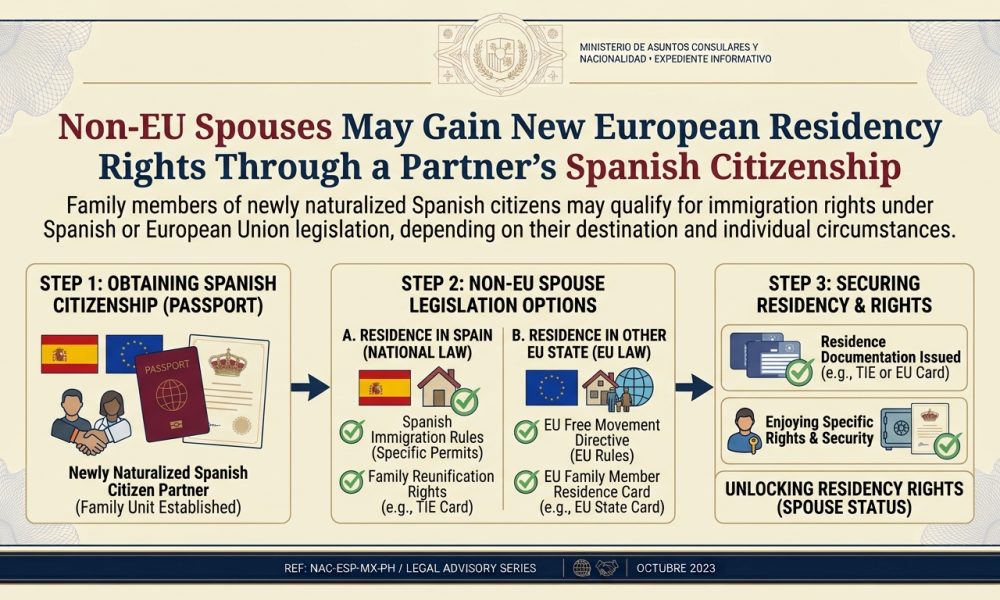
Family members of newly naturalized Spanish citizens may qualify for residence and employment rights under Spanish or European Union legislation, depending on their destination, marital status, family circumstances, and compliance with the applicable immigration procedures.
WASHINGTON, D.C., November 24, 2026
Mexican and Filipino nationals who acquire Spanish citizenship may create new residence opportunities for their spouses and dependent relatives. However, family members do not automatically become European citizens and must meet the legal requirements of their destination.
The distinction matters for international families considering settlement in Spain, France, Germany or another European Union country, because different immigration frameworks apply depending on whether the Spanish citizen remains in Spain or exercises free movement abroad.
Spanish Citizenship Can Change a Family’s Immigration Options
A person who completes Spanish naturalization becomes a European Union citizen, gaining rights that can support family unity, while the nationality, immigration status, and documentary obligations of a non-EU husband or wife remain subject to separate assessment.
For Mexican and Filipino families, the practical advantages can be substantial when one spouse completes Spain’s shortened naturalization pathway, particularly if the other partner previously depended on an employment visa, temporary residence authorization, or the conventional family reunification procedure.
Spain Introduced a Specific Family Residence Framework
Spain’s immigration regulations, ns effective May 20, 2025, introduced a dedicated temporary residence authorization for qualifying relatives of Spanish nationals, distinguishing their position from ordinary family reunification procedures designed mainly for foreign residents sponsoring other foreign nationals.
The framework established under Royal Decree 1155/2024 covers eligible spouses and other family relationships while preserving requirements involving identity, criminal history, genuine family ties, and the actual intention to accompany or join the Spanish citizen in Spain.
An applicant should therefore distinguish the residence category for relatives of Spanish citizens from the European Union residence-card procedure, because the controlling legal route can change depending on the Spanish sponsor’s movement and the family’s immigration history.
Marriage Alone Does Not Automatically Grant Residency
A valid marriage can establish an important qualifying relationship. However, the foreign spouse must still demonstrate eligibility and follow the relevant submission procedure rather than assume the Spanish partner’s newly issued passport automatically grants permission to remain indefinitely.
Spanish authorities may review the marriage certificate, relevant divorce records, identity documents, and the authenticity of the relationship, particularly where a couple married abroad or previously registered family information under different national civil-status systems.
Unmarried Partners May Also Qualify
Spain’s domestic family authorization can cover properly registered partnerships and certain demonstrably stable unmarried relationships, including cases where partners establish at least twelve continuous months of qualifying cohabitation or satisfy the rules involving common children.
This broader recognition matters for families whose relationships began outside traditional marriage. However, the required evidence and administrative treatment differ depending on whether the couple relies on formal registration or documented stable cohabitation.
Work Rights Are an Important Practical Benefit
The residence authorization for qualifying relatives of Spanish nationals generally grants the right to work for an employer or pursue self-employment in Spain without requiring a separate work authorization once the applicable conditions are met.
Spanish guidance also permits provisional work rights during processing for specified close-family categories, subject to eventual approval, so the exact filing category and procedural stage matter for applicants planning to work before their physical residence card arrives.
Initial Authorization Can Last Five Years
Spain’s dedicated family residence permission is generally valid for five years, or for the Spanish family member’s shorter intended period of residence when applicable, giving eligible households a framework for organizing accommodation, employment and longer-term settlement.
The authorization’s duration should not be confused with immediate permanent residence or Spanish nationality, since separate rules govern the legal consequences of extended residence, renewal, independent immigration status and any subsequent citizenship application.
Family Circumstances Determine the Required Documents
A foreign spouse may need a valid passport, an authenticated marriage certificate, evidence identifying the Spanish partner, and criminal-record certificates from relevant countries of previous residence, along with any additional records requested under the applicable procedure.
Documents issued in Mexico, the Philippines, or another jurisdiction may require an apostille, legalization, or an accepted Spanish translation; early preparation helps when marriage records use different surname conventions or administrative details.
European Free Movement Applies Outside the Spanish Home Country
When a Spanish citizen relocates to another European Union member state, Directive 2004/38 generally provides the framework under which qualifying non-EU spouses may accompany or join that citizen, subject to the sponsor’s residence circumstances.
This creates an important distinction between living together in Spain and moving together to Germany, Ireland or France, because EU free movement legislation ordinarily governs qualifying cross-border situations. In contrast, the domestic rules primarily govern residence in Spain.
A Filipino spouse accompanying a newly naturalized Spanish citizen to France may therefore have an EU-derived family residence route, even though the same couple remaining in Madrid would ordinarily be assessed under Spain’s applicable domestic arrangements.
Residence Beyond Three Months Requires Attention
EU legislation generally allows qualifying family members to accompany a mobile EU citizen for an initial period, while a non-EU spouse staying longer than three months must follow the destination country’s residence-card procedures.
The Spanish citizen’s circumstances also matter, because employees, self-employed people, students, and economically inactive residents may face different substantive requirements regarding employment, sufficient financial resources, and comprehensive sickness insurance.
A retired Spanish citizen moving to Portugal with a Filipino spouse may consequently need to demonstrate adequate resources and healthcare coverage. In contrast, a Spanish citizen genuinely employed in France ordinarily relies on the worker-related provisions.
Residence Cards Document Existing Family Rights
When the conditions of European free movement law are satisfied, a non-EU spouse’s residence card documents the applicable family right rather than creating a new nationality, and the issuing authority must follow established European procedural protections.
The European framework generally provides a residence card valid for five years, or for the shorter intended residence period, while requiring the competent authority to process the application within the deadlines and safeguards established by law.
A card issued in one member state should not be mistaken for permanent permission to settle in every other European country, because relocation to another destination may require a separate registration and residence-card process.
Foreign Spouses Can Often Work in the Host Country
Qualifying non-EU family members exercising residence rights under Directive 2004/38 generally have access to employment and self-employment in the host member state, eliminating the ordinary separate work-permit obstacle that affects many unrelated third-country nationals.
Employers may still request evidence of the underlying residence entitlement and identity. At the same time, professional licensing, tax registration, and social security obligations remain independently applicable to the work performed in the destination country.
This distinction can benefit international couples who previously confronted incompatible employment and immigration schedules. However,h applicants should verify their actual rights before accepting a job or assuming a pending application guarantees authorization.
Spain’s New Framework Has Attracted Significant Demand
Spain’s government reported about 102,000 applications for the new residence authorization for relatives of Spanish nationals between May and October 2025, reflecting strong interest after the country implemented its revised immigration regulations.
Those figures concern applications rather than confirmed approvals, and they should not be interpreted as evidence that every applicant possessed a genuine qualifying relationship or that particular nationalities received guaranteed preference during government assessment.
A separate Associated Press report on Spain’s broader immigration regularization initiative described substantial demand for legal residence, illustrating the country’s wider administrative pressures without suggesting that regularization and Spanish-citizen family residence operate under identical eligibility rules.
Family Residence and General Regularization Are Different
Spain’s 2026 immigration regularization initiative addressed specified foreign residents already living in the country without authorization, while the Spanish-citizen family framework depends on qualifying family relationships and separate legal requirements under immigration regulations.
Applicants should avoid confusing publicity surrounding broad regularization programs with the legal protections available to spouses of Spanish citizens, because eligibility, supporting evidence, permission to work, and residence duration can differ substantially.
Children May Have Separate Nationality Opportunities
Children of newly naturalized Spanish citizens may qualify for nationality by option under Article 20 of Spain’s Civil Code, depending on parental authority, the timing of the parent’s citizenship and the child’s age. This potential nationality pathway differs from residence rights obtained as a family member, so it is important to determine whether a child should seek Spanish nationality recognition, a residence authorization, or another applicable immigration status.
Spain’s domestic family residence rules can include children of the Spanish citizen or qualifying partner under specified age, dependency, and disability conditions. However, each child’s legal relationship and personal documentation must be established independently.
Parents and Other Dependents Require More Evidence
Certain dependent parents, other relatives, and family members providing care may qualify under specific domestic or European provision. Still, these categories generally require additional evidence of dependency, family support, health needs, or other specified circumstances.
An applicant should not assume that every adult relative can accompany a Spanish citizen indefinitely, because European law distinguishes core family members from relatives whose circumstances require facilitation or a more individualized administrative assessment.
Returning to Spain Can Involve Special Rules
A Spanish citizen who genuinely exercised free movement rights in another qualifying European country and subsequently returns to Spain may have a different family residence position from someone who never established residence outside Spain.
Spanish government instructions recognize circumstances in which returning nationals and their relatives can invoke European free movement provisions or the domestic Spanish family framework, making the relocation history important in choosing the right route.
Existing Residence Cards Need Careful Review
Foreign spouses already holding Spanish residence permits should not assume that a partner’s successful naturalization automatically cancels their existing authorization, because transitional provisions and changes between residence categories require specific administrative consideration.
Couples should review the current permit, its expiration date, and the consequences of changing status before submitting another application, particularly when employment, travel, or a pending renewal depends on uninterrupted authorization.
Marriage Breakdown Does Not Always End Every Right
European free movement rules include circumstances in which qualifying non-EU spouses may retain residence rights after divorce, annulment, or the end of a registered partnership, subject to conditions involving marriage duration, residence, and other factors.
Spain’s domestic legislation also contains provisions for obtaining independent residence following specified family changes, making the applicant’s actual authorization and personal circumstances essential to determining which Protection may remain available.
These protections do not guarantee continued residence after every separation, and affected individuals should seek qualified advice before deadlines expire, or they assume a former partner’s cooperation remains legally indispensable.
Permanent Residence Can Offer Greater Security
Qualifying non-EU family members may generally acquire permanent residence under European free movement law after five years of continuous lawful residence in the host member state, subject to applicable rules concerning absences and qualifying conditions.
Permanent residence provides stronger Protection against dependence on the sponsoring citizen’s continuing economic activity, although it remains different from acquiring Spanish nationality or receiving an independent national passport through naturalization.
Healthcare Rights Require Separate Verification
A residence card can establish an important immigration position without automatically providing identical medical coverage in every European country, because eligibility for statutory healthcare depends on employment, insurance coordination, and applicable domestic systems.
Families relocating with children or older relatives should identify the responsible healthcare institution and confirm coverage before departure, particularly where a financially inactive Spanish citizen must demonstrate comprehensive insurance for the household.
Cross-Border Families Must Coordinate Their Records
Mexican and Filipino families often keep civil records issued by several countries, which can create differences in surname order, marriage registration, birth certificates, and previous names that should be resolved through authentic government documentation.
Couples should retain complete records of lawful identity changes, foreign marriages, and prior immigration authorizations, allowing officials to establish the same family relationship across jurisdictions without relying on unsupported explanations or inconsistent documentary histories.
U.S. Nationality Can Create Additional Considerations
Some spouses of newly naturalized Spaniards also hold American citizenship, which can affect travel documentation and ongoing legal responsibilities even when the individual qualifies for European residence through an accompanying family relationship.
The U.S. State Department’s guidance on dual nationality explains that American citizens must use American passports when entering or departing the United States, illustrating why European family residence cannot override separate nationality obligations.
Privacy Planning Cannot Replace Authentic Documentation.
International couples considering Amicus International Consulting’s new identity services should distinguish legitimate privacy arrangements from misrepresenting a marriage, concealing legally relevant previous identities,s or presenting fabricated records during immigration or citizenship proceedings.
A lawful name change may require additional supporting evidence. Still, it does not erase earlier family relationships or immigration history, so accurate documentation is essential when multiple governments review the same household.
Second Passport Planning Must Include Dependents
Families exploring Amicus International Consulting’s second passport services may evaluate European mobility opportunities. Still, private consultants cannot grant family residence rights or guarantee approval of government applications where substantive conditions remain unsatisfied.
A comprehensive plan should identify each adult’s and child’s citizenship status, the country where the family intends to settle, and the applicable residence procedure before committing to employment contracts or long-term housing.
Family Residence Is Not Automatic Citizenship
The most important distinction is that a spouse’s Spanish naturalization can create substantial immigration opportunities for qualifying relatives. Still, those relatives retain their existing nationalities unless they independently acquire another citizenship through an applicable legal procedure.
For Mexican and Filipino households, effective planning therefore combines verified family relationships, proper immigration registration, and destination-specific advice, allowing relatives to pursue European residence opportunities without confusing a Spanish citizen’s passport with automatic citizenship for the entire family.




