
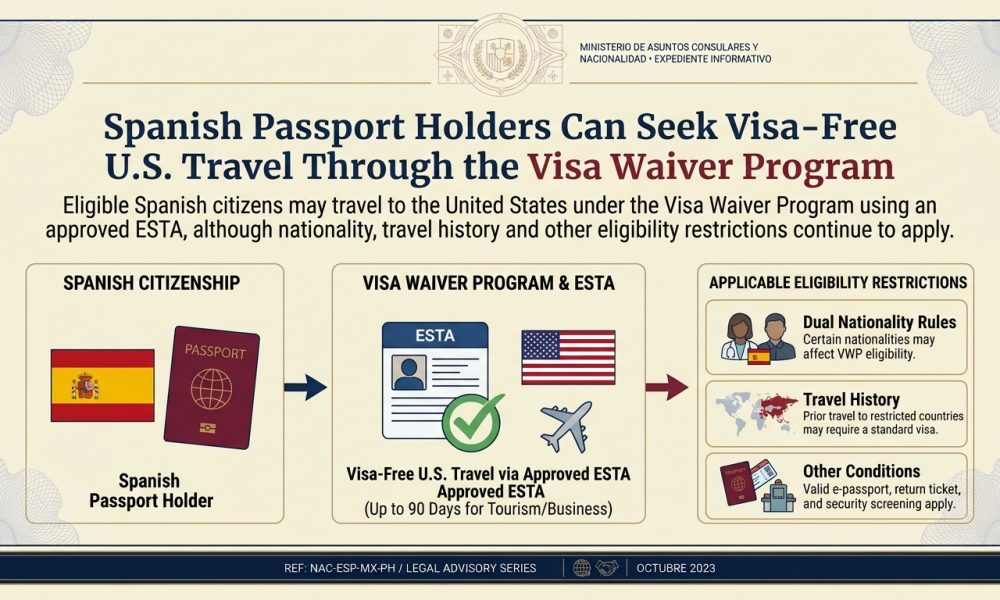
Eligible Spanish citizens can seek short-term United States travel through an approved ESTA, but nationality, previous international journeys, security screening and the permitted purpose of each visit remain decisive requirements rather than optional formalities.
WASHINGTON, D.C., November 24, 2026
Spanish citizenship can create an additional travel option for qualifying former Mexican and Filipino nationals, because Spain participates in the United States Visa Waiver Program, allowing eligible travelers to seek admission for short business or tourism visits without obtaining a conventional visitor visa.
That opportunity depends on possession of a valid Spanish electronic passport and an approved Electronic System for Travel Authorization, commonly called ESTA. At the same time, immigration officers retain authority to determine admission at the United States border.
Spain Participates in the American Visa Waiver Program
The program permits qualifying nationals of designated countries, including Spain, to travel for eligible business, pleasure, or transit purposes for stays of no more than 90 days, provided they meet all additional statutory conditions.
A Mexican or Philippine passport alone does not provide this particular benefit, because neither Mexico nor the Philippines participates in the program, even though their citizens may qualify for other United States visitor documentation or entry arrangements.
Someone who has lawfully naturalized as Spanish can potentially apply using the new Spanish passport, but cannot accurately claim that an unfinished naturalization application or an unregistered nationality approval already establishes eligibility under American immigration rules.
Citizenship Must Be Completed Before ESTA Filing
European nationality law and American border law answer different questions, so successful Spanish naturalization establishes eligibility to hold a Spanish passport but does not independently establish whether the same individual meets United States security screening or admission requirements.
Spanish nationality through residence requires more than completing the applicable residence period, because a favorable government resolution must be followed by the legally prescribed declarations and Civil Registry registration before the government issues a passport.
Qualifying Mexican and Filipino nationals by origin can generally seek Spanish naturalization after two years of legal, continuous residence. Still, that threshold creates the opportunity to apply ,rbut does not guaranteea date of nationality acquisition.
Travel plans relying on ESTA should therefore wait until the individual has a valid Spanish electronic passport, because a residence card, naturalization receipt, or pending passport application cannot substitute for the program’s travel-document requirement.
ESTA Is Advance Authorization, Not a Visa
Some travelers receive prompt authorization while others need additional review, which makes advance filing prudent even when flights and accommodations have already been identified, especially if earlier travel or immigration complications might require further investigation.
ESTA screens eligibility to travel under the Visa Waiver Program before departure. Still, approval is not a visa and does not guarantee that United States Customs and Border Protection will admit the traveler on arrival.
An approved authorization generally lasts two years, or until the associated passport expires, whichever comes first. However, travelers should verify their actual authorization dates and remember that a new passport requires a new ESTA.
Applicants should use the official government application service, enter truthful biographical and passport information, and avoid commercial intermediaries that claim additional service fees can override eligibility rules or guarantee border admission after arrival.
The 90-Day Limit Applies to Each Authorized Visit.
Repeated short trips should reflect genuine temporary visits rather than an attempt to live indefinitely in the United States, because immigration officers may examine residence abroad, travel patterns, and the practical purpose of frequent entries.
Visa Waiver Program travelers are ordinarily limited to 90 days or less for an authorized visit, making the category unsuitable for plans that depend on remaining indefinitely, starting permanent residence or undertaking an extended employment assignment.
A short excursion to Canada, Mexico,o or nearby islands normally does not reset the 90-day clock, because the applicable rules generally count such side trips within the original permitted period rather than granting an automatic fresh admission.
Travelers should carefully check their electronic admission record and departure deadlines, since staying beyond the authorized period can jeopardize future visa-free eligibility and create significant consequences beyond an otherwise routine holiday abroad.
Business Visits Must Not Become Unauthorized Employment
Prospective investors attending meetings should also distinguish lawful preliminary commercial discussions from actively managing an American business or providing ongoing services, since the permitted activities depend on specific immigration rules rather than the business traveler’s preference.
Qualifying activities can include certain business meetings, negotiations, conferences, and consultations normally permitted for B-1 visitors. Still, routine productive work for a United States employer requires a different immigration assessment.
A Spanish passport holder considering an American job should confirm the proper employment authorization instead of using ESTA as a shortcut, because the Visa Waiver Program does not provide an ordinary right to work.
Digital professionals should also obtain individualized advice about proposed remote work while physically present in the United States, rather than assume that employment by an overseas company automatically makes every activity permissible as tourism.
Cuba Travel Can Change Eligibility
United States authorities identify travel to or presence in Cuba on or after January 12, 2021, as a restriction on Visa Waiver Program eligibility, subject to limited exceptions connected with specified official service.
A newly Spanish traveler who previously visited Cuba on a Mexican or Philippine passport should not conceal that trip or assume changing passports erases the travel history, because the eligibility rule concerns the person rather than one document.
Dual nationality with Cuba and a Visa Waiver Program country also generally precludes travel using ESTA under the current rules, making an ordinary visitor visa application the relevant alternative for affected travelers seeking lawful entry.
Other Travel Histories Can Trigger Restrictions
The restrictions are not limited to trips recorded in the Spanish passport, since border authorities can assess travel reflected in earlier documents, immigration databases, and truthful applicant disclosures, even when the journeys preceded a formal change in nationality.
Travel or presence in Iran, Iraq, Libya, North Korea, Somalia, Sudan, Syria or Yemen on or after March 1, 2011, can likewise create restrictions, with limited statutory exemptions or waivers for particular circumstances.
Applicants who traveled for journalism, humanitarian activity or official business should not assume their occupation creates automatic eligibility, because individual exceptions and waivers must be assessed under the precise rules governing the relevant journey.
A responsible screening review considers all passports and previous travel records, including trips made before Spanish naturalization, so applicants should gather accurate dates and appropriate documentation rather than guess when completing government security questions.
Certain Dual Nationalities Are Separately RestrictedU.S.s guidance also restricts Visa Waiver Program use for specified dual nationals, including nationals of Iran, Iraq, North Korea, Suda,n, or Syria, with separate restrictions involving Cuba under the relevant federal measures.
A person can therefore hold a valid Spanish passport and still be ineligible for ESTA because of another nationality, making accurate disclosure of every citizenship more important than assumptions drawn from the cover of the newest passport.
Mexican and Philippine nationality alone do not appear among these specified dual-nationality restrictions. However,h criminal history, immigration violations, and other admissibility grounds can independently affect a particular traveler’s eligibility for the United States program.
A Denied ESTA Does Not Necessarily Prohibit Every Visit
Depending on the reason for refusal, an applicant may need to supply additional records or answer questions at a consular interview, and the ordinary visa process has its own standards, scheduling requirements, and possible outcomes.
A traveler who is ineligible for the waiver route may still be able to seek the appropriate United States visa through a consular application, where the relevant eligibility and admissibility questions are assessed separately.
Visa issuance is not guaranteed, and the applicant should explain previous travel, citizenship history,y or immigration matters accurately instead of treating an ESTA refusal as evidence that another newly obtained passport will resolve the concern.
American Citizenship Creates an Entirely Different Rule
A person who also holds United States citizenship must generally enter and depart the country on a valid American passport, rather than seek ESTA as a foreign visitor using their newly acquired Spanish nationality.
This distinction matters for Mexican American or Filipino American applicants pursuing Spanish citizenship, because a third passport does not replace their American citizenship status or authorize them to disregard United States travel-document obligations.
A former American citizen claiming that nationality has ended should obtain proper official evidence of any lawful loss, since private assertions or use of a foreign passport cannot independently establish that the person is no longer American.
Passport Security and Identity Continuity Remain Essential
Visa Waiver Program travel requires an eligible electronic passport, and applicants should ensure the document is authentic, correctly issued, and consistent with their lawful identity before seeking online authorization or presenting it at an airport.
People exploring Amicus International Consulting’s new identity services should distinguish legitimate record updates from invented identities, because immigration authorities can examine previous names, citizenship histories, passports, and travel records when assessing ESTA eligibility.
A lawful name change does not erase prior immigration violations, outstanding legal issues or previous visits to restricted countries, and applicants should preserve documentation connecting their identities when official records were issued under different names.
Travel Screening Remains a Public Policy Debate
A Reuters report on proposed social-media screening of visa-waiver travelers described concerns raised by tourism representatives and travelers about expanded information collection, illustrating that the authorization process can attract policy proposals beyond its longstanding passport and security checks.
Proposals should not be described as final requirements without verification, so travelers should consult the live official application and current government instructions rather than rely on headlines about possible future screening measures under consideration.
Family Members Need Their Own Authorizations
Travelers whose children hold only Mexican or Philippine passports should research the correct visitor-visa procedures, because theparent’ss later Spanish nationality does not automatically transfer Spanish citizenship or Visa Waiver Program eligibility to every dependent.
Each eligible traveler, including a child, generally requires an individual passport and ESTA authorization when using the waiver route, and parents should not assume their own approval extends automatically to accompanying dependents during family travel.
Families with Spanish and non-Spanish members may need different admission arrangements, so a spouse still traveling on a Philippine or Mexican passport should independently determine whether a visa is required for the planned journey.
Parents should also carry appropriate relationship and consent documentation, where applicable, because airport checks on minors and custody arrangements remain separate from the electronic eligibility decision made before a family departed for an international journey.
Consular and Border Decisions Remain Separate
The U.S. State Department’s Visa Waiver Program guidance identifies participating countries, eligible travel purposes, and key disqualifying circumstances. At the same time,e the admission decision at an American port of entry remains with the responsible border officers.
Travelers may need evidence of intended departure, a suitable itinerary, and sufficient means for the proposed visit, and they should answer questions consistently with the purpose and duration entered into the authorization application.
A visa or ESTA authorization cannot guarantee admission if officials identify an applicable legal bar, so transparent planning and accurate documentation matter more than promotional promises of automatic entry through a prestigious passport.
Temporary travelers should also plan to maintain their ordinary homes and responsibilities abroad, since a plausible departure plan and truthful answers about intended activities can matter when officers evaluate admission requests.
ESTA Is Not a Path to Permanent American Residence
Someone pursuing marriage-based immigration, employment sponsorship, or another permanent pathway should seek advice on the legal route actually available, since an intent to immigrate may conflict with presenting a proposed visit as strictly temporary.
An individual planning to relocate permanently, take regular employment or pursue a longer course of study should research the corresponding immigration category rather than assume repeated short visits can replace a lawful long-term status.
Visa Waiver Program admission also generally limits access to extensions and changes of status, with narrow exceptions, so travelers should not structure essential personal or business plans around a presumed ability to remain beyond their permitted time.
Planning With Multiple Passports Requires Care
Families reviewing Amicus International Consulting’s second passport services may compare the advantages of lawful travel. Still, no private consultant can guarantee ESTA approval, determine American admissibility, or erase a traveler’s previous immigration history or existing nationality obligations.
A useful plan should identify all citizenships, verify the chosen passport, review past travel, and confirm the intended activities before purchasing tickets, because an eligible nationality is only one component of the government’s screening process.
Visa-Free Travel Offers Convenience With Conditions
The convenience is greatest when travel is genuinely temporary, records are accurate,e and the traveler remains eligible throughout the journey, making careful review of official rules a necessary part of responsible international mobility planning.
Spanish citizenship can offer eligible former Mexican and Filipino citizens a valuable opportunity to visit the United States without applying for a conventional visitor visa, provided the traveler qualifies for and obtains ESTA approval.
The key distinction is that visa-free travel remains conditional on accurate personal records, permitted activities, admissibility, and the 90-day limit. At the same time, a Spanish passport never guarantees entry or authorizes permanent American residence without further immigration approval.




