
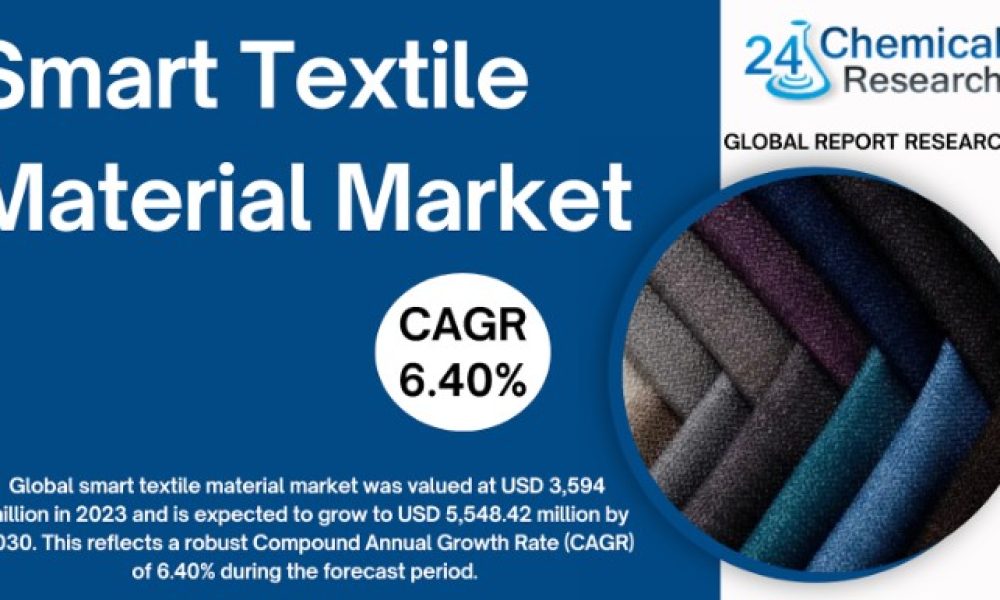
Global Smart Textile Material Market is experiencing transformative growth, valued at USD 3.59 billion in 2023 and projected to reach USD 5.55 billion by 2030, expanding at a CAGR of 6.4%. This revolution stems from the fusion of textiles with advanced technologies, creating fabrics that respond to environmental stimuli through integrated electronics, conductive fibers, and nanomaterials. The market’s momentum builds on increasing demand across healthcare, sports, defense, and fashion sectors where functionality meets innovation.
Download FREE Sample Report: https://www.24chemicalresearch.com/download-sample/285958/smart-textile-material-market
Recent News & Innovations
- Computing Fiber in Clothing
Scientists have embedded computing components (sensors, microcontroller, communication modules, etc.) into a single stretchable fiber that can go through a washing machine. It can do action recognition when worn (squats, planks etc). - Banana Fiber Textiles from Taiwan
A startup is using the pseudostem of banana plants (usually agricultural waste) to make fibers for clothing, vegan leather, blended socks/yarn etc. It performs better than cotton in water use and absorbency. - Upcycling Plastics into Smart / Wearable Textiles
An engineering student in the US transformed red Solo cups into yarn / filaments, developed textiles from them. These materials are dyed by the original plastic color (so fewer dyes) and are designed to shed fewer microplastics. - Milkweed Fibre as Alternative Textile
In India (Ludhiana), a new textile material based on milkweed fibre (locally known) has been developed: lighter, warmer than wool; less chemical/pest input; blends already being trialed in jackets, quilts, etc.
Key Trends & Growth Drivers
- IoT & Embedded Sensors: Textiles with sensors for biometric / environmental data (heart rate, temperature, sweat etc.) are gaining fast adoption. Integration of wireless modules, BLE, etc.
- Active & Ultra‑Smart Textiles: Materials that do more than passive functions (sensing). These include active response (heating, moisture control), energy harvesting, smart displays etc.
- Sustainability: Growing demand for biodegradable, upcycled, natural fibres; minimizing waste; greener finishing / auxiliaries; reducing synthetic, virgin polymers.
- Wearable Health Tech: Strong pull from healthcare & fitness segments. Smart clothes that monitor health, rehabilitative features, emergency response, etc.
- Miniaturization & Comfort: Smaller electronics, flexible circuits, washable electronics, sensors woven in yarn etc., to make wearables comfortable and durable.
Challenges
- High production / R&D costs; achieving scale profitability.
- Durability / washability / long‑term performance under wearing conditions.
- Regulatory and standardisation gaps (what qualifies as “smart textile”, safety, emissions, electronics integration etc.).
Market Overview & Regional Analysis
North America leads with 26% market share, driven by robust R&D investments and early adoption of wearable technologies. The U.S. dominates, particularly in medical textiles and military applications, where temperature-regulating fabrics and biometric-monitoring uniforms are gaining traction. Europe follows closely, with Germany and the UK pioneering sustainable smart textiles, supported by EU initiatives like the Horizon 2020 program funding textile innovation.
Asia-Pacific emerges as the fastest-growing region, fueled by China’s manufacturing prowess and India’s burgeoning technical textiles sector. Japan’s expertise in nanotechnology and South Korea’s wearable tech advancements further solidify APAC’s position. Latin America and Africa show nascent but promising growth, particularly in industrial and healthcare applications.
Key Market Drivers and Opportunities
The healthcare segment accounts for 35% of total demand, with ECG-monitoring shirts and pressure-sensitive wound dressings becoming mainstream. Meanwhile, sports and fitness applications grow at 8.1% CAGR, as brands like Under Armour and Nike integrate motion sensors into performance wear. The defense sector presents untapped potential, with projects like the U.S. Army’s “Flexible Soldier” initiative exploring uniforms with integrated energy harvesting and communications.
Circular economy trends create opportunities—bio-based conductive fibers and recyclable smart textiles align with global sustainability goals. The IoT integration wave further propels market expansion, enabling real-time data transmission from textiles to devices. Luxury fashion houses now collaborate with tech firms, blending haute couture with functionality through color-changing dresses and self-cleaning fabrics.
Challenges & Restraints
Despite promising growth, the industry faces hurdles. High production costs limit mass adoption—thermochromic fabrics cost 3-5x more than conventional textiles. Technical limitations persist in wash durability; most smart textiles withstand fewer than 30 wash cycles before functionality degrades. Regulatory bottlenecks also slow commercialization, particularly for medical-grade smart fabrics requiring FDA/CE certifications.
Supply chain complexities emerge as a critical challenge. Sourcing rare-earth materials for conductive yarns faces geopolitical risks, while IP disputes over textile-embedded sensor technologies intensify among key players. Consumer skepticism about data privacy in wearables further hampers adoption rates.
Market Segmentation by Type
- Passive Smart Textiles (Sensing only)
- Active Smart Textiles (Sensing and reacting)
- Ultra-Smart Textiles (Adaptive learning systems)
Download FREE Sample Report: https://www.24chemicalresearch.com/download-sample/285958/smart-textile-material-market
Market Segmentation by Application
- Healthcare (Patient monitoring, therapeutic textiles)
- Sports & Fitness (Biometric tracking, performance enhancement)
- Military & Defense (Camouflage, hazard detection)
- Fashion & Entertainment (Interactive designs)
- Automotive (Smart seating, climate control)
- Architecture (Light-responsive facades)
Competitive Landscape
The market features a blend of material science giants and agile startups. DuPont leads in smart fiber technologies, while Schoeller Textiles dominates performance fabrics. Emerging players like Myant specialize in textile-based health platforms, challenging traditional boundaries. Recent developments include:
- Google’s Project Jacquard partnering with Levi’s for touch-sensitive denim
- Toray Industries’ acquisition of Carbon Nexus to strengthen smart carbon fiber production
- BASF’s launch of phase-change material microcapsules for temperature regulation
Report Scope
Covers technical and commercial analysis of smart textile materials from 2023-2030, including:
- Market sizing and projections by technology, material, and application
- Competitive benchmarking of 25+ key players
- Patent landscape and R&D expenditure analysis
- Supply chain mapping from raw materials to end-use sectors
Get Full Report Here: https://www.24chemicalresearch.com/reports/285958/smart-textile-material-market




