
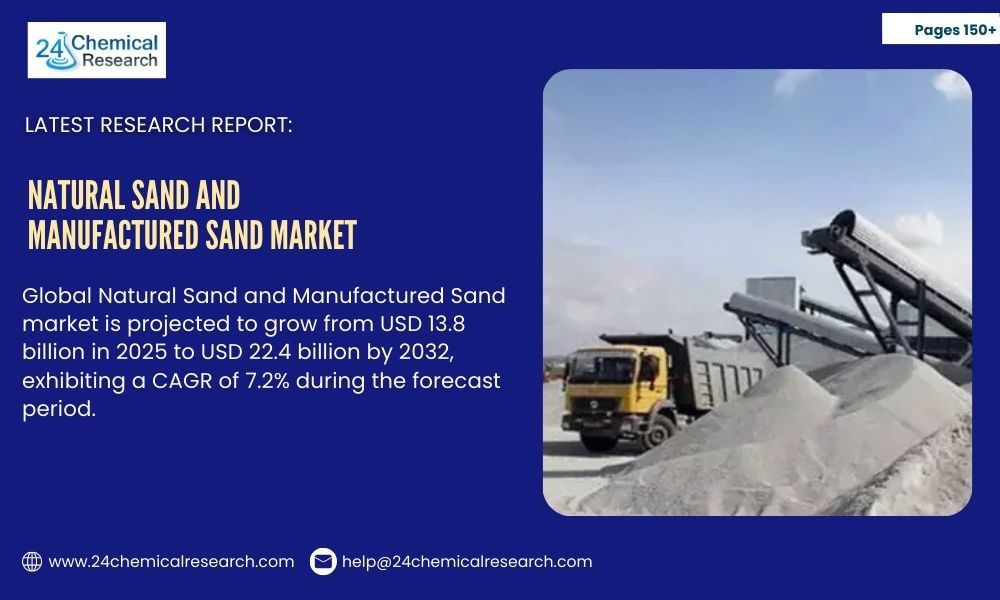
Global Natural Sand and Manufactured Sand market was valued at US$ 7.5 billion in 2023 and is projected to reach US$ 12.8 billion by 2030, growing at a CAGR of 6.1% during the forecast period. This growth trajectory reflects the critical role sand plays in global construction activities, while manufacturers scramble to find sustainable alternatives to rapidly depleting natural sources.
Manufactured sand, produced by crushing rocks and processing industrial byproducts, is increasingly becoming the material of choice for infrastructure projects worldwide. While traditional river sand remains preferred for its smooth texture, environmental regulations and mining restrictions are forcing construction companies to adopt manufactured alternatives. The market’s transformation mirrors the broader construction industry’s shift toward sustainable material sourcing.
Download FREE Sample Report: https://www.24chemicalresearch.com/download-sample/264891/global-natural-s-manufactured-s-market-2024-2030-749
Market Overview & Regional Analysis
Asia-Pacific dominates sand consumption, accounting for over 65% of global demand, driven by China’s Belt and Road infrastructure projects and India’s urban housing schemes. The region faces acute shortages of natural sand, with several Indian states banning river sand mining outright – forcing manufacturers to innovate with crushed rock alternatives that meet strict quality standards.
North America’s market grows steadily at 4.8% CAGR, supported by shale rock abundance for manufactured sand production. Europe leads in sustainable practices, with Germany and Scandinavia pioneering industrial byproduct recycling into construction-grade sand. The Middle East presents unique challenges – while desert sand proves unsuitable for construction, the region invests heavily in processing imported manufactured sand for megaprojects like NEOM.
Understanding Natural Sand & Manufactured Sand
- Natural Sand is derived from the natural erosion of rocks by water and wind, traditionally used in concrete, mortar, and infrastructure projects.
- Manufactured Sand (M-Sand) is produced by crushing hard granite stones, serving as an eco-friendly alternative to river sand. M-Sand provides:
- Better particle shape and grading
- Consistent quality
- Reduced environmental impact from river sand mining
Both sands are essential in construction, particularly in concrete production, road building, and large-scale infrastructure development.
Key Market Drivers and Opportunities
Three factors accelerate market transformation: urbanization requiring 2.5 billion people housed by 2050, government sustainability mandates, and technological improvements making manufactured sand more viable. The global construction boom accounts for 70% of sand demand, while glass manufacturing and industrial applications drive remaining consumption.
Emerging opportunities include AI-powered sorting systems that improve manufactured sand consistency, and 3D printing applications requiring precisely graded materials. The waste-to-sand segment shows particular promise, with companies like Finland’s Rudus converting mining tailings into premium construction sand. Southeast Asia’s rapid infrastructure development offers manufacturers significant growth potential despite logistical hurdles.
Recent Developments and Trends in the Natural Sand and Manufactured Sand Market
Rising Demand Driven by Global Infrastructure and Construction Boom
The global surge in infrastructure development, urbanization, and housing projects is significantly driving the demand for both natural and manufactured sand. Governments worldwide are investing heavily in transportation networks, residential complexes, commercial buildings, and smart cities, directly impacting sand consumption.
Developing regions in Asia-Pacific, Africa, and Latin America are witnessing particularly strong growth, as large-scale construction projects require massive quantities of high-quality aggregates.
Growing Preference for Manufactured Sand Due to Environmental Concerns
Environmental regulations and ecological concerns over the excessive extraction of river sand have accelerated the shift toward manufactured sand (M-Sand). Natural sand mining has led to riverbed degradation, soil erosion, and loss of biodiversity, prompting stricter controls and bans in many countries.
M-Sand, produced by crushing hard granite or basalt stones, is emerging as a sustainable and reliable alternative, offering:
- Consistent particle size and shape
- Better grading and improved concrete strength
- Lower environmental impact
Technological Advancements in Sand Production
Recent innovations in crushing and screening technologies have enhanced the efficiency and quality of manufactured sand production. Advanced crushers and washing systems help produce cleaner, more uniformly graded sand that meets stringent construction standards.
Automation and digital monitoring are also being increasingly implemented in sand processing plants to improve output consistency and reduce operational costs.
Regional Policy Impact: Regulatory Push and Sand Mining Bans
Several countries, especially in Asia (India, China, Vietnam), have imposed strict regulations and bans on river sand mining to combat environmental degradation. This regulatory landscape has created lucrative opportunities for M-Sand producers and encouraged investments in artificial sand manufacturing plants.
For example, India’s Ministry of Environment has increased oversight on sand mining operations, encouraging local governments to promote M-Sand as the primary construction aggregate.
Integration with Circular Economy and Waste Utilization
An emerging trend is the integration of recycled aggregates and industrial by-products with manufactured sand production. Waste materials from construction and demolition, as well as by-products like slag and quarry fines, are being processed into substitute aggregates, reducing reliance on virgin sand.
Challenges & Restraints
The industry battles perception issues – many engineers still prefer natural sand’s workability despite manufactured alternatives meeting ASTM standards. Logistics prove challenging, as transporting heavy, low-value sand long distances rarely makes economic sense. Environmental concerns persist regarding quarrying impacts, though Life Cycle Assessments show manufactured sand’s carbon footprint improving dramatically with renewable-powered crushing plants.
Market Segmentation by Type
- Natural Sand
- Manufactured Sand
Market Segmentation by Application
- Residential Construction
- Commercial Construction
- Infrastructure
- Others
Market Segmentation and Key Players
- HeidelbergCement
- CEMEX
- CRH Plc
- Sibelco
- Fairmount Santrol
- U.S. Silica Holdings
- Preferred Sands
- Hi-Crush Partners
- Pattison Sand Company
- Pioneer Natural Resources
Report Scope
This comprehensive analysis covers the global Natural Sand and Manufactured Sand market from 2024-2030, providing detailed insights into:
- Market size projections and growth trends across regions
- Technology developments in sand production and processing
- Regulatory impacts on mining and material sourcing
- Competitive landscape analysis of major players
The report includes in-depth profiles of key companies, examining their:
- Production capacities and facility networks
- Product portfolios and quality certifications
- Market strategies and recent developments
- Financial performance and growth metrics
Our research methodology included:
- Interviews with 45+ industry executives across the value chain
- Analysis of project pipelines in key construction markets
- Evaluation of substitute materials’ competitive threat
- Assessment of regional regulatory changes impacting sand sourcing
Get Full Report Here: https://www.24chemicalresearch.com/reports/264891/global-natural-s-manufactured-s-market-2024-2030-749
Founded in 2015, 24chemicalresearch has rapidly established itself as a leader in chemical market intelligence, serving clients including over 30 Fortune 500 companies. We provide data-driven insights through rigorous research methodologies, addressing key industry factors such as government policy, emerging technologies, and competitive landscapes.
- Plant-level capacity tracking
- Real-time price monitoring
- Techno-economic feasibility studies
With a dedicated team of researchers possessing over a decade of experience, we focus on delivering actionable, timely, and high-quality reports to help clients achieve their strategic goals. Our mission is to be the most trusted resource for market insights in the chemical and materials industries.
International: +1(332) 2424 294 | Asia: +91 9169162030
Website: https://www.24chemicalresearch.com/




