
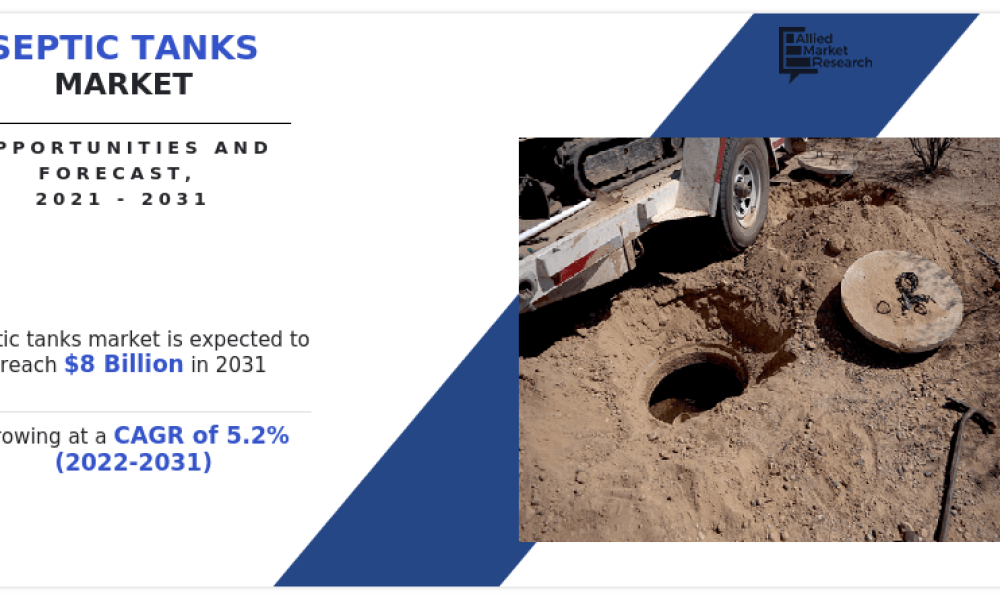
Global Septic Tanks Market Forecast: From $4.8 Billion in 2021 to $8 Billion by 2031
The global septic tanks market, valued at $4.8 billion in 2021, is projected to reach $8 billion by 2031, growing at a compound annual growth rate (CAGR) of 5.2% from 2022 to 2031. Septic tanks, essential for managing domestic wastewater in areas without centralized sewer systems, are underground chambers made of materials like concrete, plastic, or fiberglass. These systems facilitate basic sewage treatment by collecting and decomposing waste through bacterial activity, separating solids and liquids. Widely used in rural residential areas, campgrounds, and non-residential settings, septic tanks are critical for maintaining sanitation and environmental health.
𝐃𝐨𝐰𝐧𝐥𝐨𝐚𝐝 𝐏𝐃𝐅 𝐒𝐚𝐦𝐩𝐥𝐞 𝐂𝐨𝐩𝐲@ https://www.alliedmarketresearch.com/request-sample/A07725
Role of Septic Tanks in Wastewater Management
Septic tanks serve as a cornerstone for decentralized wastewater treatment, particularly in regions where sewer infrastructure is unavailable or impractical. These systems are designed to collect sewage from households or facilities, allowing bacterial processes to break down organic matter while separating solids from liquids. The treated effluent is then dispersed into a drain field for further filtration, while solids are periodically removed. Septic tanks are vital in rural and semi-urban areas, campgrounds, picnic sites, and small-scale commercial facilities, ensuring safe and hygienic waste management.
The demand for septic tanks is closely tied to population growth, urbanization, and the need for effective sanitation systems. As developing economies expand and urban populations increase, the reliance on septic tanks for residential and non-residential applications continues to grow, driving market expansion.
Market Dynamics
Key Drivers
The septic tanks market is propelled by several key factors. The surge in residential and commercial construction, particularly in developing economies, has significantly increased demand for septic tanks. Rapid urbanization, fueled by population growth in countries like China, India, and the United States, is boosting the residential construction sector. According to the United Nations, 68% of the global population is expected to live in urban areas by 2050, driving the need for housing and associated infrastructure, including septic systems.
Rising awareness of the health and environmental benefits of proper wastewater treatment is another critical driver. Septic tanks provide an efficient and cost-effective solution for managing sewage, reducing the risk of waterborne diseases and groundwater contamination. Governments and communities are increasingly prioritizing sanitation, further fueling market growth.
Additionally, government investments in infrastructure projects are creating lucrative opportunities for the septic tanks market. Public initiatives to improve rural sanitation, develop affordable housing, and enhance public facilities like campgrounds and recreational areas are driving demand for reliable wastewater management systems.
Challenges
The COVID-19 pandemic posed significant challenges to the septic tanks market. In 2019 and 2020, global lockdowns disrupted manufacturing, supply chains, and construction activities, halting production and installation of septic tanks. The economic slowdown reduced demand for new systems, particularly in the residential and commercial sectors. However, with the introduction of vaccines and the gradual decline in COVID-19 cases, the market is recovering. By the end of 2022, septic tank manufacturers are expected to resume full-scale operations, supported by renewed construction activities and infrastructure investments.
Another challenge is the need for manufacturers to adapt to post-pandemic realities. Companies must prioritize workforce safety, strengthen supply chains, and adopt innovative production methods to remain competitive. While these adjustments require investment, they are essential for sustaining growth in a recovering market.
𝐄𝐧𝐪𝐮𝐢𝐫𝐞 𝐁𝐞𝐟𝐨𝐫𝐞 𝐁𝐮𝐲𝐢𝐧𝐠@ https://www.alliedmarketresearch.com/purchase-enquiry/A07725
Opportunities
The septic tanks market is poised for growth as industries recover and urbanization accelerates. Innovations in septic tank design, such as advanced materials and modular systems, present opportunities to enhance durability, efficiency, and ease of installation. Additionally, increasing government focus on sustainable sanitation solutions and green infrastructure is expected to drive demand for eco-friendly septic tanks, creating new avenues for market expansion.
Market Segmentation
The septic tanks market is segmented by material type, capacity, application, and region, offering a detailed perspective on its growth dynamics.
By Material Type
The market is categorized into concrete, plastic, fiberglass, and others. In 2021, the plastic segment generated the highest revenue due to its corrosion resistance, waterproof properties, and flexibility, which reduce the risk of cracking compared to concrete tanks. Plastic septic tanks are also more hygienic, making them a preferred choice for residential and non-residential applications. Fiberglass and concrete tanks remain relevant, particularly for larger-capacity systems, but plastic is expected to maintain its dominance due to its durability and cost-effectiveness.
By Capacity
The market is divided into under 1,000 liters, 1,000–5,000 liters, and more than 5,000 liters. The 1,000–5,000 liters segment is the most widely used, catering to residential households and small commercial facilities. However, demand for larger-capacity tanks (more than 5,000 liters) is growing in non-residential applications, such as industrial sites and public facilities, driven by the need for high-volume wastewater management.
By Application
The market is segmented into residential and non-residential applications. In 2021, the residential segment accounted for the highest revenue, driven by government investments in housing and population growth in emerging economies. The non-residential segment, which includes municipalities, hospitals, industries, and other facilities, is also expanding, supported by the need for robust sanitation systems in public and commercial settings.
By Region
Regionally, the market is analyzed across North America, Europe, Asia-Pacific, and LAMEA (Latin America, Middle East, and Africa). Asia-Pacific dominated the market in 2021, accounting for the largest share due to rapid population growth, urbanization, and industrial development in countries like China, India, and Japan. This region is expected to maintain its leadership throughout the forecast period, driven by increasing construction activities and government initiatives to improve sanitation. North America and Europe are also significant markets, supported by established infrastructure and demand for advanced septic systems. LAMEA is poised for growth, particularly in Brazil and the Middle East, where infrastructure investments are rising.
Competitive Landscape
The septic tanks market is competitive, with key players focusing on product innovation, strategic partnerships, and geographic expansion to strengthen their market position. Leading companies include Saint Dizier Environment, Asio, Biorock, Inc., Bluetec, Chem-Tainer Industries, Danmotech Ltd., Eurobeton, Graf UK Ltd., Indian Centrifuges, JoJo, Klargester Environmental, Orenco Systems, Inc., Rewatec, Simop, Techneau, WPL Ltd, and Zehnder Pumpen GmbH. These companies are investing in research and development to introduce durable, eco-friendly, and cost-effective septic tank solutions. Strategic collaborations and mergers are also common strategies to expand market reach and enhance product portfolios.
𝐔𝐩𝐝𝐚𝐭𝐞 𝐎𝐧 𝐃𝐞𝐦𝐚𝐧𝐝@ https://www.alliedmarketresearch.com/septic-tanks-market-A07725
Key Benefits for Stakeholders
This comprehensive analysis of the septic tanks market offers valuable insights for stakeholders, including:
- Quantitative Analysis: Detailed market size, growth projections, and segment-wise trends from 2021 to 2031.
- Market Drivers and Opportunities: Identification of key factors driving growth and emerging opportunities in the market.
- Competitive Insights: Analysis of key players’ strategies and market positioning to facilitate benchmarking.
- Regional Opportunities: Mapping of high-growth regions and countries to guide investment decisions.
- Porter’s Five Forces Analysis: Evaluation of buyer and supplier dynamics to support profit-oriented business strategies.
Conclusion
The global septic tanks market is on a steady growth trajectory, driven by urbanization, population growth, and increasing demand for effective sanitation systems. With a projected market size of $8 billion by 2031, the industry is benefiting from rising construction activities, government investments, and growing awareness of health and hygiene. While the COVID-19 pandemic posed temporary challenges, the market is recovering, with manufacturers adapting to new operational realities. The dominance of plastic septic tanks, the residential sector, and the Asia-Pacific region underscores the market’s growth potential. Stakeholders can leverage the insights provided in this analysis to capitalize on emerging trends, invest in innovative solutions, and drive sustainable growth in the septic tanks market.




