
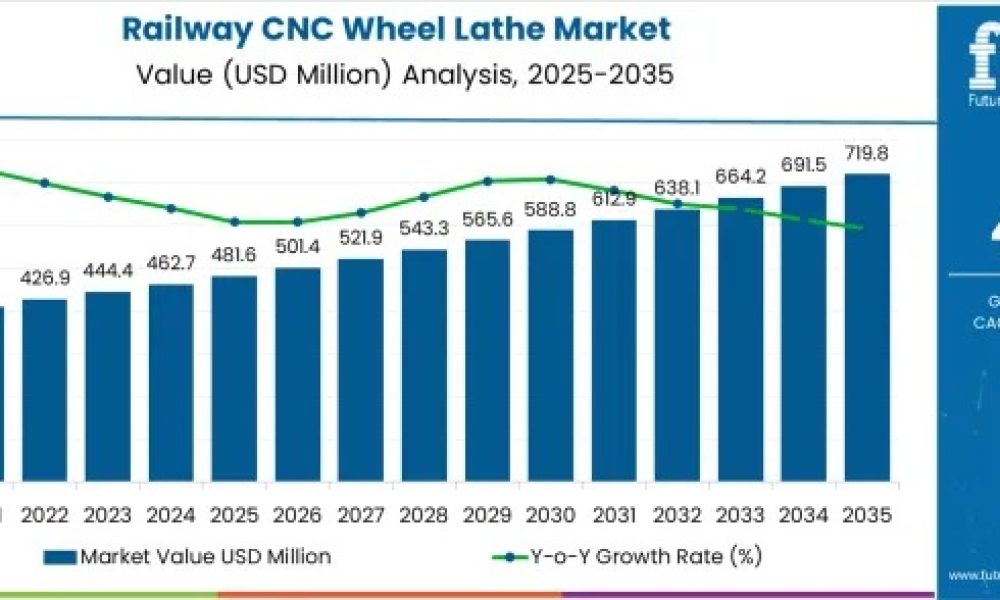
From 2025 to 2035, the railway CNC wheel lathe market is expected to expand from USD 481.6 million to USD 719.8 million, registering a 4.1% CAGR and generating an absolute dollar opportunity of USD 238.2 million over the forecast period. Growth is structurally stable rather than cyclical, as demand is directly tied to mandatory wheel reprofiling cycles, rail safety regulations, and rolling-stock utilization, not discretionary capital expenditure trends.
Unlike fast-scaling technology markets, railway CNC wheel lathe demand evolves steadily because wheel maintenance is non-negotiable for operational safety, ensuring continuous replacement and upgrade demand across passenger and freight fleets. Rising rail traffic volumes, especially in high-speed, metro, and long-haul freight networks, are reinforcing the need for precision CNC machining systems that reduce downtime, extend wheel life, and improve fleet availability.
Peak-to-Trough Growth Pattern Analysis
2025–2028: Initial Acceleration Phase (Moderate Peak)
During the early forecast years, growth remains slightly above the long-term average as rail operators accelerate maintenance depot modernization programs and replace aging manual or semi-automatic wheel lathes with CNC systems. Expansion of metro networks, high-speed rail corridors, and urban transit projects—particularly in China and India—supports stronger equipment procurement. Adoption of CNC underfloor wheel lathes, which enable wheel reprofiling without bogie removal, contributes to early momentum by improving workflow efficiency and safety.
Get access to comprehensive data tables and detailed market insights — request your sample report today!
2029–2031: Stabilization Phase (Relative Trough)
Between 2029 and 2031, the market experiences a relative trough in growth momentum, not due to declining demand, but because major fleet operators in developed regions complete initial modernization cycles. Growth becomes more replacement-driven in Europe, Japan, and North America, where rail networks are mature and maintenance intervals are well established. Capital spending remains consistent but disciplined, resulting in slower year-on-year expansion while utilization rates remain high.
Why is the Railway CNC Wheel Lathe Market Growing?
Market expansion is being supported by the increasing global demand for railway infrastructure modernization and the corresponding shift toward automated maintenance solutions that can provide superior precision and efficiency while meeting industry requirements for reliable and cost-effective rail maintenance operations. Modern railway operators and maintenance facilities are increasingly focused on incorporating CNC wheel lathes to enhance maintenance capabilities while satisfying demands for improved wheel profile accuracy and reduced maintenance downtime. Railway CNC wheel lathes’ proven ability to deliver superior machining precision, operational efficiency, and maintenance reliability makes them essential equipment for modern rail maintenance facilities and railway depot operations.
The growing emphasis on railway safety and operational efficiency is driving demand for high-quality railway CNC wheel lathe products that can support distinctive maintenance capabilities and premium equipment positioning across passenger rail, freight rail, and urban transit categories. Equipment manufacturer preference for systems that combine machining excellence with automation capabilities is creating opportunities for innovative CNC wheel lathe implementations in both traditional rail maintenance and emerging high-speed rail applications. The rising influence of predictive maintenance and Industry 4.0 technologies is also contributing to increased adoption of premium railway CNC wheel lathe products that can provide authentic high-performance rail maintenance characteristics.
2032–2035: Secondary Peak Phase (Technology-Led Upswing)
From 2032 onward, growth re-accelerates as Industry 4.0 integration, predictive maintenance adoption, and smart depot investments gain traction. Rail operators increasingly prioritize CNC wheel lathes with IoT connectivity, real-time diagnostics, automated profiling, and data-driven wear prediction, driving higher system value and upgrade demand. Expansion of high-speed rail in Asia Pacific and renewed investment in freight efficiency in the Americas support the late-cycle growth peak.
Personalize Your Experience: Ask for Customization to Meet Your Requirements
Long-Term Growth Characteristics
The 1.49× market expansion over the decade highlights a low-volatility, high-reliability growth profile, distinct from emerging rail technologies that experience sharper peaks and troughs. The market benefits from:
- Mandatory wheel maintenance cycles linked to safety compliance
- Predictable replacement demand across passenger and freight fleets
- Gradual shift from manual to fully automated CNC systems
- Incremental value addition through digitalization rather than volume spikes
Overall, the peak-to-trough pattern remains shallow, reinforcing the railway CNC wheel lathe market’s positioning as a stable, infrastructure-anchored investment segment with sustained long-term demand driven by rail safety, efficiency, and lifecycle cost optimization.
About Future Market Insights (FMI)
Future Market Insights, Inc. (FMI) is an ESOMAR-certified, ISO 9001:2015 market research and consulting organization, trusted by Fortune 500 clients and global enterprises. With operations in the U.S., UK, India, and Dubai, FMI provides data-backed insights and strategic intelligence across 30+ industries and 1200 markets worldwide.



