
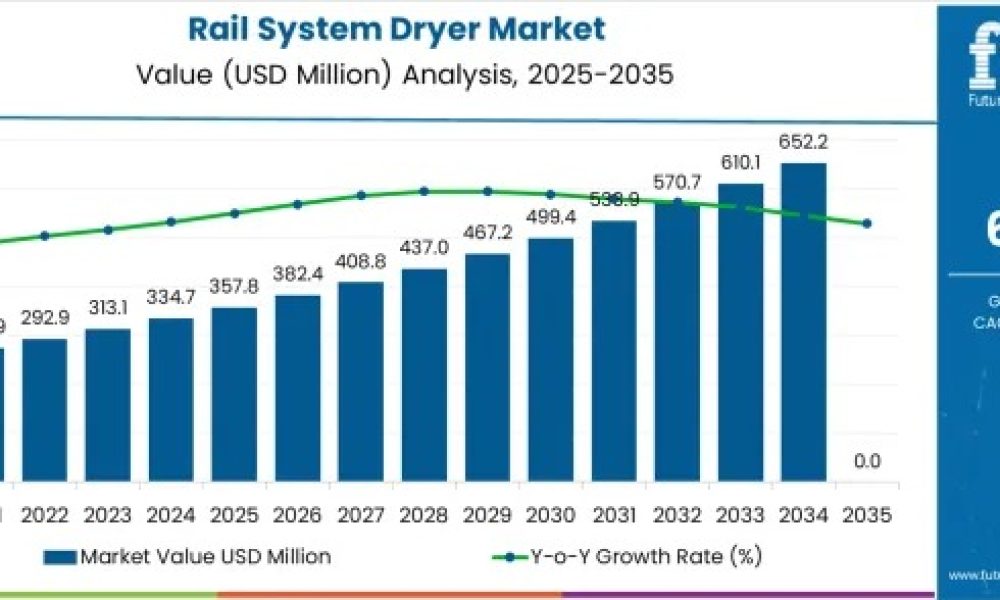
The global rail system dryer market is positioned for strong and sustained growth over the next decade, expanding from a valuation of USD 357.8 million in 2025 to USD 697.2 million by 2035, registering a compound annual growth rate (CAGR) of 6.9%. Over the forecast period, the market is expected to generate USD 339.4 million in incremental value, underlining the critical role of moisture-control technologies in modern railway operations.
Rail system dryers are becoming indispensable as rail operators worldwide modernize fleets and infrastructure to improve safety, reliability, and operational efficiency. Moisture-free compressed air is essential for braking systems, pneumatic doors, signaling mechanisms, pantographs, HVAC units, and other mission-critical rail subsystems. As networks expand and operating conditions become more demanding, investment in high-performance air drying solutions is rising steadily across both freight and passenger rail segments.
Two-Phase Growth Pattern Reflects Technology Adoption Curve
Market expansion unfolds across two distinct phases. Between 2025 and 2030, the rail system dryer market is projected to reach approximately USD 502–515 million, accounting for nearly 41% of total decade growth. This phase is driven primarily by fleet renewal programs, reliability-focused retrofits, and upgrades to compressed air systems in freight locomotives and passenger rolling stock.
The 2030–2035 period contributes the remaining 59% of market expansion, as adoption deepens for smart dryers equipped with advanced sensors, predictive maintenance capabilities, and regenerative drying architectures. These systems significantly reduce lifecycle costs, energy consumption, and unplanned downtime—benefits that are increasingly prioritized by large rail operators managing extensive, high-utilization networks.
Get access to comprehensive data tables and detailed market insights — request your sample report today!
Desiccant Dryers Dominate Amid Harsh Operating Conditions
By product type, desiccant rail system dryers command 58% of global market share, reflecting their superior adsorption efficiency and stable performance across extreme temperatures and humidity levels. These systems are particularly well suited for heavy-duty freight locomotives and long-haul operations, where consistent air quality is essential to braking reliability and overall system safety.
Membrane and hybrid dryers remain niche solutions, finding adoption mainly in urban transit and passenger rail applications where compact design, low maintenance, and space efficiency are key considerations. However, the growing emphasis on reliability and durability continues to favor desiccant-based solutions across most rail environments.
Freight Railways Anchor Demand
From an application perspective, freight railways account for 67% of total market demand, underscoring the sector’s reliance on robust pneumatic systems to support heavy axle loads, long-distance duty cycles, and safety-critical braking operations. Continuous moisture removal is vital to minimizing corrosion, preventing freezing, and ensuring consistent performance under varied climatic conditions.
Passenger railways represent the remaining share, supported by expanding metro systems, high-frequency commuter rail, and high-speed rail investments. As urban transit networks scale up, the need for reliable compressed air systems to support doors, suspension, and signaling continues to strengthen demand for advanced rail system dryers.
Infrastructure Modernization Drives Market Momentum
One of the primary growth drivers is the global surge in railway infrastructure investment. Governments and transport authorities are expanding and upgrading metro rail, high-speed rail, commuter networks, and freight corridors to accommodate urbanization, reduce congestion, and advance sustainable mobility goals. These initiatives require advanced compressed air systems with high-performance dryers capable of supporting automated, electrified, and digitally monitored rail operations.
At the same time, the shift toward preventive and predictive maintenance strategies is accelerating adoption of intelligent dryers with real-time monitoring and diagnostics. Integration with digital rail management systems enables operators to anticipate failures, optimize maintenance schedules, and improve asset utilization—directly enhancing network uptime and safety performance.
Cost Challenges Offset by Long-Term Reliability Gains
Despite its strong outlook, the rail system dryer market faces challenges related to high installation and maintenance costs, particularly when integrating advanced dryers into aging rail fleets. Retrofitting often requires system upgrades and specialized technical expertise, raising upfront investment requirements. However, operators increasingly recognize that improved reliability, reduced maintenance downtime, and longer equipment lifecycles deliver compelling long-term returns, supporting continued market adoption.
Asia Pacific Leads, While Mature Markets Modernize
Geographically, Asia Pacific anchors global demand, led by aggressive rail expansion programs in China (9.3% CAGR) and India (8.6%). Massive investments in freight corridors, metro systems, and high-speed rail are driving large-scale adoption of advanced air drying technologies.
In Europe, Germany records a strong 7.9% CAGR, supported by engineering upgrades and high-speed rail investments, while the United Kingdom grows at 5.9% CAGR on the back of modernization-led adoption. North America, led by the United States at 6.6% CAGR, shows steady growth tied to freight rail optimization and infrastructure renewal. Brazil (7.2% CAGR) and Japan (5.2% CAGR) further contribute to a diversified global growth profile.
Personalize Your Experience: Ask for Customization to Meet Your Requirements
Competitive Landscape Focused on Performance and Efficiency
The rail system dryer market is moderately concentrated, with leading players competing on dew-point performance, energy efficiency, durability, and digital integration rather than price alone. Wabtec Corporation holds a leading position, supported by its long-established portfolio of air-drying systems for freight, metro, and high-speed rail applications.
Other key participants—including Hedson Technologies, Atlas Copco, Norgren (IMI Precision Engineering), and AVENTICS (Emerson)—continue to strengthen their positions through high-performance desiccant solutions, smart monitoring platforms, and close collaboration with global rail OEMs and operators. Challenger brands such as Tsunami, Trident Pneumatics, Eldridge USA, Meier Prozesstechnik, SolvAir, and Graham-White expand adoption through robust, service-friendly dryers tailored to regional and climatic requirements.
Outlook: Reliability and Intelligence Define the Next Decade
As rail networks worldwide evolve toward higher speeds, heavier loads, and greater automation, rail system dryers will remain a foundational component of safe and reliable operations. The convergence of infrastructure modernization, digital monitoring, and energy-efficient design positions the market for consistent growth through 2035.
With moisture control directly influencing braking safety, system longevity, and operational uptime, rail system dryers are transitioning from auxiliary components to strategic assets—making this market an increasingly attractive opportunity for technology providers, OEMs, and infrastructure stakeholders across the global rail ecosystem.
About Future Market Insights (FMI)
Future Market Insights, Inc. (FMI) is an ESOMAR-certified, ISO 9001:2015 market research and consulting organization, trusted by Fortune 500 clients and global enterprises. With operations in the U.S., UK, India, and Dubai, FMI provides data-backed insights and strategic intelligence across 30+ industries and 1200 markets worldwide.



