
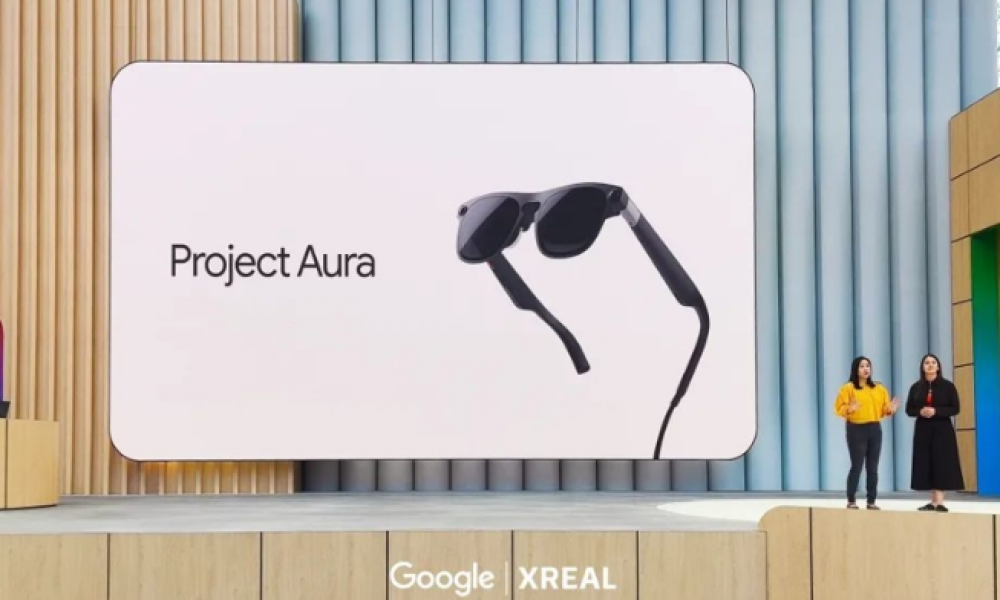
Today, the field of augmented reality (AR) technology continues to usher in a series of major breakthroughs, which are expected to completely change the user experience of AR glasses and accelerate their popularity in the consumer and enterprise markets.
Qualcomm AR2 chip promotes the leap of AR technology
It is learned that Qualcomm (QCOM) Snapdragon AR2 chip has become the core driving force of this technological innovation. By adopting an innovative multi-chip architecture, Snapdragon AR2 has successfully achieved a significant result of increasing the end-side computing power by 3 times.
Qualcomm said that in practical applications, this means that when users use AR glasses, they can get a stable and efficient AR experience even in an environment with poor network signals. And while achieving powerful computing power, the Snapdragon AR2 chip has also achieved remarkable results in lightweight design, greatly improving work efficiency.
Not long ago, Google (GOOG) officially unveiled its first Android system AR (augmented reality) glasses at the Global Developers Conference. It was jointly created by Google and Shanghai AI hardware company XREAL, opening the “Android moment” of the AR industry.

Looking around the world, more technology giants are ready to launch smart glasses. For example, Meta’s (META) new smart glasses with display function Hypernova are expected to be released in October this year; Apple (AAPL) may launch its first AI smart glasses at the end of 2026, and Siri may become the core interaction method.
There are also reports that relevant departments of Samsung (SSNGY) are studying Micro-LED display technology related to AR glasses, and potential customers include Apple and Meta.
AR glasses industry goes mainstream
The entry of technology giants is of great significance in its strong brand influence and industry appeal, which will bring wider social attention and consumer awareness to the emerging category of AR glasses. This is an important market education and confidence endorsement for the entire industry, which will help promote AR glasses from trying new things to the mainstream.
Data shows that in the first quarter of 2025, global AR sales were 112,000 units, basically the same as the same period last year; benefiting from the significant increase in Ray Ban Meta’s sales, global AI smart glasses sales were 600,000 units, a year-on-year increase of 216%.
The industry generally believes that AR glasses are one of the fastest growing categories in the consumer electronics industry. From a technical perspective, smart glasses are expected to become the next generation of mainstream computing terminals after smartphones, driving the entire industry chain (chips, optics, sensors, foundry, etc.) into a period of rapid growth.

Galaxy Securities Research Report stated that technological progress drives market demand, and AR glasses are moving towards the “next computing terminal”. Through technological breakthroughs + ecological integration + market penetration, AR glasses manufacturers are pushing AR glasses from “niche geek toys” to “mass smart terminals”.
WiMi accelerates competition for AR technology and ecology
According to data, Wimi Hologram Cloud Inc (WIMI), as a core enterprise in the AR track, has seized the opportunity in the AR hardware industry chain with years of industry accumulation in AR, AI algorithm models, multimodal human-computer interaction, and semiconductors, and through parallel layout, it has gathered a complete industry chain in some smart hardware industries, achieving capacity accumulation and rapid growth.
Looking at the AR glasses industry, the increasing maturity of AI and display technology, the gradual improvement of the industrial chain and the diversified expansion of application scenarios are jointly pushing the industry towards a breakthrough stage, and also bringing new development opportunities to upstream and downstream companies in the industrial chain. In this regard, WiMi will increase its R&D investment in the future, focusing on breakthroughs in cutting-edge technologies such as AI applications and light waves, and preparing for the creation of the next generation of smart terminals.
Conclusion
Speaking of future development, the common view of AR practitioners is that it has become an inevitable trend for AR glasses to replace mobile phones, and AR glasses will replace mobile phones as the mainstream computing platform. From the perspective of scenarios, the application of AR glasses has gradually expanded from audio-visual entertainment to the fields of food, clothing, housing and transportation, greatly expanding the use scenarios of AR glasses. It can be believed that in this era, technological breakthroughs will drive the industry to evolve in a standardized and sustainable direction.




