

Bifacial Solar Market Size, Share and Trend Analysis Report : Global Opportunity Analysis and Industry Forecast 2022-2031
According to a new report published by Allied Market Research, the bifacial solar market size was valued at $8.7 billion in 2021, and bifacial solar market size is estimated to reach $31.1 billion by 2031, growing at a CAGR of 13.6% from 2022 to 2031.
Bifacial Solar Panels: Maximizing Solar Energy Generation
Bifacial solar panels are a type of photovoltaic (PV) technology that can capture sunlight from both sides of the panel. This design allows for increased energy generation compared to traditional monofacial panels, making them an attractive option for solar energy systems.
Download PDF Brochure: https://www.alliedmarketresearch.com/request-sample/A16957
Europe accounts the largest share of the market, followed by North America and Asia-Pacific. Europe bifacial solar market would exhibit CAGR of 13.2% during 2022-2031.
Major companies in bifacial solar industry report included Jinko Solar Holdings, Canadian Solar, Yingli Green Energy, LG Electronics, LONGi, JA Solar Holding Co. Ltd., Sharp Corporation, Sun Power Corporation, Trina Solar, and Wuxi Suntech Power Co., Ltd.
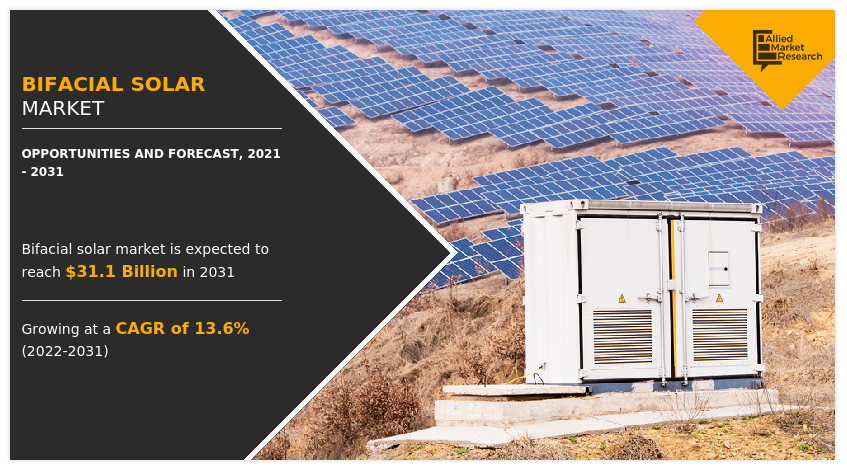
Bifacial solar cells use high-watt modules and high-efficiency panels in solar panels and cell development. Rise in demand from commercial & industrial sectors for electricity propels growth of the market, especially during peak times.
Increase in demand for solar-based electricity across the globe has led companies to introduce latest advanced solar modules that focus on cost, efficiency, and design.
Reduction of energy cost and rise in affordability has accelerated the bifacial solar market forecast growth.
The bifacial solar market is proliferating on global platform witnessing increase in installations of bifacial modules globally.
Bifacial solar modules offer several advantages compared to traditional solar panels, including power production from both sides, increase in total energy generation.
Bifacial modules can generate more power in a smaller array footprint; reduce in balance of system (BOS) costs.
These modules are extremely durable, with UV resistant applied on both sides. Frameless bifacial modules are considered beneficial for reducing potential-induced degradation (PID) concerns.
Bifacial solar is a rapidly growing technology which can improve electricity production by utilizing light irradiation from both sides of the panel.
Bifacial solar panels have two production peaks one at the morning and evening compared to conventional which has only one production peak at noon.
Many research institutes are increasing studies to improve functionalities of bifacial solar modules that can decrease the level of cost of electricity (LCOE).
Feed in Tariff (FiT) is one of the major attractions of taking up renewable energy such as solar panels.
The initiative essentially meant that electricity produced by solar panel system was paid by governments to help offset the cost of buying the system.
The European Union initiated “Green Deal” program to reduce carbon emissions and harness residential potential to harvest solar energy.
Various other initiatives of the government to improve the environment in rural areas and provide electricity for basic electronic gadgets are the factors that drive growth of the bifacial solar market trends.
Applications
- Utility-Scale Solar Farms: Ideal for large solar installations where maximizing output is crucial.
- Commercial Rooftops: Suitable for buildings with adequate space and reflective surfaces to enhance performance.
- Agrivoltaics: Can be integrated into agricultural settings, allowing for simultaneous crop production and energy generation.
On the basis of cell type of bifacial solar, the market is segmented into heterojunction cell and passivated emitter rear cells. The Passivated emitter rear cell segment accounted for the largest share in 2021.
On the basis of frame type, it is bifurcated into framed and frameless. Framed type bifacial solar was the leading segment in 2021.
On the basis of end use, it is segmented into residential, commercial, and industrial. Industrial end use segment was the highest revenue contributor in 2021.
Rapid development of industrialization, modernization, and spread of information through internet led to development of the tourism industry, which fuels demand for bifacial solar.
Buy This Report (300 Pages PDF with Insights, Charts, Tables, and Figures): https://bit.ly/4f1H0M1
Advantages
- Increased Energy Yield: The ability to capture solar energy from both sides leads to higher overall energy production.
- Reduced Land Use: Higher efficiency allows for more energy generation in smaller areas, optimizing land use.
- Long-Term Investment: The potential for increased energy output can lead to better returns on investment over time.
IMPACT OF COVID-19 ON THE GLOBAL BIFACIAL SOLAR MARKET
Emergence of COVID-19 had a negative impact on the growth of the global bifacial solar market during this period.
This impact is mostly attributed to the significant disruptions in the raw material transportation, presence of low-labor, led to shutdown of many manufacturing industries led to decline of demand for bifacial solar during this period.
The decrease in demand for many non-essential products and shut down of construction and tourism related industries have created a negative impact on the development of global bifacial solar market.
Thus, the abovementioned factors are expected to have negative impact the global bifacial solar market growth during the pandemic period.
Future Trends
- Technological Advancements: Ongoing research is focused on improving efficiency and reducing costs associated with bifacial panels.
- Integration with Smart Technology: Developments in monitoring and optimization technologies will enhance the performance of bifacial systems.
- Sustainability Initiatives: As the push for renewable energy grows, bifacial solar technology is expected to gain further traction in the market.
Conclusion
Bifacial solar panels represent a significant advancement in solar technology, offering enhanced energy generation capabilities. Their ability to capture sunlight from both sides makes them a compelling choice for various applications in the renewable energy sector. As technology continues to evolve, bifacial panels are likely to play an increasingly important role in the quest for efficient and sustainable energy solutions.
Other Trending Reports:-
About Us:
Allied Market Research (AMR) is a market research and business-consulting firm of Allied Analytics LLP, based in Portland, Oregon. AMR offers market research reports, business solutions, consulting services, and insights on markets across 11 industry verticals. Adopting extensive research methodologies, AMR is instrumental in helping its clients to make strategic business decisions and achieve sustainable growth in their market domains. We are equipped with skilled analysts and experts and have a wide experience of working with many Fortune 500 companies and small & medium enterprises.
Pawan Kumar, the CEO of Allied Market Research, is leading the organization toward providing high-quality data and insights. We are in professional corporate relations with various companies. This helps us dig out market data that helps us generate accurate research data tables and confirm utmost accuracy in our market forecasting. Every data company in the domain is concerned. Our secondary data procurement methodology includes deep presented in the reports published by us is extracted through primary interviews with top officials from leading online and offline research and discussion with knowledgeable professionals and analysts in the industry.




