
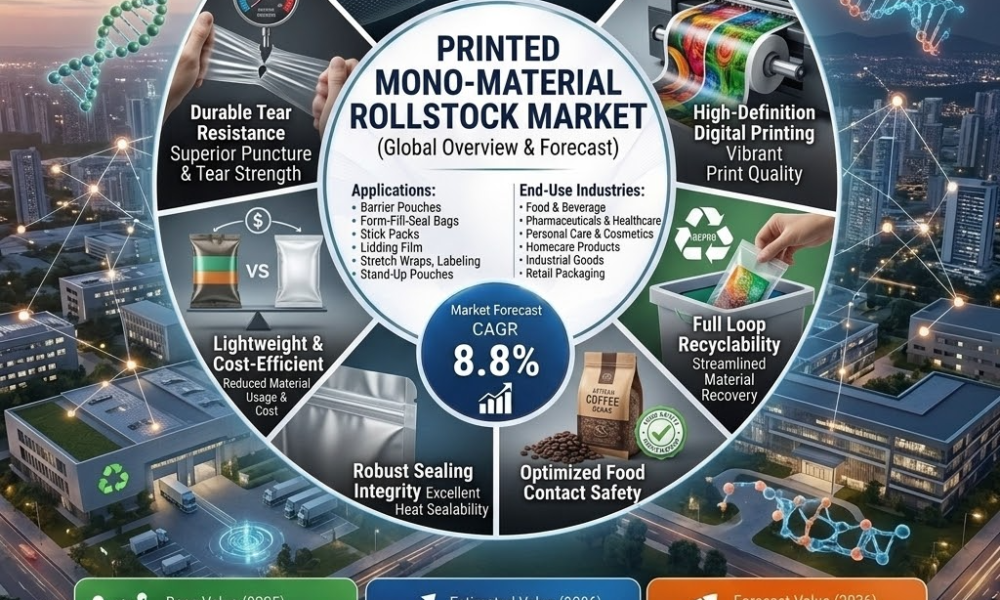
Rockville, MD., September 23, 2026 — The global printed mono-material rollstock market is projected to increase from USD 8.3 billion in 2026 to USD 19.2 billion by 2036, expanding at an 8.8% CAGR from 2026 to 2036. The market was valued at USD 7.6 billion in 2025, with an absolute opportunity of USD 11.0 billion expected between 2026 and 2036.
A key regulatory development is shaping packaging redesign. Regulation (EU) 2025/40 entered into force on February 11, 2025, and applies from August 12, 2026. The report notes that design-for-recycling requirements begin to apply from 2030, increasing attention on packaging structures that can meet recycling requirements while maintaining required barrier and processing performance.
Get detailed market forecasts, competitive benchmarking, and packaging technology trends: https://www.factmr.com/connectus/sample?flag=S&rep_id=16529
Global Segment Leaders
- PE mono-material — 33.0% share in 2026: PE mono-material leads the polymer platform segment because seal and print layers can remain within one polymer family, while MDO-PE supports stiffness and web transport.
- EVOH-compatible barrier — 34.0% share in 2026: This barrier technology leads because thin layers can provide oxygen protection in mainly polyolefin-based films.
- Printed rollstock — 37.0% share in 2026: Printed rollstock leads the format segment because it feeds directly into continuous packaging lines and supports changes in pack length and artwork with limited equipment changes.
- Snacks — 29.0% share in 2026: Snacks lead end-use demand because printed mono-material films provide broad print areas, moisture control, and lightweight packaging suited to high-volume production lines.
Food packers are seeking printable barrier films that can operate on existing form-fill-seal equipment. The report cites Berry Global’s January 2025 report that Entour MDO-PE/PE films reached about 60 cycles per minute on a new B&B Verpackungstechnik GmbH line.
The report estimates design-for-recycling conversion at a +1.6% impact on CAGR, while packaged-food throughput has a +1.2% impact and MDO-PE and BOPE web performance contributes +0.9%. Recyclable high-barrier food webs represent a +1.0% opportunity impact.
Country-Level Performance
- China — 10.0% CAGR: China’s National Bureau of Statistics reported in February 2026 that retail sales of consumer goods reached RMB 50.1 trillion in 2025, supporting demand for printed flexible packaging.
- USA — 9.5% CAGR: USDA Economic Research Service reported on June 11, 2026, that U.S. food spending reached USD 2.51 trillion in 2025, supporting a broad base for printed flexible packs.
- Germany — 9.3% CAGR: The German Environment Agency reported on January 27, 2026, that around 5.5 million tonnes of packaging from dual systems were recycled in 2024, keeping recycling requirements central to film design.
- France — 8.8% CAGR: INSEE reported in May 2026 that household spending on food and non-alcoholic drinks reached EUR 195.3 billion in 2025, supporting demand for flexible food packaging.
- Japan — 7.6% CAGR: Japan’s Ministry of Economy, Trade and Industry reported in February 2026 that supermarket sales reached JPY 18.4 trillion in 2025, supporting recurring demand for printed food films.
Regional Context
China and the USA form the faster-growing country tier, with CAGRs of 10.0% and 9.5%, respectively. China’s growth is linked to packaged-food retail and high-volume flexible packaging, while the USA benefits from a large packaged-food base and steady web-conversion demand.
Germany and France represent the middle growth tier, with CAGRs of 9.3% and 8.8%. Germany’s packaging system and recycling requirements support demand for structures designed for cleaner polymer streams. France’s food market supports printed flexible packaging for snacks and chilled foods. Japan records the lowest CAGR among the five profiled countries at 7.6%, with supermarket activity and careful pack approval supporting recurring rollstock use.
The full report covers North America, Latin America, Western Europe, Eastern Europe, East Asia, South Asia & Pacific, and the Middle East & Africa, with country-level analysis for five countries: the USA, China, Germany, Japan, and France.
Browse Report: https://www.factmr.com/report/printed-mono-material-rollstock-market
Competitive Landscape
Key companies profiled in the printed mono-material rollstock market are Amcor plc, Mondi plc, Coveris, Constantia Flexibles, and ProAmpac. The report notes that Amcor includes the former Berry Global portfolio following the combination completed on April 30, 2025. Mondi supplies mono-material barrier films for food packaging, while Coveris, Constantia Flexibles, and ProAmpac offer recycle-ready flexible packaging solutions. Buyers compare print quality, sealing, barrier performance, recycling fit, and line performance when assessing suppliers.
Recent developments include Amcor’s completion of its combination with Berry Global on April 30, 2025, creating a larger flexible-packaging portfolio. Mondi and Saga Nutrition launched a sustainable pet-food packaging solution on June 5, 2025, using its mono-material re/cycle FlexiBag with high-barrier protection against moisture and odor. Constantia Flexibles announced on August 12, 2025, that it was investing more than €100 million and expanding its product portfolio.
According to Shambhu Nath Jha, Principal Consultant at Fact.MR, “The main test combines line performance with recycling design. Mono-material films can gain wider use when they keep print quality and seal control. Suppliers should support film design with line trials and barrier tests.”
Top Reports:
3D Printed Aerospace Fasteners Market:
Aerospace and Defense Printed Circuit Board Market:
Report Scope
The Printed Mono-Material Rollstock Market covers printed flexible films built mainly from one polymer family and supplied as inputs for continuous packaging lines. The study includes PE and PP structures with oriented or coated variants, including printed mono-PE, mono-PP, MDO-PE, and BOPE structures.
The analysis covers polymer platform, barrier technology, format, end use, and region. Polymer platforms include PE mono-material, PP mono-material, MDO-PE, BOPE, and recyclable coated mono-web. Barrier technologies include EVOH-compatible barriers, AlOx/SiOx coatings, barrier coatings, orientation-enhanced barriers, and nanocomposite or specialty systems.
Formats include printed rollstock, pouches, flow wrap, lidding web, and form-fill-seal film. End-use applications include snacks, fresh and frozen food, pet food, personal care, and household or other applications.
The analysis draws on 120+ sources, 35+ company portfolios, 25+ countries, and more than 20 industry interviews, combining primary research, desk research, market sizing, forecasting, and data validation.



