
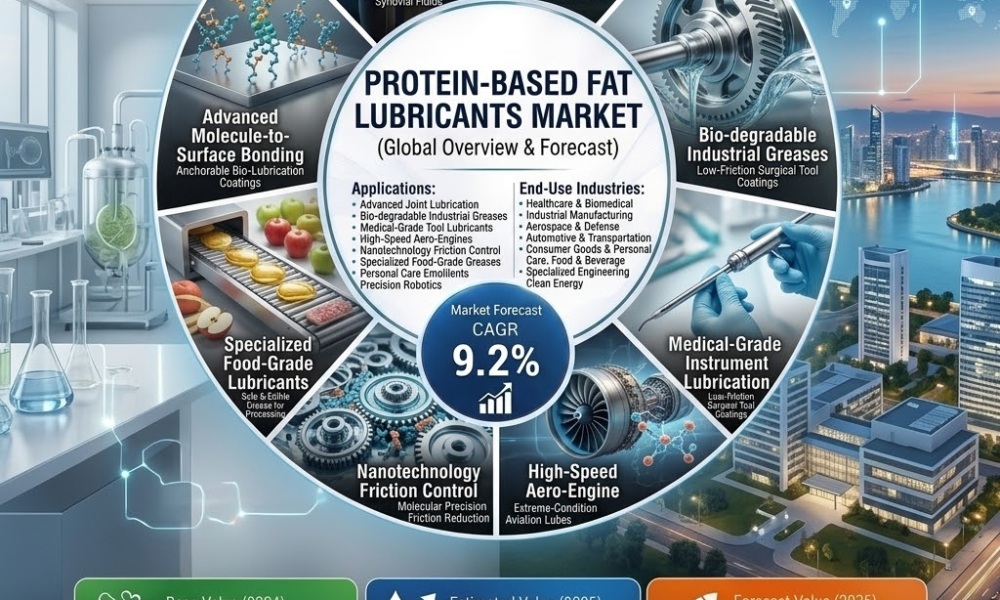
Rockville, MD., September 23, 2026 — The global protein-based fat lubricants market is projected to increase from USD 2.2 billion in 2026 to USD 5.5 billion by 2036, expanding at a 9.8% CAGR from 2026 to 2036. The market reached USD 2.0 billion in 2025, with an absolute opportunity of USD 3.4 billion expected between 2026 and 2036.
Demand is being supported by reduced-fat reformulation and the need to preserve creaminess when fat levels are lowered. The U.S. Department of Agriculture Economic Research Service reported on June 11, 2026, that U.S. food spending reached USD 2.51 trillion in 2025, highlighting the scale of the food market in which protein-based texture systems are being applied.
Get detailed market forecasts, competitive benchmarking, and pricing trends: https://www.factmr.com/connectus/sample?flag=S&rep_id=16528
Global Segment Leaders
- Whey proteins — 34.0% share in 2026: Whey proteins lead the protein platform segment because microparticulation can create a fat-like body and creamy texture while supporting protein enrichment.
- Lubrication / creaminess — 31.0% share in 2026: This functional role leads because fat reduction can remove smooth mouthfeel, creating demand for systems that rebuild body and creaminess.
- Dairy / alternatives — 36.0% share in 2026: Dairy and alternative products lead application demand because yoghurt, desserts, and dairy-style beverages depend on creaminess and controlled texture.
- Powder concentrate — 29.0% share in 2026: Powder concentrates lead the format segment because they are shelf stable and convenient to transport, dose, and blend during food production.
The report identifies reduced-fat reformulation with creaminess retention as a major demand driver, with an estimated +2.0% impact on CAGR. High-protein dairy and beverage formulation carries a +1.7% estimated impact, while plant-protein texture improvement contributes +1.3%. Clean-label texture systems are estimated to have a +1.0% impact.
Food manufacturers are also examining microparticulated whey for high-protein dairy, protein-polysaccharide systems for sauces and alternatives, and custom blends for nutrition foods and beverages. At the same time, chalkiness, graininess, excessive viscosity, protein input-price variability, and sensitivity to heat, pH, and shear can restrict adoption.
Country-Level Performance
- Japan — 9.9% CAGR (2026–2036): USDA Foreign Agricultural Service reported on April 1, 2026, that Japan’s food-processing industry was valued at USD 174 billion in 2025.
- United States — 9.5% CAGR (2026–2036): USDA National Agricultural Statistics Service reported on April 30, 2026, that U.S. milk production reached 232 billion pounds in 2025, up 2.6%.
- France — 9.5% CAGR (2026–2036): Agreste reported on June 12, 2026, that French cow-milk collection reached 2.11075 billion litres in April 2026, up 1.2% year over year.
- Germany — 9.3% CAGR (2026–2036): Germany’s Federal Statistical Office reported on January 14, 2026, that the country produced 1.7 million tonnes of ready meals in 2024, with a production value of EUR 5.9 billion.
Regional Context
China and Japan form the faster-growing country tier, with CAGRs of 11.0% and 9.9%, respectively. China’s broad food-processing base, dairy ingredient availability, and milk output support wider commercial use. Japan’s large processed-food industry creates recurring demand for ingredients that improve texture while supporting protein and nutrition targets.
The United States and France form the middle growth tier at 9.5% each. The U.S. benefits from a large dairy raw-material base and established food categories, while France combines substantial dairy production with established yoghurt, dessert, and cheese manufacturing. Germany records the lowest CAGR among the five profiled countries at 9.3%, supported by packaged-food production, ready-meal manufacturing, and demand for controlled texture and emulsion performance.
The full report covers North America, Latin America, Western Europe, Eastern Europe, East Asia, South Asia & Pacific, and the Middle East & Africa, with country-level analysis for five countries: the United States, China, Germany, Japan, and France.
Browse Report: https://www.factmr.com/report/protein-based-fat-lubricants-market
Competitive Landscape
Key companies profiled in the protein-based fat lubricants market are Kerry Group, Arla Foods Ingredients, Roquette, and Cargill. Kerry Group provides protein, dairy-taste, and texture solutions. Arla Foods Ingredients offers its Nutrilac® ProteinBoost portfolio of patented microparticulated whey proteins. Cargill provides protein and texture technologies across food applications.
Recent developments include Arla Foods Ingredients strengthening its U.S. foothold through a Valley Queen agreement announced on March 3, 2025. Roquette expanded its NUTRALYS® plant-protein portfolio on June 17, 2025, adding NUTRALYS® T WHEAT 600L textured wheat protein and NUTRALYS® T PEA 700XC textured pea protein.
According to Shambhu Nath Jha, Principal Consultant at Fact.MR, “These ingredients compete on both texture and protein content. Food makers are expected to favor systems that provide creaminess at practical protein levels. Suppliers also need reliable process performance.”
Top Reports:
Fat Replacers and Fat Mimetics Market:
Report Scope
The Protein-Based Fat Lubricants Market covers food-grade protein systems used to improve lubrication, creaminess, fat-like mouthfeel, emulsion stability, and related sensory performance in reduced-fat and protein-enriched foods.
The study analyzes the market by protein platform, functional role, application, format, and region. Protein platforms include whey, milk, plant, egg, and fermented/novel proteins. Functional roles include lubrication/creaminess, fat mimicking, mouthfeel enhancement, emulsion stabilization, and calorie reduction. Applications include dairy/alternatives, beverages, sauces/dressings, bakery, and nutrition foods. Formats include powder concentrate, microparticulated protein, hydrolyzed protein, protein-polysaccharide systems, and custom functional blends.
The assessment draws on 120+ sources, 35+ company portfolios, 25+ countries, and more than 20 industry interviews, using a hybrid top-down and bottom-up approach.



