
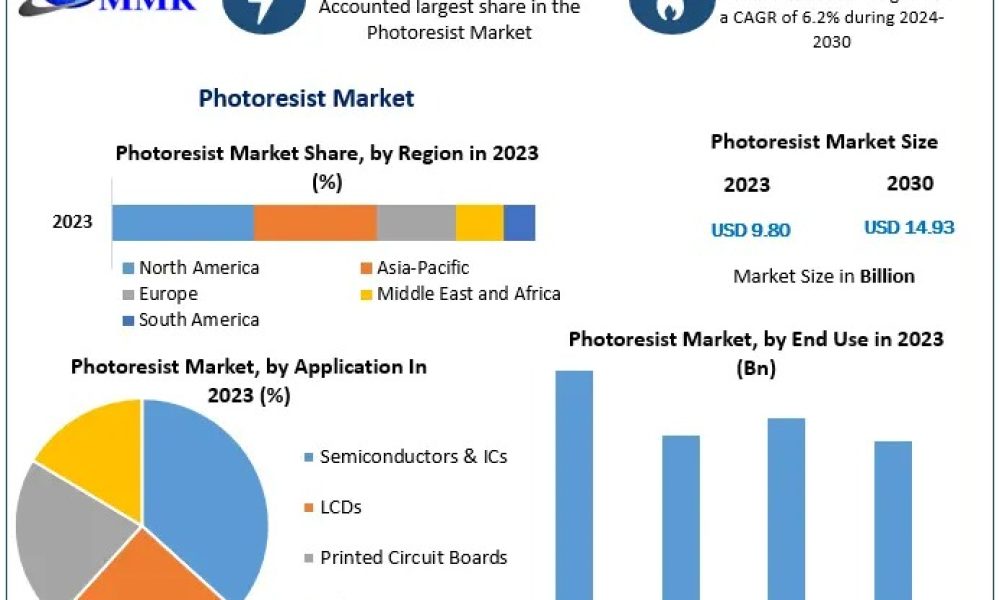
Photoresist Market was valued at approximately USD 9.80 billion in 2023 and is expected to grow to around USD 14.93 billion by 2030, reflecting a compound annual growth rate (CAGR) of about 6.2% during the forecast period from 2024 to 2030.
Photoresist Market Overview
Photoresists are specialized synthetic compounds used primarily in the fabrication of micro- and nano-scale structures, essential in the semiconductor and microelectronics manufacturing industries. These compounds exhibit unique chemical properties when exposed to light, allowing precise patterning during photolithography and etching processes. Photoresists enable the production of high-performance semiconductor chips, integrated circuits (ICs), and microelectromechanical systems (MEMS).
Common photoresist materials include polymethyl methacrylate (PMMA), polymethyl glutarimide (PMGI), phenol-formaldehyde resin (DNQ), and polymers such as SU-8 and OSTE. Photoresists classify broadly into positive and negative types – each working differently but serving similar lithographic precision needs.
Market Dynamics and Growth Drivers
The rapidly increasing demand for semiconductors and electronic devices significantly drives the photoresist market. Expanding use in consumer electronics, PCs, servers, integrated circuits, smartphones, LCD and OLED displays, and other electronic applications underpins market growth. Advances in nanotechnology, fostering convergence of MEMS and nanoelectromechanical systems (NEMS), also fuel demand due to reducing device sizes and increasing complexity.
Technological innovation is ongoing, exemplified by semiconductor manufacturers adopting newer photolithography processes, including ArF immersion technology, to achieve smaller chip dimensions and higher circuit densities. ArF immersion photoresists cater to advanced semiconductor fabrication by enabling finer-resolution patterning essential for next-generation electronics.
Interested in detailed insights? Inquire for a sample report :https://www.maximizemarketresearch.com/request-sample/3587/
Market Segmentation
The photoresist market segments include:
- By Application: Dominated by semiconductors and integrated circuits manufacturing, followed by LCDs and printed circuit board (PCB) production, with expanding use across electronic components.
- By Type: Includes ArF immersion photoresist, ArF dry photoresist, KrF photoresist, and G-line & I-line photoresists. ArF types hold the largest share due to their suitability for advanced lithography and precision manufacturing.
- By End Use: Electronics remain the largest end-use segment, led by consumer devices and enterprise hardware. Other segments include automotive applications, packaging, and miscellaneous uses.
Regional Insights
The Asia Pacific region dominates the photoresist market with nearly 47% market share. This dominance aligns with the region’s leadership in electronics manufacturing, semiconductor production, and strong growth in consumer electronics demand in countries such as China, South Korea, Taiwan, Japan, and India. China represents the world’s largest manufacturing hub for microelectronics, driving substantial photoresist consumption.
North America is expected to grow steadily, leveraging developed semiconductor fabrication capacity, technological innovation, and highly skilled workforces. The U.S. and Canada maintain significant presence in high-end semiconductor manufacturing.
Europe plays a supportive role, with technological contributions and production of specialty photoresist materials, though its share is smaller compared to Asia Pacific.
Market Challenges
The photoresist market faces challenges related to high costs of raw materials and manufacturing complexities. Dependence on petroleum-based compounds results in price volatility, influenced by crude oil market fluctuations. Regulatory restrictions regarding chemical usage, environmental impacts, and safety standards such as those enforced by agencies like EPA and REACH pose compliance burdens.
Manufacturing intricacy increases as semiconductor designs become smaller and more precise, raising the technical barriers for photoresist producers. Limited local manufacturing in developing economies constrains market expansion there due to import duties and logistical complexities.
Competitive Landscape
Key players in the global photoresist market include Tokyo Ohka Kogyo Co., Ltd, JSR Corporation, DuPont, Shin-Etsu Chemical Co., Ltd, Fujifilm Corporation, Sumitomo Chemical, Merck Group, Dow, Micro Resist Technology, and LG Chem. These companies engage aggressively in research and development to enhance photoresist performance and expand production capacity.
Strategies encompass mergers, acquisitions, technological innovation, and broad geographic presence to maintain leadership and meet evolving semiconductor industry demands.
Future Outlook
Driven by the relentless advancement of semiconductor and consumer electronic devices, the photoresist market is positioned for steady growth. Increasing adoption of cutting-edge photolithography techniques and growing demand for smaller, faster, and more energy-efficient semiconductor components propel the market forward.
Dominance of Asia Pacific reflects the region’s centrality in global electronics manufacturing and the adoption of next-generation semiconductor fabrication technologies. Cost challenges and regulatory pressures encourage continued innovation and alternative materials development.
As digital transformation accelerates globally, the photoresist market remains critical to technological progress and will likely experience increasing integration with emerging technologies such as MEMS/NEMS and flexible electronics.




