
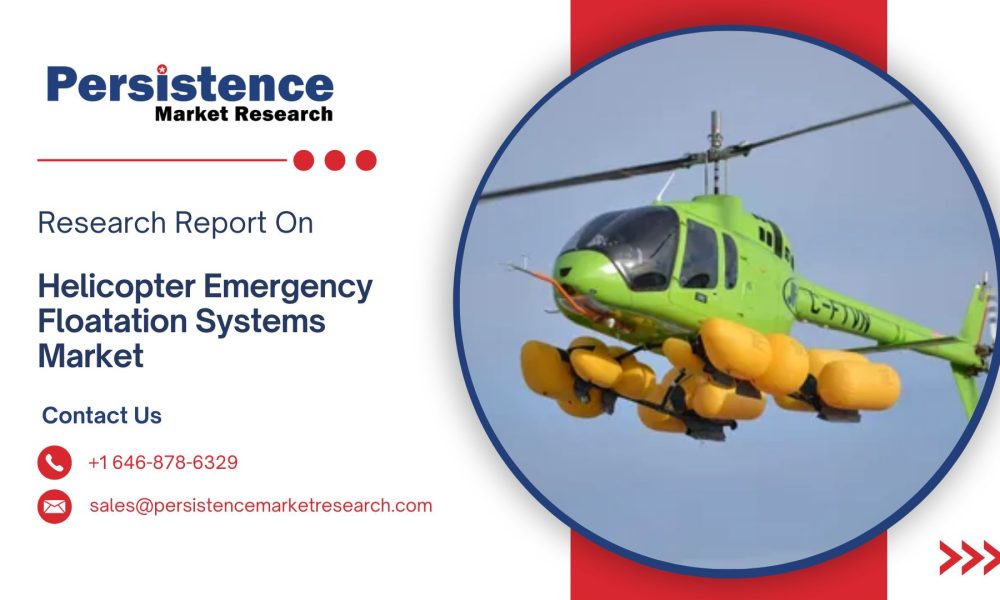
The global helicopter emergency floatation systems market has gained significant traction in recent years owing to its crucial role in ensuring passenger and crew safety during overwater operations. According to Persistence Market Research, the market is projected to reach a valuation of US$ 1.9 Bn in 2025, with strong growth prospects to hit US$ 3.2 Bn by 2032. This reflects a robust CAGR of 7.8% between 2025 and 2032, highlighting the expanding use of helicopters for both civilian and military purposes in maritime and offshore environments.
The market growth is driven by the rising demand for offshore oil and gas exploration activities, increasing military operations over water, and the adoption of stricter aviation safety regulations worldwide. Among product segments, the single-sponson and dual-sponson systems dominate owing to their widespread use in commercial and defense fleets. Geographically, North America is expected to lead the global market, supported by a large fleet of commercial helicopters, strong defense spending, and well-established aerospace infrastructure. This region’s emphasis on aviation safety protocols further strengthens its dominant position in the global landscape.
Get a Sample Copy of Research Report (Use Corporate Mail id for Quick Response): https://www.persistencemarketresearch.com/samples/29083
Key Highlights from the Report
➤ The global helicopter emergency floatation systems market is expected to grow from US$ 1.9 Bn in 2025 to US$ 3.2 Bn by 2032.
➤ Rising offshore oil and gas exploration activities are driving higher adoption of emergency floatation systems for helicopters.
➤ Military applications are projected to account for a significant share due to increased maritime operations and defense spending.
➤ North America is anticipated to remain the leading regional market, backed by strong aviation safety regulations.
➤ Dual-sponson systems continue to dominate the product landscape, ensuring improved stability and safety performance.
➤ Manufacturers are focusing on lightweight, advanced-material-based floatation systems to enhance efficiency and reduce lifecycle costs.
Market Segmentation
The helicopter emergency floatation systems market can be segmented by product type, primarily into single-sponson and dual-sponson systems. Single-sponson floatation systems are valued for their compact design and application in smaller helicopter models, particularly those used in civil and medical emergency services. Dual-sponson systems, on the other hand, are widely deployed in larger helicopters due to their superior stability during water landings, making them the preferred choice for defense and offshore oil and gas operations. The dual-sponson segment is anticipated to hold the largest market share owing to its critical role in commercial aviation safety compliance.
Another important segmentation lies in the end-user spectrum, which can be broadly classified into defense, commercial, and civil operators. Defense applications dominate the market due to the increasing volume of naval operations and maritime surveillance requiring helicopter deployment. Commercial operators, particularly in offshore energy exploration and cargo transport, also represent a significant market segment. The civil end-user group, including medical evacuation services and coast guard operations, continues to grow steadily with increased demand for rapid-response aviation solutions in coastal and island regions.
Regional Insights
Regionally, North America holds the largest market share, attributed to robust investments in both civil and military aviation, coupled with the presence of leading helicopter manufacturers and aerospace suppliers. The region benefits from stringent Federal Aviation Administration (FAA) safety standards, which mandate advanced floatation systems in helicopters operating over water. The U.S. and Canada are at the forefront of adoption, with continuous technological innovations supporting market expansion.
Europe is another key region witnessing substantial growth, driven by its thriving offshore energy exploration sector in the North Sea and increasing reliance on helicopter-based rescue missions. Countries such as the UK, Norway, and Germany are key contributors, ensuring demand for emergency floatation systems remains strong. Additionally, the presence of leading aerospace companies in the region is fueling R&D investments, resulting in lighter, more efficient floatation systems for modern helicopter fleets.
Market Drivers
One of the primary drivers for the helicopter emergency floatation systems market is the surge in offshore oil and gas exploration activities, which demand the use of helicopters for crew transport and logistics support. With many rigs located far from the mainland, ensuring safe water landings becomes essential, thus boosting the demand for advanced floatation systems. Furthermore, increased maritime defense operations by naval forces worldwide have accelerated the adoption of helicopters equipped with reliable emergency safety systems.
Another strong driver is the implementation of stricter aviation safety regulations by international and regional aviation authorities. These safety standards compel operators to invest in advanced floatation systems that comply with the latest norms, ensuring passenger safety during emergencies. Moreover, the rising use of helicopters in search and rescue missions, medical evacuations, and coastal surveillance continues to create strong growth opportunities for manufacturers in this niche but critical aviation safety segment.
Market Restraints
Despite promising growth, the market faces several restraints. The high installation and maintenance costs of helicopter emergency floatation systems present challenges, especially for smaller civil operators with limited budgets. These systems require regular testing and certification to ensure compliance, which can significantly add to operational expenditures.
Another restraint is the limited adoption of helicopters in developing economies, where budget constraints and infrastructure gaps hinder large-scale investment in aviation safety systems. Additionally, the weight and design limitations of helicopters sometimes restrict the deployment of advanced floatation systems, particularly in lightweight helicopter models. These challenges slow down penetration in certain markets despite the growing global emphasis on safety.
Market Opportunities
While restraints exist, the market offers multiple opportunities for growth. Advancements in materials and lightweight composites are opening avenues for the development of next-generation floatation systems that reduce helicopter weight without compromising safety. This is particularly attractive for operators seeking fuel efficiency and improved performance.
Emerging economies in Asia-Pacific and the Middle East also present significant untapped opportunities. Rapid infrastructure development, rising defense budgets, and the expansion of offshore energy exploration in these regions are likely to boost demand for advanced helicopter safety systems. Moreover, the growing focus on autonomous and unmanned aerial systems (UAS) is expected to create new possibilities for integrating emergency floatation solutions tailored to next-gen aviation platforms.
Frequently Asked Questions (FAQs)
➤ How Big is the Helicopter Emergency Floatation Systems Market in 2025 and 2032?
➤ Who are the Key Players in the Global Helicopter Emergency Floatation Systems Market?
➤ What is the Projected Growth Rate of the Market during 2025–2032?
➤ What is the Market Forecast for Helicopter Emergency Floatation Systems by 2032?
➤ Which Region is Estimated to Dominate the Helicopter Emergency Floatation Systems Industry through the Forecast Period?
Company Insights
Key players operating in the helicopter emergency floatation systems market include:
- Dart Aerospace
- Zodiac Aerospace (Safran)
- Aero Sekur
- Robertson Fuel Systems
- Survitec Group Limited
- Switlik Survival Products
- Floats & Fuel Cells, Inc.
Recent Developments
- Manufacturers are increasingly focusing on lightweight floatation systems utilizing composite materials, reducing overall helicopter weight and improving efficiency.
- Several leading companies have introduced integrated safety packages combining floatation systems with life rafts, providing holistic solutions for emergency overwater operations.
Explore more related market insights and reports by visiting our website.




