
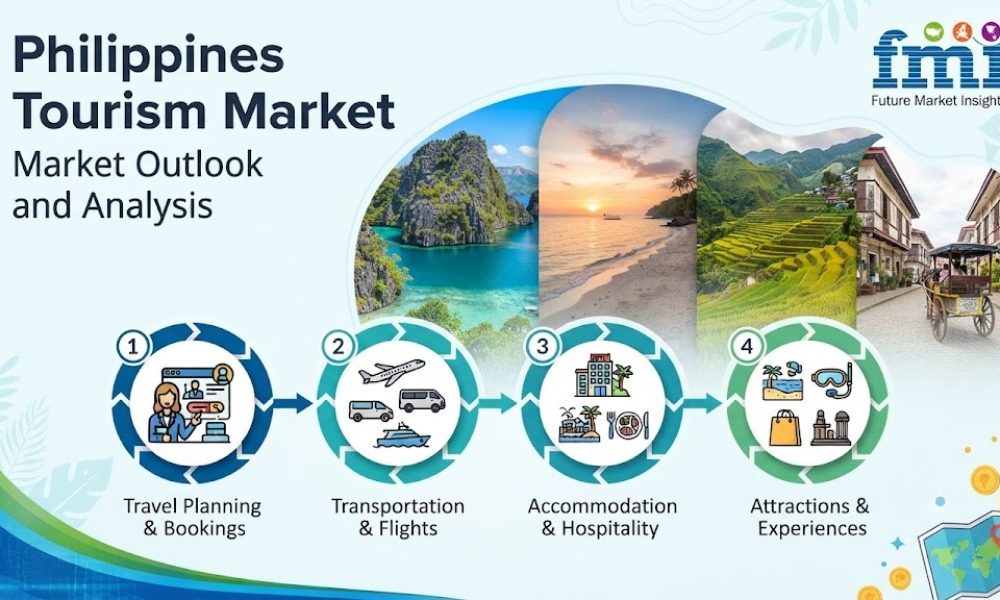
The Philippines tourism market is entering a sustained growth phase as domestic travel, expanding air connectivity, tourism infrastructure investment, and digital booking continue to influence visitor spending. According to Future Market Insights (FMI), the market was valued at USD 82.1 billion in 2025 and is estimated to reach USD 86.5 billion in 2026. It is projected to reach USD 146.4 billion by 2036, expanding at a 5.4% CAGR from 2026 to 2036 and creating an incremental opportunity of USD 59.9 billion during the forecast period.
Domestic travelers are expected to account for 71.8% of visitor type demand in 2026, providing a substantial base for hotels, transportation providers, food services, and local tourism operators. Leisure tourism is forecast to represent 68.4% of tourism demand, supported by island trips, family holidays, and beach destinations. Online booking is expected to capture 57.6% share, as travelers increasingly compare accommodation and transportation options before confirming trips.
Get detailed market forecasts, competitive benchmarking, and pricing trends: https://www.futuremarketinsights.com/reports/sample/rep-pg-3273
Domestic Demand and Leisure Tourism Remain Central to Market Value
Domestic travel is expected to remain a major contributor to tourism spending as local trips help maintain accommodation and service demand beyond international arrival peaks. Accommodation is forecast to represent 34.9% of service-type demand in 2026, reflecting the importance of room availability, pricing, and length of stay in capturing tourism expenditure.
Beach islands are expected to account for 39.2% of destination-type demand, with destinations such as Cebu and Boracay continuing to influence leisure travel patterns. At the same time, cultural sites, urban stays, nature parks, and cruise ports provide opportunities for tourism businesses to diversify visitor itineraries and encourage additional nights and local spending.
Travel demand is also increasingly connected to digital booking. With online booking projected to hold 57.6% share, suppliers with connected accommodation, transportation, and activity inventories can respond more efficiently to travelers comparing options before payment. Travel agencies remain relevant for group tours and long-haul visitors seeking bundled transportation and local support.
Ronak Shah, Principal Consultant for Travel and Tourism at Future Market Insights, observes, “Philippine tourism has moved beyond a simple recovery story. Route access now decides how visitors enter the country. Domestic travel gives the sector a large spending floor. Foreign visitors add higher value when direct flights and hotels align. Suppliers should watch airline capacity and resort room additions closely. Live booking control will decide the next stage of value creation.”
India and China Show Strong Source-Market Growth
Source-market performance is expected to vary according to travel access, visa policies, and visitor-market maturity. India is projected to record an 8.2% CAGR through 2036, the fastest growth among the countries covered in the report. Visa-free access for Indian nationals for stays of up to 14 days is expected to reduce entry barriers and support first-time leisure and family travel.
China is projected to expand at 7.1% CAGR, supported by visa easing and a gradual recovery in group travel. Australia follows at 6.3% CAGR, with beach and diving trips supporting longer stays. Canada is expected to grow at 5.8% CAGR, while the United States is projected at 5.4% CAGR. Japan and South Korea are forecast to expand at 4.9% and 4.1% CAGR, respectively.
Challenges and Opportunities Across the Tourism Supply Chain
While expanding access is supporting demand, shortages of hotel rooms and tourism services can limit spending during peak leisure periods. The market therefore presents opportunities for accommodation developers, airlines, online booking platforms, tour operators, and destination service providers that can address capacity gaps and improve trip coordination.
For tourism suppliers, the ability to combine air access, rooms, transportation, and activities before payment is becoming increasingly relevant. Secondary gateways, new hotel capacity, cruise traffic, and stronger domestic travel provide multiple channels for expanding tourism value across established and emerging destinations.
Access the Complete Report in PDF Format: https://www.futuremarketinsights.com/reports/brochure/rep-pg-3273
Competitive Landscape
The competitive landscape includes airline operators and hotel and resort groups with different areas of market participation. Philippine Airlines, Cebu Pacific, and AirAsia Philippines support domestic and international air connectivity, while Ayala Land Hospitality, Megaworld Hotels and Resorts, SM Hotels and Conventions, and Robinsons Hotels and Resorts contribute accommodation capacity.
Recent developments include AirAsia Philippines reopening three domestic and two international routes through Mactan-Cebu International Airport in August 2025. Cebu Pacific opened bookings for Manila-Riyadh flights in December 2025, with services beginning in March 2026. In May 2026, Megaworld announced plans to open six new hotels across key Philippine destinations within three years.
Report Scope
The Philippines Tourism Market report covers tourism spending by domestic travelers, international tourists, and overseas Filipinos within the Philippines. The analysis includes visitor type, tourism category, booking channel, service type, destination type, and region.
Segments covered include domestic travelers, international tourists, and overseas Filipinos; leisure, business, MICE, medical, and education tourism; online booking, travel agencies, and direct booking; accommodation, transportation, food services, activities, and retail; and beach islands, cultural sites, urban stays, nature parks, and cruise ports.
The report covers the forecast period 2026 to 2036 and provides country-level analysis for India, China, Australia, Canada, the United States, Japan, and South Korea.
Business Impact
FMI helps organizations transform market complexity into strategic clarity, enabling leadership teams to identify growth opportunities faster, optimize resource allocation, strengthen competitive positioning, and make high-stakes business decisions with confidence.
To explore how FMI Custom Research can support your strategic priorities, please connect with our team at – [email protected]
About Future Market Insights (FMI)
Future Market Insights, Inc. (FMI) is an ESOMAR-certified, ISO 9001:2015 market research and consulting organization, trusted by Fortune 500 clients and global enterprises. With operations in the U.S., UK, India, and Dubai, FMI provides data-backed insights and strategic intelligence across 30+ industries and 1200 markets worldwide.



