
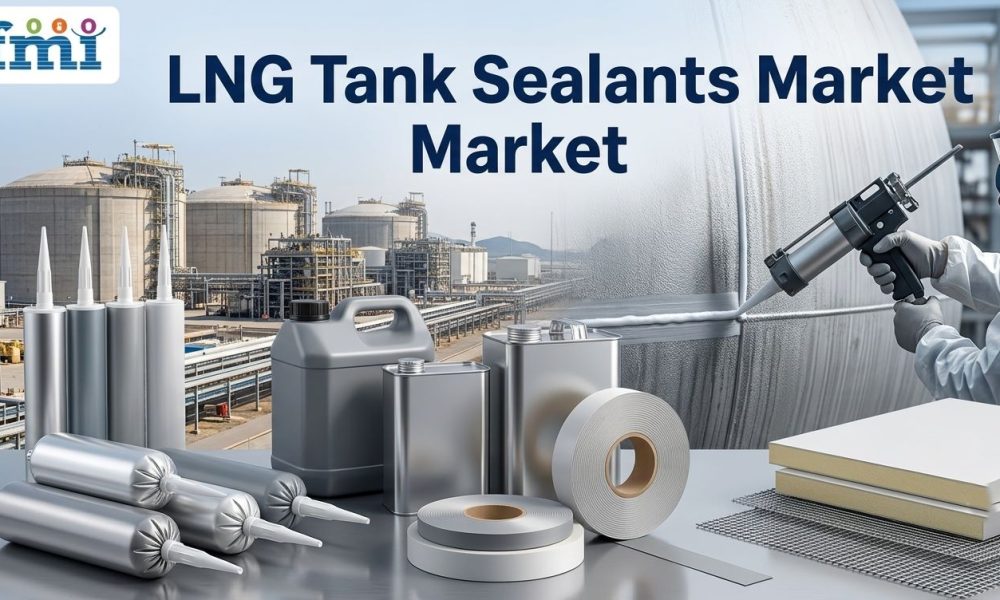
The global LNG tank sealants market is projected to grow from USD 967.6 million in 2026 to USD 1,644.4 million by 2036, advancing at a 5.4% CAGR during the forecast period. Market demand is being supported by LNG infrastructure expansion, new storage tank construction, and recurring maintenance requirements across terminals, carriers, and other LNG facilities.
As LNG projects move through engineering and construction stages, EPC teams evaluate sealants for tank joints, insulation ends, vapor stops, penetrations, and repair points. Cold-service performance, cure control, surface compatibility, and traceable material records influence product approval before procurement and installation.
LNG Tank Sealants Market: Key Growth Drivers
Post-FID LNG projects create demand for specialized sealants well before facilities begin operations. Full containment tanks contain multiple sealing points across layered structures, while operating terminals generate recurring repair requirements.
Polysulfide sealants are estimated to account for 34.0% of chemistry demand, while LNG terminals are expected to represent 31.0% of end-use demand in 2026. These shares reflect the role of elastic sealing systems across LNG infrastructure.
Get detailed market forecasts, competitive benchmarking, and pricing trends: https://www.futuremarketinsights.com/reports/sample/rep-gb-35525
Polysulfide Sealants Lead Chemistry Demand
By chemistry, polysulfide sealants are projected to hold a 34.0% share in 2026, supported by their use in elastic secondary tank joints. Silicone, polyurethane, epoxy, and hybrid cryogenic sealants address different bonding, weather-resistance, and temperature requirements.
By application, full containment tanks are estimated to account for 29.0% of demand in 2026. Their layered construction creates numerous joints requiring controlled sealing and inspection.
LNG Terminals Create Recurring Opportunities
LNG terminals combine large construction programs with long-term maintenance requirements. New tanks require sealing during construction, while operating facilities generate repair demand around insulation ends, openings, and other joints.
Products rated for below -160°C are forecast to account for 37.0% of temperature-rating demand in 2026, reflecting LNG storage conditions near its boiling point. EPC contractors are expected to lead the sales channel with 38.0% share, supported by their role in project specifications and approved product lists.
Country Markets Show Different Growth Patterns
South Korea is projected to record the highest CAGR among profiled countries at 7.2%, followed by Australia at 6.7%, Canada at 6.4%, USA at 6.0%, Germany at 5.7%, France at 5.3%, and Japan at 5.0% through 2036.
South Korea benefits from active LNG storage-tank construction, while Australia combines mature LNG assets with remote maintenance needs. Canada and the USA are supported by expanding LNG infrastructure, whereas Germany, France, and Japan have stronger requirements from existing facilities and planned maintenance.
Access the Complete Report in PDF Format: https://www.futuremarketinsights.com/reports/brochure/rep-gb-35525
Competitive Landscape
The competitive landscape includes PPG, 3M, Sika, Henkel, H.B. Fuller, Bostik, Dow, Wacker Chemie, Trelleborg, and Momentive.
Competition centers on cryogenic performance, sealant breadth, field support, surface compatibility, and geographic reach. 3M, H.B. Fuller, and Trelleborg participate in demanding bonding and marine-interface applications. Sika, Henkel, PPG, and Bostik provide broad adhesive and sealant portfolios, while Dow, Wacker Chemie, and Momentive supply silicone and hybrid formulation options.
“Tank sealant choices start early because approved material lists limit later changes. Suppliers need cold-service proof and traceable batch records. They also need field help for each joint and surface.”
— Nikhil Kaitwade, Principal Consultant, Future Market Insights
LNG Tank Sealants Market: Report Scope
The report covers the market by chemistry, application, end use, temperature rating, sales channel, and region. Chemistry includes polysulfide, silicone, polyurethane, epoxy, and hybrid cryogenic sealants. Applications include full containment tanks, membrane tanks, tank penetrations, joint sealing, and repair or retrofit.
End uses include terminals, carriers, small-scale LNG, peak shaving plants, and bunkering stations. Temperature ratings include below -160°C, -160°C to -100°C, thermal cycling, and fire-safe grades. Sales channels include EPC contractors, tank builders, marine yards, and MRO/distributors.
Business Impact
FMI helps organizations transform market complexity into strategic clarity, enabling leadership teams to identify growth opportunities faster, optimize resource allocation, strengthen competitive positioning, and make high-stakes business decisions with confidence.
To explore how FMI Custom Research can support your strategic priorities, please connect with our team at – [email protected]
About Future Market Insights (FMI)
Future Market Insights, Inc. (FMI) is an ESOMAR-certified, ISO 9001:2015 market research and consulting organization, trusted by Fortune 500 clients and global enterprises. With operations in the U.S., UK, India, and Dubai, FMI provides data-backed insights and strategic intelligence across 30+ industries and 1200 markets worldwide.



