
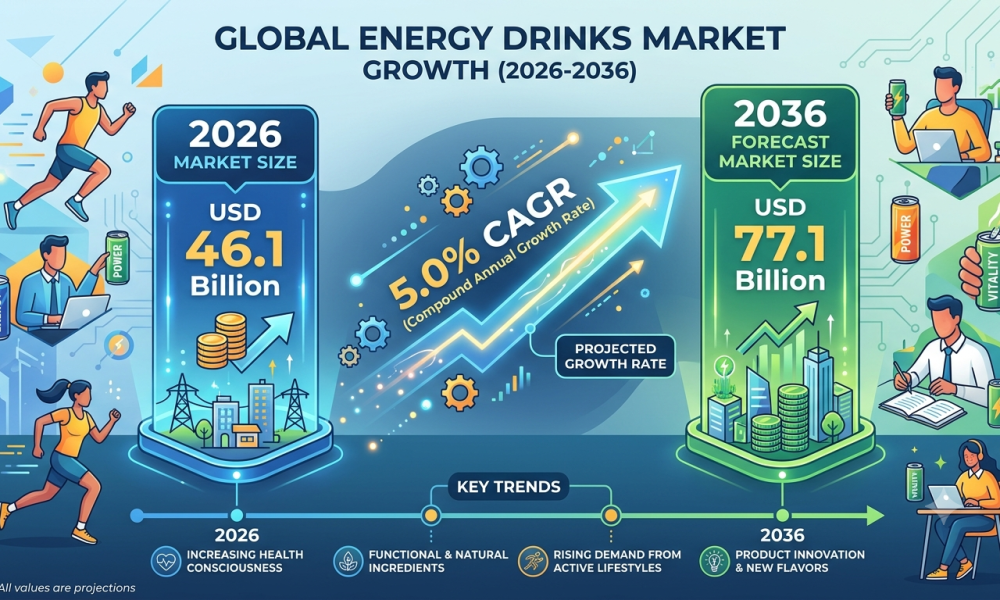
The global energy drinks market is projected to grow from USD 46.1 billion in 2026 to USD 77.1 billion by 2036, registering a 5.0% CAGR during the forecast period. Demand is being supported by zero-sugar choices, flavor innovation, wider chilled availability, and expanding distribution. Product launches are increasingly focused on differentiated formulations and flavors, while retailers continue to emphasize shelf availability and replenishment of fast-moving SKUs.
Zero-sugar innovation is creating additional opportunities for energy drink manufacturers as consumers seek products with reduced or no sugar. Smaller can formats are also supporting trial, portion control, and additional consumption occasions. At the same time, caffeine-related regulations are influencing retail access and compliance requirements in some markets. England, for example, confirmed in July 2026 that sales of high-caffeine energy drinks to under-16s will be prohibited from April 2027, subject to Parliamentary approval.
Get detailed market forecasts, competitive benchmarking, and pricing trends: https://www.futuremarketinsights.com/reports/sample/rep-gb-11625
Global Segment Leaders
- Product Type – Alcoholic Energy Drinks: 52.0% in 2026. The segment leads the product type category, with demand linked to adult consumption occasions and local rules governing alcohol-containing formulations and retail access.
- Nature – Non-Organic: 70.0% in 2026. Wider sourcing flexibility, formulation options, and mainstream price positioning support the segment across mass retail and convenience channels.
Country-Level Performance
The USA is projected to grow at an 8.0% CAGR through 2036, supported by broad distribution and the integration of major energy brands into larger beverage distribution systems. Celsius Holdings reported in August 2026 that its Alani Nu and Rockstar Energy portfolio integration was progressing within the PepsiCo-led distribution system.
Germany is expected to record a 7.0% CAGR, with product communication around caffeine remaining important in a mature retail environment. The EDKAR study published in August 2025 highlighted high energy-drink consumption among adolescents, reinforcing attention to caffeine information and responsible product positioning.
The United Kingdom is forecast to grow at a 6.0% CAGR. England’s planned restrictions on sales of high-caffeine energy drinks to under-16s from April 2027, subject to Parliamentary approval, are expected to influence packaging, retail controls, and marketing practices for affected products.
Japan is projected to record a 5.0% CAGR through 2036. Localized flavor innovation remains an important route to market development. In June 2026, Monster Energy announced Monster Bad Apple, a dry apple-flavored product distributed through Asahi Beverages and launched nationally in Japan on June 30, 2026.
South Korea is expected to grow at a 4.0% CAGR. Caffeine awareness is influencing retail communication, with the Ministry of Food and Drug Safety publishing participating stores for a 2025 youth caffeine-reduction campaign that included major convenience-store chains.
Regional Context
The USA and Germany represent the two fastest-growing profiled country markets, with CAGRs of 8.0% and 7.0%, respectively. The UK follows at 6.0%, while Japan and South Korea are projected to grow at 5.0% and 4.0%. Differences in distribution systems, caffeine-related regulations, local flavor preferences, and retail execution shape country-level growth conditions.
The full report covers North America, Latin America, Western Europe, Eastern Europe, East Asia, South Asia and Pacific, and the Middle East and Africa. Countries profiled individually include the USA, Germany, UK, Japan, and South Korea.
Access full Report in PDF Format: https://www.futuremarketinsights.com/reports/brochure/rep-gb-11625
Competitive Landscape
The competitive landscape includes Red Bull GmbH, Monster Beverage Corporation, PepsiCo Inc., Celsius Holdings Inc., and Keurig Dr Pepper Inc. Competition is shaped by brand strength, portfolio breadth, distribution control, product innovation, zero-sugar offerings, pack-size choices, and retail availability.
Recent developments include Celsius Holdings’ completed integration of Alani Nu and Rockstar Energy into its multi-brand portfolio in August 2026, with Alani Nu transitioned into the PepsiCo distribution system and Rockstar Energy integration completed on its reported nine-month timeline. In February 2026, Keurig Dr Pepper introduced 8.4-ounce GHOST Energy cans alongside its 16-ounce range. Red Bull also launched a reformulated Red Bull Zero across the USA in January 2025, adding another zero-sugar option to its core portfolio.
About Future Market Insights (FMI)
Future Market Insights, Inc. (FMI) is an ESOMAR-certified, ISO 9001:2015 market research and consulting organization, trusted by Fortune 500 clients and global enterprises. With operations in the U.S., UK, India, and Dubai, FMI provides data-backed insights and strategic intelligence across 30+ industries and 1200 markets worldwide.



