
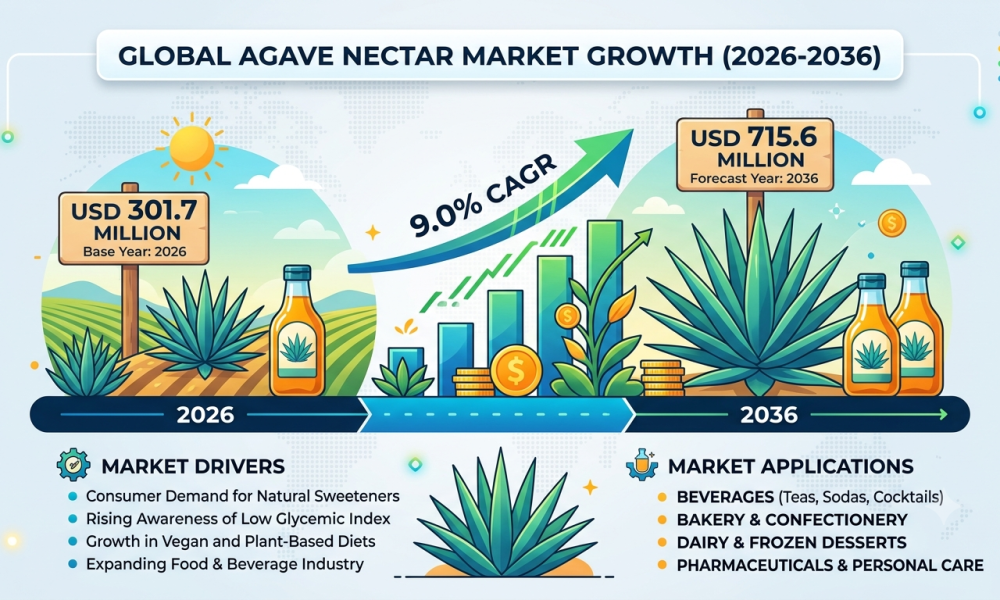
The global agave nectar market is projected to grow from USD 301.7 million in 2026 to USD 715.6 million by 2036, registering a 9.0% CAGR during the forecast period. Demand is supported by the versatility of liquid agave across household sweetening and formulated food applications, growing interest in naturally derived sweeteners, and opportunities created by documented Mexican origin and recognized certification. Agave nectar continues to serve beverages, bakery products, dairy applications, foodservice, and packaged sweetener formats.
Light agave is gaining traction because its milder sensory profile and broad recipe compatibility allow manufacturers to incorporate sweetness without adding a pronounced cooked agave flavor. Retail and bulk formats also enable suppliers to serve both consumer and ingredient channels. At the same time, added-sugar disclosure requirements are influencing reformulation decisions, creating a need for suppliers to demonstrate clear sensory, sourcing, and application value.
Get detailed market forecasts, competitive benchmarking, and pricing trends: https://www.futuremarketinsights.com/reports/sample/rep-gb-2478
Global Segment Leaders
- Product Type – Light Agave: 62.0% in 2026. The segment leads due to its mild sensory profile and wider recipe compatibility, supporting use across beverages, bakery, dairy, foodservice, and other applications.
- Nature – Conventional Agave: 56.0% in 2026. Conventional agave remains prominent as buyers seek the base sweetening function without the additional certification requirements associated with organic products.
Country-Level Performance
Japan is projected to record the fastest growth among the profiled markets, with an 11.0% CAGR through 2036. Growth is supported by a defined import route for Mexican agave syrup under Japan’s 2026 tariff-allocation framework and continued opportunities across specialty-food applications.
The United States is forecast to grow at a 9.0% CAGR, supported by established branded retail and formulated-food channels. Agave is used both as a packaged sweetener and as an ingredient, although FDA guidance on added sugars creates additional considerations for formulations targeting lower declared sugar levels.
The United Kingdom is projected to expand at a 9.0% CAGR through 2036. Bakery and foodservice applications continue to support demand, while beverage manufacturers face changing sugar-related requirements that influence the economics of using caloric sweeteners.
South Korea is expected to grow at a 9.0% CAGR, with broader nutrition-labeling requirements increasing visibility of sugar content in packaged foods. Suppliers need accurate nutrition information when agave is evaluated for specialty and functional food formulations.
Germany is projected to record an 8.0% CAGR through 2036. Specialty-food and organic channels provide opportunities for differentiated agave products, while national sugar-reduction initiatives are encouraging manufacturers to assess sweetness solutions based on both formulation performance and nutritional considerations.
Regional Context
Japan represents the fastest-growing country among the profiled markets at 11.0% CAGR, followed by the United States, United Kingdom, and South Korea at 9.0% each. Germany records an 8.0% CAGR. Differences in growth reflect variations in import mechanisms, food labeling requirements, reformulation priorities, specialty-food channels, and consumer demand.
The broader market covers North America, Latin America, Western Europe, Eastern Europe, East Asia, South Asia and Pacific, and the Middle East and Africa. The report provides country-level analysis across Japan, the United States, the United Kingdom, South Korea, Germany, and more than 20 additional countries.
Access full Report in PDF Format: https://www.futuremarketinsights.com/reports/brochure/rep-gb-2478
Competitive Landscape
The competitive landscape includes Wholesome Sweeteners, Inc., NOW Health Group, Inc. dba NOW Foods, Madhava Natural Sweeteners, Sustainable Agave Ltd dba The Sustainable Agave Company, Brass Products Ltd dba Brass Products, Lot 49, LLC dba Box 7 Imports, Essex Food Ingredients, Tate & Lyle PLC, Ingredion Incorporated, and Cargill, Incorporated.
Competition spans direct branded agave suppliers, certified agave-syrup specialists, ingredient distributors, and broader sweetener platforms. Competitive activity is shaped by product certification, origin documentation, pack formats, formulation breadth, retail availability, and the ability to support applications affected by sugar-reduction requirements.
Recent developments include Wholesome Sweeteners shipping Organic Agave Nectar with Hot Chili Peppers in May 2026 as a flavored extension of its certified agave line. In December 2025, Sustainable Agave Ltd received CCOF USDA NOP and Handling certification with agave syrup included in the certified scope. Brass Products Ltd also received CCOF Handling and USDA NOP certification plus US/Canada Equivalence for agave syrup trade in December 2025.
Analyst Perspective
“Agave nectar earns repeat orders when suppliers match sweetness with verifiable origin and the pack format required by the application. The main trade-off is straightforward: buyers accept a caloric syrup where flavor or sourcing value outweighs the pressure to remove added sugar.”
— Nandini Roy Choudhury, Principal Consultant, Future Market Insights.
About Future Market Insights (FMI)
Future Market Insights, Inc. (FMI) is an ESOMAR-certified, ISO 9001:2015 market research and consulting organization, trusted by Fortune 500 clients and global enterprises. With operations in the U.S., UK, India, and Dubai, FMI provides data-backed insights and strategic intelligence across 30+ industries and 1200 markets worldwide.



