
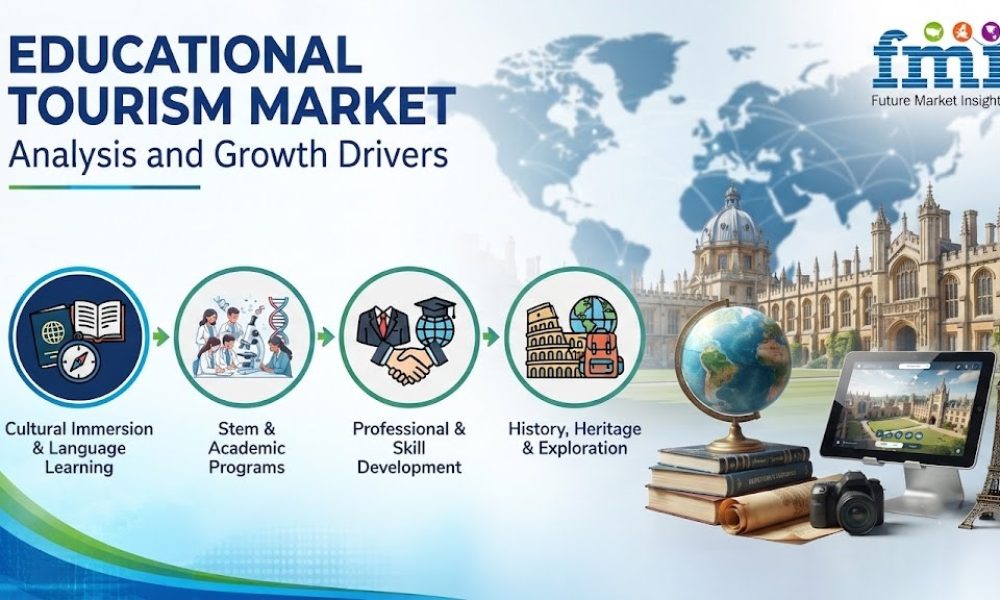
The global educational tourism market is projected to expand from USD 75.46 billion in 2025 to USD 432.43 billion by 2036, registering a 17.2% CAGR from 2026 to 2036, according to Future Market Insights (FMI). The market is expected to reach approximately USD 88.4 billion in 2026, with academic programs accounting for 45.0% of the service segment as degree-seeking enrollment, language immersion, and structured academic exchange programs continue to shape demand.
The market’s expansion is closely linked to increasing international student mobility and the diversification of educational travel beyond conventional study-abroad models. Government investment in international education exchange programs, university internationalization strategies, and scholarship initiatives are creating structured demand channels. At the same time, the combination of digital learning with in-person cultural experiences is supporting hybrid educational tourism formats.
Get detailed market forecasts, competitive benchmarking, and pricing trends: https://www.futuremarketinsights.com/reports/sample/rep-gb-13880
International Student Mobility Supports Market Expansion
The continued movement of students across borders is generating demand for services spanning academic enrollment, accommodation, travel, cultural activities, language learning, and professional development. Educational tourism providers are increasingly serving participants who seek both formal qualifications and international exposure.
Academic programs remain the largest service category, holding a 45.0% share in 2026. This reflects the established role of degree-seeking enrollment and semester-exchange programs in educational travel spending. Language learning, English-language programs, foreign-language immersion, university exchanges, certification courses, and skill-based learning are adding further depth to the service landscape.
Short-term programs are also gaining traction as providers address demand for language workshops, cultural immersion, professional development, and skills-based experiences. These formats can attract students as well as professionals and lifelong learners seeking international exposure without committing to a full academic year abroad.
Experiential Learning Broadens the Addressable Market
Educational tourism is increasingly extending into experiential and skills-based travel. Cultural exchange, heritage learning, STEM learning tours, technology workshops, technical training, professional courses, and field research are becoming part of the broader educational travel ecosystem.
This diversification is creating opportunities for providers that can combine academic content with destination experiences and supporting services. Online pre-arrival and post-program engagement is also emerging as a competitive differentiator, while integrated offerings covering visa support, accommodation, safety logistics, and cultural activities can address multiple requirements within the student mobility journey.
However, the market remains exposed to visa processing delays, policy changes, geopolitical tensions, and destination-switching behavior. These factors can influence enrollment decisions and create volatility across international education destinations. Providers with multi-destination portfolios can respond by offering greater flexibility across markets.
France Leads Country Growth at 23.2% CAGR
Country-level performance indicates strong expansion across major European educational tourism destinations.
- France is projected to register a 23.2% CAGR through 2036, supported by established academic institutions, cultural heritage assets, international connectivity, and government-supported international education programs.
- Italy is expected to grow at 21.5% CAGR, supported by university exchange programs, cultural heritage infrastructure, and experiential education demand.
- Spain is projected to record a 19.8% CAGR, driven by study-abroad programs, language learning travel, university exchange activity, and cultural immersion.
- Germany is forecast to expand at 14.6% CAGR, with demand supported by university exchanges, research mobility, language learning, and cultural education.
- USA is projected to grow at 12.9% CAGR, reflecting international student mobility, university exchange activity, and structured academic travel programs.
Policy Changes Create New Market Considerations
Regulatory developments are becoming an important factor in destination planning. In January 2025, Canada capped study permits for 2025 at 437,000, down 10% year over year, and subsequently reduced its 2026 target to 408,000. Australia also announced plans to cap new international student commencements at 270,000 for 2025.
Such policy measures demonstrate how changes in international student intake can influence educational travel flows and reinforce the importance of destination diversification for market participants.
Competitive Landscape
The educational tourism market includes overseas education counselors, international education organizations, educational travel operators, and specialized program providers.
Meridean Overseas, EF Education First, and CIEE (Council on International Educational Exchange) maintain competitive positions through destination portfolios, university partnerships, program diversity, and geographic reach. WorldStrides and Kaplan International compete through regional expertise and program specialization, while Study Group, American Institute For Foreign Study (AIFS), Road Scholar, Explorica, and Academic Programs International (API) participate across specialized educational travel segments.
Competitive priorities include geographic expansion, broader program portfolios, university partnerships, cost optimization, and adaptation to evolving regulatory requirements.
Access the Complete Report in PDF Format: https://www.futuremarketinsights.com/reports/brochure/rep-gb-13880
Report Scope
The Educational Tourism Market report covers 2026 to 2036 and analyzes the market by service, program duration, participant type, age group, booking mode, accommodation type, application, and region.
Services covered include academic programs, language learning, university exchange programs, study abroad programs, skill-based learning, and experiential learning. Program duration includes short-term, medium-term, and long-term programs. Regions covered are North America, Latin America, Europe, East Asia, South Asia and Pacific, and Middle East & Africa, with analysis spanning more than 30 countries.
Business Impact
FMI helps organizations transform market complexity into strategic clarity, enabling leadership teams to identify growth opportunities faster, optimize resource allocation, strengthen competitive positioning, and make high-stakes business decisions with confidence.
To explore how FMI Custom Research can support your strategic priorities, please connect with our team at – [email protected]
About Future Market Insights (FMI)
Future Market Insights, Inc. (FMI) is an ESOMAR-certified, ISO 9001:2015 market research and consulting organization, trusted by Fortune 500 clients and global enterprises. With operations in the U.S., UK, India, and Dubai, FMI provides data-backed insights and strategic intelligence across 30+ industries and 1200 markets worldwide.



