
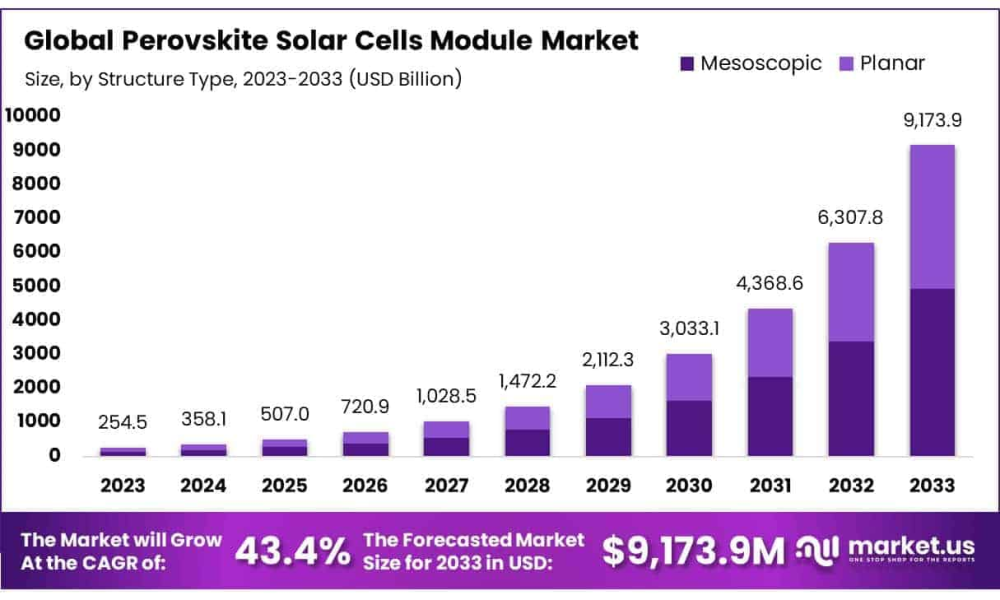
New York, NY – July 07, 2025 – The Global Perovskite Solar Cells Module Market is projected to expand from approximately USD 254.45 million in 2023 to around USD 9,173.94 million by 2033, representing a robust compound annual growth rate (CAGR) of 43.4% between 2024 and 2033.
This surge in demand can be attributed to several key factors: perovskite materials exhibit excellent light absorption, high charge mobility, and compatibility with cost-effective fabrication techniques such as roll-to-roll printing, making them appealing alternatives to traditional silicon modules. The popularity of Perovskite Solar Cells Modules is rising as researchers and manufacturers report efficiency breakthroughs and enhanced stability, driving investor interest and pilot production initiatives worldwide.
The expansion of the Perovskite Solar Cells Module Market is further supported by the growing adoption across diverse applications from rigid utility-scale panels to flexible modules used in building-integrated photovoltaics, portable systems, and consumer electronics, creating multiple avenues for growth. Significant opportunities exist in tandem solar cells, transparent modules for smart infrastructure, and regions with supportive renewable energy policies. Overall, the market demand is underpinned by global sustainability goals and the need for scalable, affordable, and efficient solar solutions, positioning perovskite solar modules for transformative deployment over the next decade.
Important Revelation
- The global perovskite solar cells module market was valued at US$ 254.45 million in 2023.
- The global perovskite solar cells module market is projected to reach US$ 9,173.94 million by 2033.
- Among structure type, the mesoscopic held the majority of the revenue share at 53.9%.
- Based on product types, flexible accounted for the largest market share with 61.8%.
- Among types, single junction accounted for the majority of the perovskite solar cells module market share with 62.9%.
- Among technologies, solution method accounted for the majority of the perovskite solar cells module market share with 59.2%.
- Among applications, solar panel accounted for the majority of the perovskite solar cells module market share with 42.9%.
- Based on end-uses, the utility dominated the market with a share of 42.0%.
➤ Download Exclusive Sample Of This Premium Report (Including Full TOC, Table & Figures): https://market.us/report/perovskite-solar-cells-module-market/request-sample/
Report Segmentation
Structure Type Analysis
- The perovskite solar cells market module market is divided into mesoscopic and planar structure types. In 2023, mesoscopic PSCs captured the largest revenue share at 53.9%, driven by their exceptional performance and manufacturing advantages over planar types. Mesoscopic PSCs deliver higher power conversion efficiencies due to their enhanced light harvesting and charge collection capabilities. The mesoporous layer increases the internal surface area, enabling more efficient electron transport and collection, which significantly boosts overall cell efficiency.
Product Type Analysis
- The perovskite solar cells market is segmented into rigid and flexible product types, with flexible PSCs holding the majority share at 61.8% in 2023. Their dominance stems from their lightweight, bendable nature and adaptability for diverse applications. Flexible PSCs are fabricated on substrates like plastic, metal foil, or flexible glass, enabling their use in portable electronics, wearable devices, and unconventional surfaces such as vehicle roofs, building facades, and textiles. This versatility expands their application beyond traditional rigid solar panels.
Type Analysis
- The perovskite solar cells market is categorized into single-junction and multi-junction PSCs, with single-junction cells commanding a 63.3% market share in 2023 due to their simpler design, cost-effectiveness, and high efficiency. Single-junction PSCs feature a single perovskite layer that absorbs sunlight and converts it into electricity, offering a less complex and more scalable design compared to multi-junction cells. This simplicity reduces production costs, making them economically viable for mass production and commercial use.
Technology Analysis
- The perovskite solar cells market is segmented by technology into solution method, vapor-assisted solution method, and vapor-deposition method. In 2023, the solution method held the largest share at 47.6%, driven by its simplicity, cost-effectiveness, and scalability. The solution method involves dissolving perovskite precursors in a solvent and depositing them onto a substrate, requiring minimal equipment and lower energy inputs compared to other methods. Its compatibility with flexible substrates, such as plastics, metals, and glass, makes it ideal for both rigid and flexible PSC modules.
Application Analysis
- The perovskite solar cells market is divided by application into smart glass, building-integrated photovoltaics, solar panels, and others. In 2023, solar panels accounted for the largest share at 42.9%, driven by their alignment with mainstream energy needs, high efficiency, and scalability. Perovskite-based solar panels offer lower production costs and comparable or superior efficiency compared to traditional silicon panels, making them highly attractive for utility-scale and residential applications. The global push for renewable energy, supported by clean energy policies, has fueled demand for PSCs in solar panels.
Market Key Segmentation
By Structure Type
- Mesoscopic
- Planar
By Product Type
- Rigid
- Flexible
By Type
- Single Junction
- Multi Junction
By Technology
- Solution Method
- One-step
- Two-step
- Vapor-Assisted Solution Method
- Vapor-Deposition Method
By Application
- Smart Glass
- Building-Integrated Photovoltaics
- Solar Panel
- Others
By End-User
- Residential
- Commercial
- Industrial
- Utility
Geopolitical Impact Analysis
Geopolitical tensions disrupt the perovskite solar cells market by imposing trade restrictions, tariffs, and sanctions that affect the global supply chain for critical raw materials, such as lead and rare elements, essential for PSC production. These disruptions, often stemming from conflicts involving key material suppliers, lead to delays and increased costs, hindering manufacturers’ ability to produce PSC modules efficiently and competitively. For example, trade barriers between major renewable energy markets like the U.S., China, and Europe can restrict access to vital components, escalating production costs.
As the PSC industry is still in its developmental phase, it relies heavily on research and development (R&D) to enhance cell efficiency, durability, and scalability. Geopolitical tensions can limit international collaboration by restricting scientific exchanges, joint funding, or access to cutting-edge technologies from leading research hubs in Europe, North America, and Asia. This lack of cooperation slows innovation, delaying the commercialization and widespread adoption of PSCs. Additionally, trade barriers and sanctions increase the cost of imported machinery, chemicals, and equipment, further complicating large-scale PSC manufacturing.
Regional Analysis
Asia-Pacific commanded the largest share of the perovskite solar cells module market at 59.5%, driven by the rapid expansion of industries such as packaging, commercial printing, and labels. The region’s dominance is fueled by robust industrialization and urbanization in countries like China, India, and Southeast Asia, where demand for high-quality packaging has surged across consumer goods, food and beverage, pharmaceuticals, and e-commerce sectors.
China, the world’s leading manufacturer and exporter of consumer goods, significantly drives PSC module demand due to its large-scale production capabilities and growing need for durable, visually appealing packaging solutions. The rise of e-commerce has further amplified the need for protective packaging with premium varnishing to ensure product safety and brand differentiation.
Japan and South Korea also bolster the region’s market leadership with their advanced printing technologies and high-tech industries. These countries prioritize innovation in printing techniques, leveraging varnishing to produce aesthetically superior and durable packaging, further solidifying Asia-Pacific’s dominant position in the PSC module market.
Competitive Landscape
- Hanwha Group
- Toshiba Corporation
- CubicPV
- Greatcell Energy
- Oxford Photovoltaics Ltd
- EneCoat Technologies Co., Ltd
- Swift Solar
- Solaronix SA
- Saule Technologies
- Tandem PV, Inc.
- Hangzhou Microquanta Co. Ltd.
- Perovskia Solar AG
- Front Materials Co. Ltd
- P3C Technology and Solutions Pvt. Ltd.
- Other Key Players
Get in Touch with Us:
Market.us (Powered By Prudour Pvt. Ltd.)
Address: 420 Lexington Avenue, Suite 300, New York City, NY 10170, United States
Send Email: [email protected]
Refer To More Related Reports:



