
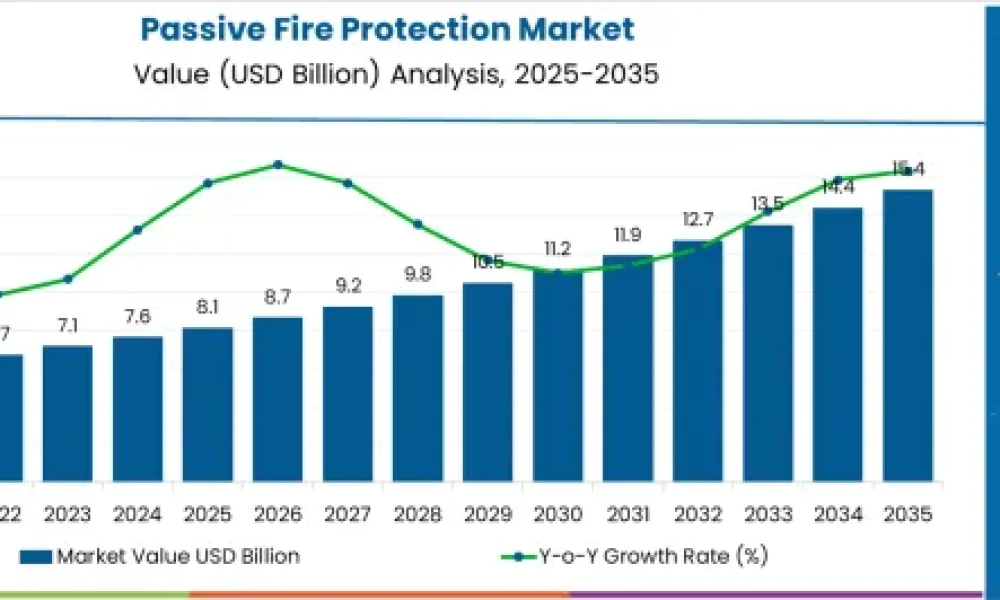
The global passive fire protection (PFP) market is projected to grow from USD 8.1 billion in 2025 to USD 15.4 billion by 2035, reflecting a compound annual growth rate (CAGR) of 6.6%, according to the latest market analysis. The expansion is being driven by stricter fire safety regulations, rising construction and infrastructure activity, and increased awareness of life safety and asset protection across industrial and commercial sectors.
Passive fire protection systems—designed to contain fires, slow structural failure, and limit the spread of flames and smoke—are increasingly mandated by building codes and safety standards worldwide. Unlike active systems, PFP solutions are integrated directly into structures through materials such as fire-resistant coatings, insulation, boards, and barriers.
To access the complete data tables and in-depth insights — Request Your Sample Report Now
Market Growth Accelerates Early, Then Stabilizes Through 2035
Between 2025 and 2030, the market is expected to grow from USD 8.1 billion to USD 11.2 billion, generating USD 3.1 billion in incremental value at a CAGR of 7.2%. This early-phase acceleration reflects heightened regulatory enforcement and adoption across construction, manufacturing, and oil and gas industries.
From 2030 to 2035, the market is forecast to expand further to USD 15.4 billion, adding USD 4.2 billion in value at a slightly moderated 6.0% CAGR. This phase signals market maturation, with growth supported by retrofit projects, continued compliance requirements, and technological advances in fire-resistant and environmentally aligned materials.
Regulatory Compliance and Urban Development Drive Market Expansion
The primary growth driver for the passive fire protection market is the tightening of fire safety regulations across infrastructure, industrial, and energy sectors. Governments and regulatory bodies are prioritizing systems that enhance evacuation safety, protect load-bearing structures, and limit economic losses from fire incidents.
Rapid urbanization and the development of high-rise and vertical infrastructure have increased reliance on materials that meet updated fire-resistance codes. Insurance incentives, structural safety audits, and disaster risk reduction policies are further accelerating adoption in public infrastructure and commercial real estate.
At the same time, investments in non-combustible, thermally insulating, and lightweight materials—along with innovations in low-VOC and water-based coatings—are reshaping product selection criteria, particularly in green-certified and sustainability-focused projects.
Intumescent Coatings Lead Product Demand
By product type, intumescent coatings are projected to account for 36.8% of global market revenue in 2025, making them the leading segment. These coatings expand when exposed to high temperatures, forming an insulating char layer that delays structural failure, especially in steel-intensive buildings.
Their compatibility with both new construction and retrofit applications, combined with ease of application and compliance with evolving fire-resistance standards, has driven widespread adoption. Ongoing research into environmentally improved formulations is further supporting demand across multiple industries.
Structural Applications and Construction Dominate End Use
By application, structural fire protection is expected to represent 31.4% of total revenue in 2025, driven by mandatory fireproofing of beams, columns, floors, and other load-bearing components. Passive systems integrated into structural elements are increasingly required to delay collapse and enable safe evacuation during fire events.
By industry, building and construction is forecast to hold 42.1% of the total market share in 2025, supported by fire safety compliance across residential, commercial, and institutional projects. High-density housing, transport hubs, and smart buildings are incorporating passive fire protection systems at the design and material stages to meet regulatory and insurance requirements.
Asia-Pacific Leads Growth, While OECD Markets Show Stability
Regionally, North America, Asia-Pacific, and Europe remain the key growth regions. Among individual countries, China leads with a projected 8.9% CAGR, followed by India at 8.3%, reflecting rapid construction growth and stricter fire safety enforcement. France is forecast to grow at 6.9%, while the United Kingdom and United States are expected to expand at 6.3% and 5.6%, respectively, driven by steady regulatory-driven demand and retrofit activity.
Competitive Landscape and Market Scope
The passive fire protection market includes major global suppliers such as 3M, Lloyd, Sherwin-Williams Company, Hempel, Nullifire, Etex SA, Saint-Gobain, Siniat International, and Promat International. These companies focus on fire-resistant coatings, insulation systems, fire-rated boards, and integrated solutions designed to meet regional and international safety standards.
The market spans products including intumescent coatings, sealants, foams and boards, mortars, cementitious sprays, and putties, serving applications across structural protection, compartmentation, opening protection, and firestopping. Coverage includes North America, Europe, Asia-Pacific, Latin America, and the Middle East & Africa.
As regulatory scrutiny intensifies and infrastructure investment continues, passive fire protection systems are expected to remain a critical component of global building and industrial safety strategies through 2035.
Have a specific Requirements and Need Assistant on Report Pricing or Limited Budget please contact us – [email protected]
About Future Market Insights (FMI)
Future Market Insights, Inc. (FMI) is an ESOMAR-certified, ISO 9001:2015 market research and consulting organization, trusted by Fortune 500 clients and global enterprises. With operations in the U.S., UK, India, and Dubai, FMI provides data-backed insights and strategic intelligence across 30+ industries and 1200 markets worldwide
Why Choose FMI: https://www.futuremarketinsights.com/why-fmi



