
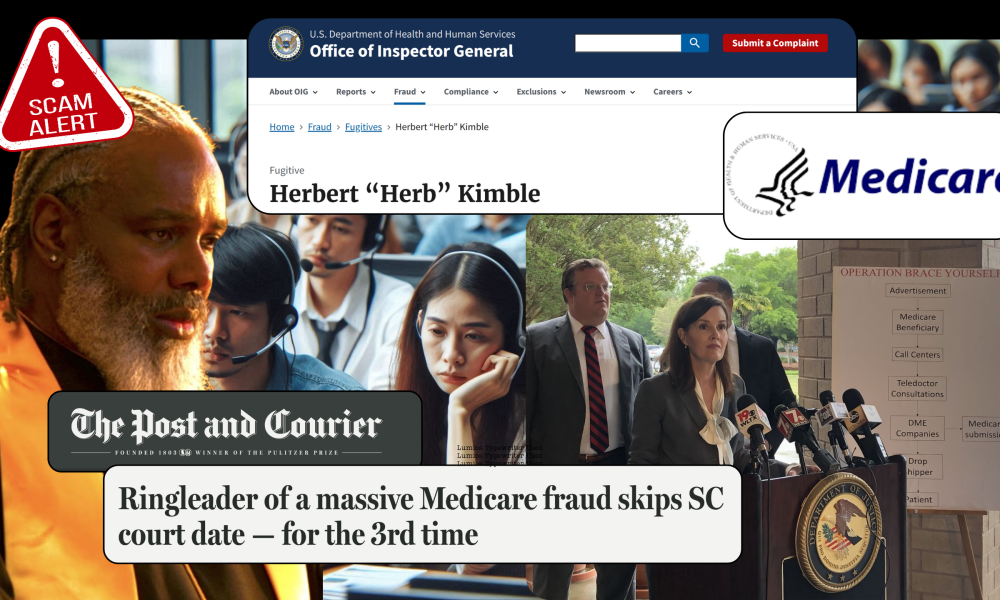
COLUMBIA, S.C. — The image is seared into memory: a nearly empty federal courtroom in Columbia, South Carolina, on a hot August morning in 2024. Judge Joseph F. Anderson, Jr. peered over his glasses, scanned the room, and delivered the line that captured the exasperation of the U.S. justice system: “Houston, do we have a problem?” The prosecutor answered flatly: “We do.”
The problem was not new. It had been five years in the making. Herb Kimble, once hailed as the government’s star cooperator in the dismantling of a billion-dollar Medicare fraud conspiracy, had failed to appear. Again. His $5 million bond had been revoked. A bench warrant was issued. And yet the man who once promised to pay $40 million in restitution and face sentencing was already thousands of miles away in the Philippines, outside the immediate reach of U.S. law.
Kimble’s transformation from convicted fraudster to fugitive highlights both the ingenuity of a seasoned white-collar operator and the systemic vulnerabilities of the justice system itself. What was supposed to be a carefully structured release designed to guarantee cooperation instead became a roadmap for escape. His case raises questions that reverberate far beyond South Carolina: how should prosecutors balance the need for insider testimony against the risk of releasing a mastermind, and how far can the promise of cooperation justify leniency?
A Fraud of National Scale
To understand the stakes of Kimble’s release, it is necessary to revisit the magnitude of his crimes. Between 2014 and 2019, Kimble orchestrated what investigators dubbed “Operation Brace Yourself.” The scheme relied on a network of offshore call centers, domestic telemedicine doctors, medical equipment suppliers, and straw company owners.
From their bases in the Philippines, Kimble’s call center employees bombarded American seniors with television and internet ads promising “free” back, knee, or shoulder braces covered by Medicare. When interested callers responded, operators confirmed their eligibility and routed them to doctors willing to issue prescriptions without examinations. These doctors, often compensated through kickbacks, signed off on braces sourced from low-cost Chinese manufacturers. The equipment suppliers were many, controlled by Kimble through hidden ownership and then billed Medicare at inflated rates.
At its height, the scheme spanned South Carolina, Florida, California, New Jersey, Texas, and Pennsylvania. Federal officials estimate that more than $1 billion in fraudulent Medicare claims were generated. Prosecutors described it as one of the largest healthcare fraud conspiracies in U.S. history.
The victims were not abstract. Elderly beneficiaries, some homebound, received braces they did not need or never requested. Others were billed for multiple devices. Taxpayers bore the ultimate cost, as fraudulent claims drained public funds from a program designed to support seniors.
The 2019 Plea Agreement
By early 2019, the weight of evidence against Kimble was overwhelming. Federal investigators had seized bank accounts, intercepted communications, and traced corporate structures back to him. Facing charges that carried decades in prison, Kimble struck a deal.
In March 2019, he pleaded guilty to conspiracy to commit healthcare fraud, violating the anti-kickback statute, and defrauding the government. The plea agreement contained two central promises: he would cooperate fully with federal prosecutors nationwide, and he would pay $40 million in restitution at sentencing. In exchange, the government agreed to recommend leniency.
The cooperation clause was critical. Kimble’s testimony and documents were expected to unlock cases against dozens of other defendants. Prosecutors acknowledged they could not have reached many of those individuals without his assistance. The restitution clause was equally important, offering taxpayers some measure of financial redress.
With the plea in place, the next question was whether Kimble would remain behind bars pending sentencing.
The Bond That Opened the Door
On April 4, 2019, Magistrate Judge Shiva Hodges issued an order setting Kimble’s conditions of release. The terms looked standard but carried extraordinary weight given the scope of the case.
Kimble was required to:
Surrender his passport and refrain from seeking new travel documents.
Report regularly to Pretrial Services and submit to supervision.
Avoid excessive alcohol use and narcotics.
Refrain from contacting witnesses.
Appear in court whenever required.
He also had to post a $5 million bond.
The order warned that any violation could result in immediate arrest, forfeiture of the bond, new felony charges, and additional consecutive prison time. Yet for all the stern language, the release gave Kimble something far more valuable than money: time and mobility.
Notably, prosecutors had initially suggested releasing him on personal recognizance, citing his voluntary return to the United States from the Philippines as evidence of good faith. Judge Hodges rejected that proposal, insisting on a financial tether. Years later, Judge Anderson would recall that moment with skepticism, noting that prosecutors had shown “such confidence” in the defendant that they had nearly let him walk free without posting a dime.
The $5 million bond was significant but not insurmountable. For a man tied to a billion-dollar conspiracy with offshore assets, it was little more than a cost of doing business.
An Offshore Safety Net
Kimble’s offshore ties were not incidental; they were central to his strategy. His call centers in Manila and Cebu had been indispensable to the fraud, connecting U.S. seniors with complicit doctors. Those centers remained active hubs of communication and revenue.
The Philippines also provided a crucial legal buffer. Although the country has an extradition treaty with the United States, enforcement is notoriously inconsistent. White-collar defendants often use the Philippine court system to delay extradition for years, filing constitutional appeals, jurisdictional challenges, and repeated motions. Political winds can further complicate the process; during the presidency of Rodrigo Duterte, U.S. requests in white-collar cases faced particular resistance.
For Kimble, who had voluntarily returned to the United States for his plea, the Philippines remained both a fallback option and a familiar base. He had staff, offices, and financial channels there. The infrastructure that enabled the fraud also offered him refuge.
Cooperation and Convictions
For several years, the government’s gamble seemed to pay off. Kimble’s cooperation yielded sweeping results. Prosecutors credited him with enabling charges against at least 80 defendants nationwide. Doctors, equipment suppliers, and telemedicine executives faced indictments. Luxury assets, including yachts and exotic cars, were seized.
By 2022, federal prosecutors filed a sentencing memorandum recommending probation. The rationale was blunt: without Kimble, many of the convictions would have been impossible. His testimony had unlocked corporate structures, identified hidden owners, and explained the inner workings of the fraud. The government argued that his cooperation, coupled with his promised $40 million restitution, justified extraordinary leniency.
That recommendation reflected the trade-off at the heart of the plea. Prosecutors secured convictions across the country, but in return, they had to trust the man at the center of it all.
The Restitution Illusion
By 2023, cracks began to appear. Financial disclosures suggested Kimble’s net worth was closer to $27 million, far short of the $40 million restitution promised. Judge Anderson pressed defence counsel on the discrepancy. James Griffin admitted the shortfall, explaining that much of Kimble’s wealth was overseas and illiquid.
Prosecutors grew uneasy. Assistant U.S. Attorney Amy Bower, who inherited the case, requested a status conference in August 2024 to address what she delicately called “developments.” Chief among them was the realization that the restitution promise might collapse.
For a plea deal built on cooperation and cash, the missing $13 million was more than an accounting issue; it was a structural failure.
The Empty Chair
On August 27, 2024, Kimble was ordered to appear in Columbia for the status conference. He did not show. His defence counsel told the court he was in “constant communication” with Kimble and assured the judge he would return within a week.
Judge Anderson was unconvinced. “He has the wherewithal to buy a plane ticket,” the judge observed dryly. At the prosecutor’s request, Anderson issued a bench warrant for Kimble’s arrest and revoked the $5 million bond.
The warrant was decisive but late. Kimble was already in the Philippines.
A Pattern of Defiance
The August hearing was not the end of Kimble’s defiance. On November 7, 2024, he again failed to appear for his sentencing. Prosecutors argued that his repeated absences constituted material breaches of his plea agreement. He had violated his bond conditions, failed to comply with supervision, and failed to deliver restitution.
Judge Anderson agreed, declaring the government’s obligations under the plea void. The probation recommendation was off the table. Kimble now faced the maximum statutory sentence.
Defence counsel admitted that contact had become sporadic. Days before the hearing, he had received a cryptic email from Kimble’s account, stating only that he would not be boarding his flight. Beyond that, there was silence.
Judicial Frustration
The courtroom exchanges captured the mounting frustration. Judge Anderson openly criticized the notion that a U.S. citizen could defraud taxpayers of nearly $800 million and then find refuge in a country shielded by American defence commitments. He noted the irony that the Philippines, a treaty ally dependent on U.S. military protection, resisted extraditing someone who had fleeced U.S. taxpayers.
Prosecutors explained that while extradition was technically possible, Philippine courts offered defendants countless avenues for delay. Even with a friendlier political administration in Manila, the process could take years. The government began exploring an INTERPOL Red Notice, which would flag Kimble if he travelled beyond Philippine borders, but admitted that bringing him back would be a challenge.
Victims Left Behind
For the victims of Kimble’s scheme, his absence was devastating. Elderly Medicare beneficiaries had been misled into ordering braces they did not need. Some received multiple shipments. Others were left confused by complex billing statements.
Taxpayers, too, bore the burden. By late 2024, prosecutors had secured nearly $800 million in restitution orders across related cases. Yet Kimble personally delivered only about $7.75 million, a fraction of the $40 million promised and far below the $230 million prosecutors argued he owed.
The victims saw little relief. Advocacy groups expressed outrage that while co-conspirators served prison time, the mastermind remained free overseas. “It tells seniors that fraud is just part of the system, and it tells criminals that if you play the game right, you can walk away,” one advocate said.
Systemic Lessons
The collapse of Kimble’s bond raises larger questions about the justice system’s handling of high-value cooperators.
Bond strategy was a central weakness. A $5 million stake, significant on paper, was dwarfed by Kimble’s offshore assets. Electronic monitoring, asset freezes, or stricter travel restrictions might have reduced his ability to flee.
Restitution promises proved illusory. Courts and prosecutors placed immense weight on the $40 million pledge. When it failed, the plea unravelled.
Extradition vulnerabilities were underestimated. The Philippines, central to Kimble’s operations, offered him protection through procedural delays. Prosecutors knew this, but allowed him to remain tied to that jurisdiction.
Judicial patience, while understandable, was stretched too far. Continuances, delays, and indulgences extended Kimble’s freedom until accountability was no longer enforceable.
A System Outmaneuvered
By the end of 2024, Kimble’s story had shifted. No longer the government’s cooperative witness, he was now a fugitive. The man who once testified against his partners in fraud had himself escaped accountability.
His disappearance was not dramatic. There was no midnight escape or cinematic flight. It was bureaucratic, incremental, and entirely predictable. Each postponed hearing, each delayed payment, each missed appearance eroded the system’s control until nothing remained.
The empty chair in Judge Anderson’s courtroom symbolized more than one man’s absence. It symbolized the risk of a system that places too much trust in those who have built careers on deception.
For Kimble, bail and bond were not shackles but opportunities. Opportunities to maneuver, to delay, and finally, to disappear. For taxpayers and victims, the result was not just financial loss but a loss of confidence in the very system designed to protect them.
Kimble’s case will remain a cautionary tale. A reminder that cooperation must never eclipse accountability. A warning that a bond is only as strong as the safeguards behind it. And a lesson that once trust is extended to a career fraudster, it may never be recovered.




