
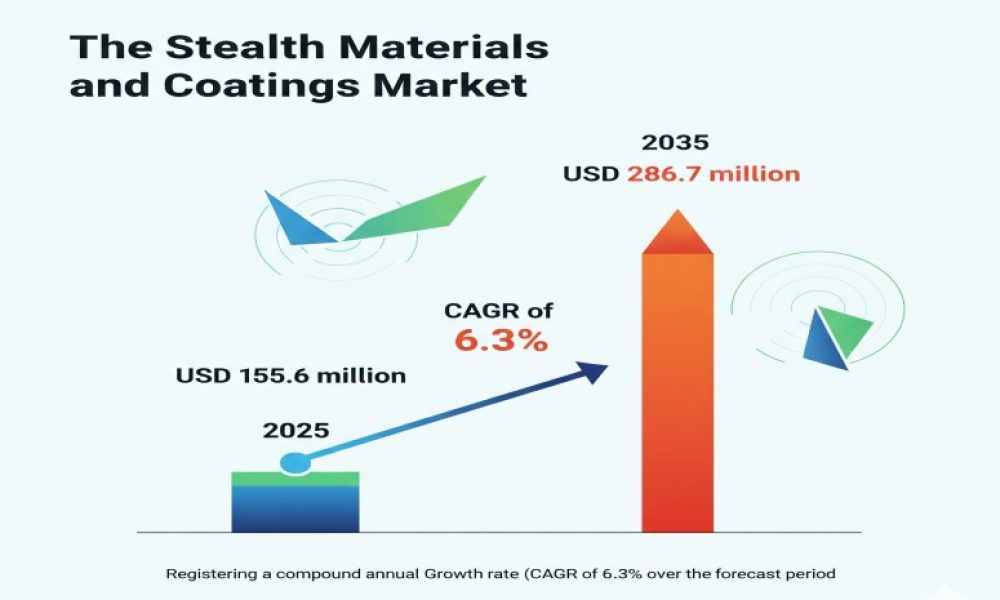
The global Stealth Materials and Coatings Market is entering a decade of transformation, with its value projected to rise from USD 155.6 million in 2025 to USD 286.7 million by 2035, reflecting a robust CAGR of 6.3%. This growth signals not only the expansion of defense modernization programs but also a new wave of collaboration between established aerospace and defense leaders and innovative new manufacturers shaping next-generation stealth technologies.
A Market Built on Adoption, Expansion, and Consolidation
From 2020 to 2025, the market saw steady acceleration growing from USD 114.7 million to USD 155.6 million—driven by defense programs investing in radar-absorbing coatings and low-observable materials for advanced aircraft and naval platforms.
Between 2026 and 2030, the pace quickens, with market size expanding from USD 165.4 million to USD 211.2 million. This surge is attributed to widespread retrofits on legacy fleets and procurement of unmanned systems, both of which require advanced signature reduction.
Access the Full Market Report Instantly. Request Purchase or Tailored Insights Here.
https://www.futuremarketinsights.com/reports/sample/rep-gb-24609
Post-2030, the growth curve shows a moderated yet consistent trajectory. By 2035, the market is forecast to reach USD 286.7 million, with demand fueled by steady replacement needs, maintenance programs, and upgrades as fleets worldwide adopt stealth-compatible solutions.
This shift from rapid adoption to consolidation highlights a maturing market where both established players and newcomers will find opportunities to innovate, scale, and specialize.
Why Demand is Accelerating
The momentum in the stealth materials and coatings market is driven by three converging factors:
- Defense Modernization: Nations are upgrading fleets with stealth-enabled platforms to ensure survivability in contested environments.
- Material Innovation: Advances in composites, nanotechnology, and multifunctional coatings enable lighter, more durable, and more effective solutions.
- Geopolitical Tensions and Rising Defense Budgets: Governments worldwide are increasing investments in stealth technology to maintain strategic advantage.
Notably, stealth coatings are no longer limited to high-profile fighter jets—they are being adopted across naval ships, UAVs, and even armored ground vehicles, widening the scope of applications.
Key Market Segments Driving Growth
- Radar Absorbing Materials (RAM): Holding a projected 30% share in 2025, RAM leads the material segment. By converting radar energy into heat or scattering it away from detection systems, RAM plays a pivotal role in reducing radar cross-sections of aircraft, naval vessels, and vehicles. Advances in lightweight polymer composites ensure RAM’s dominance continues through the forecast period.
- Aerospace Applications: Expected to command 46% of market revenue in 2025, aerospace remains the largest application segment. Fighter jets, UAVs, and bombers increasingly rely on stealth coatings that reduce radar and infrared signatures while withstanding extreme aerodynamic stress. As defense forces invest in next-gen aircraft and drone technologies, aerospace will remain the backbone of demand.
- Naval and Vehicle Integration: Stealth coatings are also penetrating naval fleets and ground vehicles. Ships are being upgraded with radar-absorbing paints and tiles, while tanks and armored vehicles are adopting infrared-suppressive coatings to improve battlefield survivability. These expansions highlight the market’s cross-domain appeal.
Regional Growth Hotspots
Global demand is distributed across advanced and emerging defense markets, with China and India leading growth.
- China: CAGR of 8.5% – driven by indigenous stealth fighter and UAV programs, and rapid expansion of naval fleets.
- India: CAGR of 7.9% – fueled by modernization of air and naval assets, supported by government offset programs with global suppliers.
- France & UK: 6.6% and 6.0% respectively, reflecting European R&D investments and modernization programs.
- USA: 5.4% CAGR – steady growth anchored in next-gen aircraft programs and naval upgrades.
Established Players Driving Innovation
Northrop Grumman, Lockheed Martin, BAE Systems, and Raytheon Technologies are maintaining leadership positions through cutting-edge material science, platform-level integration, and long-term defense contracts.
- Northrop Grumman focuses on multi-spectral stealth solutions across aircraft and UAVs.
- Lockheed Martin leverages proprietary coatings for flagship programs like next-gen fighter jets.
- BAE Systems combines expertise in naval stealth with advanced polymeric composites.
- Raytheon Technologies delivers radar- and infrared-suppressive coatings backed by strong R&D.
These companies continue to invest heavily in scaling production, advancing material chemistry, and expanding collaborations with defense agencies worldwide.
Grab Your Complimentary PDF Copy of This Report!
https://www.futuremarketinsights.com/reports/brochure/rep-gb-24609
A Market of Collaboration and Opportunity
The next decade will see an ecosystem defined by collaboration between established defense contractors and specialized material innovators. Governments are also emphasizing localized supply chains, encouraging both global giants and regional startups to invest in domestic production.
This creates a two-fold opportunity:
- For established manufacturers: To leverage their scale, global reach, and advanced R&D to dominate procurement programs.
- For new entrants: To innovate rapidly in areas like adaptive camouflage, nanostructured coatings, and lightweight composites, carving niches that complement larger players.
About Future Market Insights (FMI)
Future Market Insights, Inc. (ESOMAR certified, recipient of the Stevie Award, and a member of the Greater New York Chamber of Commerce) offers profound insights into the driving factors that are boosting demand in the market. FMI stands as the leading global provider of market intelligence, advisory services, consulting, and events for the Packaging, Food and Beverage, Consumer Technology, Healthcare, Industrial, and Chemicals markets. With a vast team of over 400 analysts worldwide, FMI provides global, regional, and local expertise on diverse domains and industry trends across more than 110 countries.



