
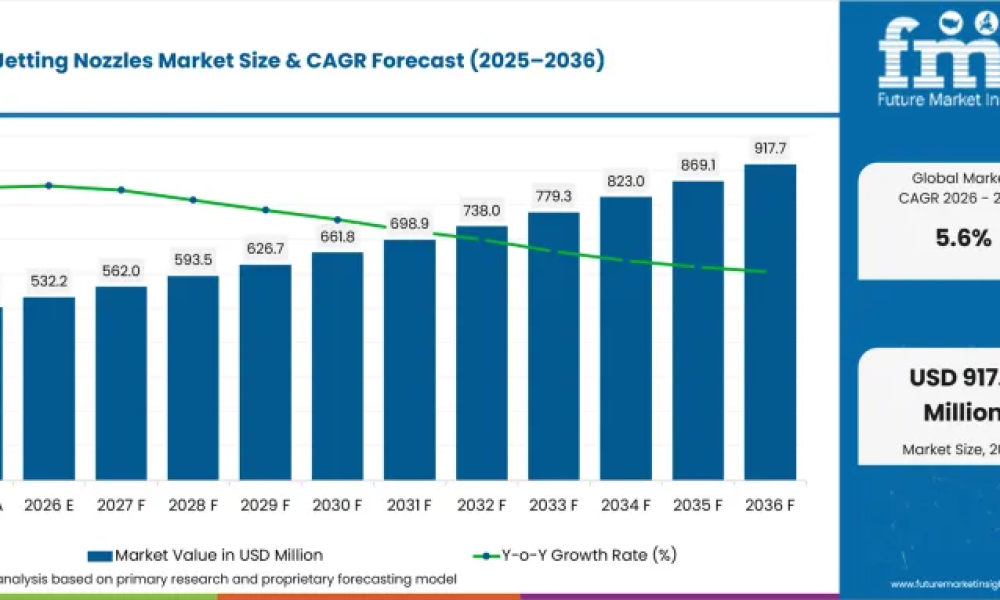
According to Future Market Insights (FMI), the Sewer Jetting Nozzles Market is positioned for steady growth as municipalities and sewer-service contractors continue to prioritize preventive cleaning, blockage removal, and network maintenance. The market is projected to grow from USD 532.2 million in 2026 to USD 917.7 million by 2036, expanding at a 5.6% CAGR throughout the forecast period.
Recurring sewer-line cleaning provides a consistent demand base for jetting nozzles, as municipalities and contractors require replacement components to maintain cleaning performance across fleets. Unlike larger capital equipment purchases, nozzle demand can follow routine maintenance schedules and recurring line-access requirements.
Get Detailed Market Forecasts, Competitive Benchmarking, and Pricing Trends: https://www.futuremarketinsights.com/reports/sample/rep-gb-34705
Why Sewer Jetting Nozzles Are Becoming Critical to Sewer Network Maintenance
Municipal wastewater networks require regular cleaning to reduce blockages and maintain hydraulic performance between major rehabilitation projects. High-pressure water jetting remains an important maintenance approach, with nozzle selection influencing water flow, pressure utilization, cleaning coverage, and overall productivity.
Flushing nozzles are estimated to account for 24.0% of demand in 2026, while 2,000–4,000 psi nozzles hold 39.0% and stainless-steel nozzles represent 36.0% of material demand.
The need for recurring cleaning is reinforced by sewer overflow risks. USA EPA guidance updated in April 2026 estimates that 23,000 to 75,000 sanitary sewer overflows occur annually and identifies blockages as one contributing cause. This ongoing risk encourages municipalities to maintain routine cleaning programs even when budgets for major infrastructure rehabilitation are constrained.
“Sewer jetting nozzles benefit from a maintenance cycle that is more frequent than the capital replacement cycle for complete drain-cleaning equipment. Municipalities and contractors need reliable nozzle performance to maintain cleaning productivity, but hydraulic compatibility remains critical. A mismatch between nozzle design, pressure, flow, and equipment can reduce the productivity gains expected from high-pressure jetting.”
— Nikhil Kaitwade, Principal Consultant, Future Market Insights
Sewer Jetting Nozzles Market Snapshot
- Market Size (2026): USD 532.2 million
- Forecast Value (2036): USD 917.7 million
- CAGR (2026–2036):6%
- Flushing Nozzles:0% of nozzle demand in 2026
- 2,000–4,000 psi:0% of pressure-range demand
- Stainless Steel:0% of material demand
- Primary Demand Driver: Recurring sewer-line cleaning
- Key Market Challenge: Hydraulic mismatch can reduce expected productivity gains
Methodology: https://www.futuremarketinsights.com/methodology
What’s Driving Near-Term Demand?
Preventive Sewer-Line Cleaning
Municipalities increasingly rely on preventive cleaning programs to reduce the probability of blockages, backups, and sanitary sewer overflows. Regular jetting allows operators to address accumulated material before it develops into more severe network restrictions.
This recurring maintenance activity provides a stable demand base for sewer jetting nozzles and replacement components.
Persistent Sewer Overflow Risks
Sanitary sewer overflows remain a concern for wastewater network operators. The USA EPA’s April 2026 guidance estimates 23,000 to 75,000 sanitary sewer overflows annually, with blockages identified as one contributing cause.
Such risks can encourage municipalities to maintain cleaning programs even when major rehabilitation projects are delayed by capital constraints. As a result, nozzle consumption can continue through routine maintenance rather than depending entirely on large infrastructure investments.
High-Pressure Jetting Applications
The 2,000–4,000 psi segment accounts for 39.0% of demand in 2026, highlighting the importance of high-pressure operating ranges in sewer-cleaning applications.
Pressure and flow requirements vary according to pipe conditions, blockage characteristics, equipment capabilities, and cleaning objectives. Selecting a nozzle that matches the available hydraulic system is therefore important to maintaining effective cleaning performance.
Stainless Steel Supports Durable Applications
Stainless steel accounts for 36.0% of material demand in 2026, reflecting the importance of durable nozzle construction in demanding sewer-cleaning environments.
Nozzles are repeatedly exposed to high-pressure water, abrasive debris, and challenging operating conditions. Material selection therefore remains an important consideration for municipalities and contractors managing recurring cleaning operations.
Market Outlook Through 2036
The Sewer Jetting Nozzles Market is expected to create an incremental opportunity of approximately USD 385.5 million between 2026 and 2036, increasing from USD 532.2 million to USD 917.7 million.
The market’s 5.6% CAGR reflects the recurring nature of sewer maintenance and the need for replacement nozzles across municipal and contractor fleets. Flushing nozzles represent 24.0% of demand, while 2,000–4,000 psi nozzles account for 39.0%, demonstrating the importance of established cleaning configurations.
Stainless steel’s 36.0% share further highlights the demand for durable components capable of operating repeatedly in demanding wastewater-maintenance conditions.
A key limitation remains hydraulic mismatch. Differences between nozzle requirements and the pressure, flow, and pump characteristics of existing jetting equipment can reduce cleaning effectiveness and undermine expected productivity improvements. This makes application-specific nozzle selection important when municipalities and contractors replace or upgrade components.
Overall, recurring sewer cleaning, blockage prevention, and the need to maintain network performance are expected to support sustained demand for sewer jetting nozzles through 2036.
About the Sewer Jetting Nozzles Market Report
Future Market Insights’ Sewer Jetting Nozzles Market report provides a comprehensive assessment of market growth, nozzle types, pressure ranges, materials, applications, regional developments, competitive dynamics, and future opportunities through 2036.
The report spans 250 pages and examines the evolution of sewer jetting nozzle demand amid preventive wastewater-network maintenance and recurring cleaning requirements.
About Future Market Insights (FMI)
Future Market Insights, Inc. (FMI) is an ESOMAR-certified, ISO 9001:2015 market research and consulting organization, trusted by Fortune 500 clients and global enterprises. With operations in the U.S., UK, India, and Dubai, FMI provides data-backed insights and strategic intelligence across 30+ industries and 1200 markets worldwide.
Contact Us:
Future Market Insights Inc.
Christiana Corporate, 200 Continental Drive,
Suite 401, Newark, Delaware – 19713, USA
T: +1-347-918-3531



