
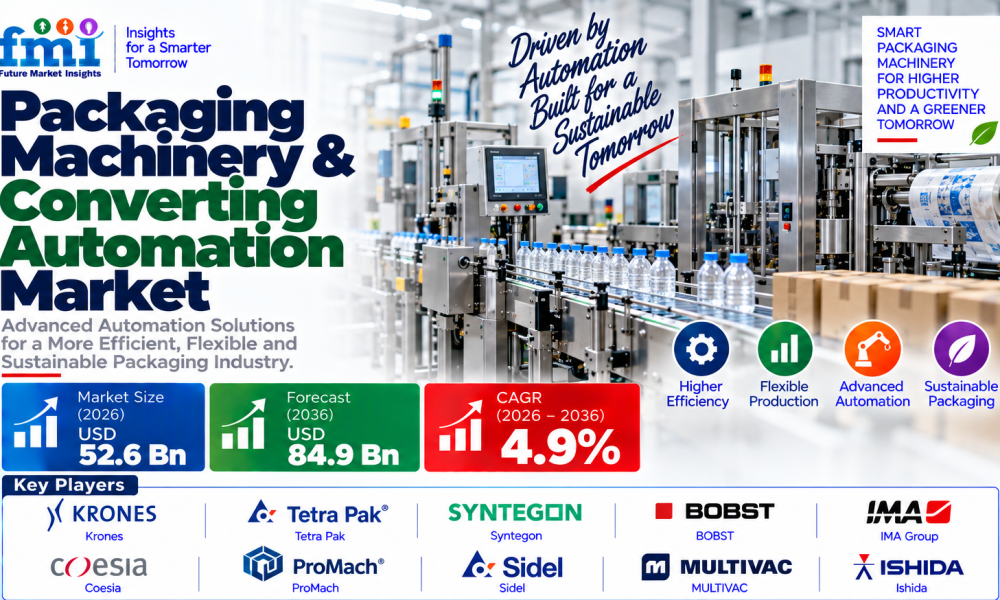
The global Packaging Machinery & Converting Automation Market is projected to reach USD 84.9 billion by 2036, rising from USD 52.6 billion in 2026 at a 4.9% CAGR, according to Future Market Insights (FMI). The market was valued at USD 50.1 billion in 2025.
Packaging machinery demand is increasingly tied to operational requirements rather than automation adoption alone. Manufacturers are evaluating equipment based on throughput, changeover performance, sanitation, installation timelines, acceptance testing, and post-commissioning service support.
>> Get Detailed Market Forecasts, Competitive Benchmarking, and Pricing Trends: https://www.futuremarketinsights.com/reports/sample/rep-gb-33941
Filling & Sealing Accounts for 34.0% of Machine Type Demand
Filling & Sealing is projected to hold a 34.0% share of the machine type segment in 2026.
These systems directly connect product dosing with package closure, making dosing accuracy and seal integrity important during every production run.
Food and beverage manufacturers in particular need machinery that can maintain repeatable output while handling changes in product viscosity, package formats, and production recipes.
For equipment buyers, supplier demonstrations are increasingly being followed by application-specific trials to verify performance at the package sizes and production conditions that matter most to the plant.
Fully Automatic Equipment Holds a 63.0% Share
Fully Automatic systems are projected to account for 63.0% of the automation level segment in 2026.
Fully automatic equipment can reduce manual transfers across feeding, inspection, and packaging stages while supporting predictable cycle control during multi-shift production.
Labor availability is another consideration. Plants facing operator shortages are evaluating automated feeding and inspection where repeated manual handoffs can affect consistency.
However, automation does not eliminate the need for operator involvement. Controlled stops, safe restart procedures, recipe management, and recovery protocols remain important during format changes and production interruptions.
Food Leads End-use Demand at 39.0%
Food is expected to represent 39.0% of end-use demand in 2026.
Food production combines hygiene requirements with frequent product and package changes. Short shelf-life windows can make downtime particularly costly when a production line stops during a changeover.
Packaging machinery therefore needs to provide more than rated speed.
Food processors evaluate cleanability, seal consistency, inspection records, tool-change time, and the ability to restore validated production settings after a format change.
Throughput Protection Drives Equipment Investment
FMI identifies throughput protection during frequent package changes and sanitation stops as a key demand driver.
Automatic recipe settings and inspection controls can help plants reduce variation during recurring production changes.
At the same time, capital approval and planned shutdown requirements remain important restraints. Replacing equipment inside an operating plant can require significant downtime and changes to upstream conveyors or controls.
This is creating space for retrofit and modular automation.
A plant may add a robotic case-packing or palletizing cell instead of replacing an entire packaging line. Phased upgrades can limit shutdown exposure while adding automation to selected production stages.
Converting and Printing Requires Different Equipment Priorities
Packaging machinery demand extends beyond filling and sealing.
Converters evaluate print registration, web handling, waste control, and format flexibility when reviewing machinery for short runs or mixed material structures.
This creates a different supplier-selection process from that used by food processors.
While food plants may prioritize sanitation and seal performance, converting operations may place greater emphasis on print quality, web stability, changeover efficiency, and material handling.
The broader market therefore includes filling and sealing, cartoning and case packing, labeling and coding, converting and printing, and palletizing and robotics.
Regional Growth Varies Across Major Markets
Among the profiled countries, India is projected to grow at a 6.9% CAGR from 2026 to 2036, followed by China at 6.2% and Brazil at 5.4%.
Italy is projected at 4.1%, the United States at 4.3%, Germany at 3.9%, and Japan at 3.6%.
India and China are seeing opportunities linked to new production capacity and expanding manufacturing clusters.
In Germany and Japan, established installed bases make replacement projects more dependent on controlled acceptance testing, safety records, maintenance planning, and compatibility with existing equipment.
Brazilian projects place greater importance on regional distributor coverage and local installation support when imported machinery is involved.
👉 Access the Complete Report in PDF Format: https://www.futuremarketinsights.com/reports/brochure/rep-gb-33941
Service and Commissioning Are Part of the Purchase Decision
Packaging machinery remains a long-term capital asset, making post-installation support an important part of supplier evaluation.
Engineering teams increasingly review:
- Installation timelines
- Acceptance criteria
- Operator training
- Parts availability
- Local service coverage
- Controller access
- Safe restart procedures
- Integration with existing machinery
A machine that meets its rated output during a demonstration still needs to perform within the customer’s actual production environment.
This makes commissioning accountability and application engineering important competitive factors.
Competitive Landscape
The market includes integrated line providers, converting specialists, automation suppliers, and end-of-line equipment companies.
Key companies profiled by FMI include Krones, Tetra Pak, Syntegon, BOBST, IMA Group, Coesia, ProMach, Sidel, MULTIVAC, and Ishida.
Recent industry activity includes Krones presenting integrated filling and packaging lines at drinktec 2025, while Tetra Pak introduced Factory OS to connect real-time production information across food and beverage equipment.
The competitive environment increasingly depends on application fit, integration capability, commissioning support, and regional service capacity alongside machinery specifications.
As packaging plants manage more frequent format changes and tighter production schedules, machinery investment is increasingly being evaluated as a complete operating system rather than as an isolated equipment purchase.
To explore how FMI Custom Research can support your strategic priorities, connect with our team at – [email protected]
About Future Market Insights (FMI)
Future Market Insights, Inc. is an ESOMAR-certified, ISO 9001:2015 market research and consulting organization trusted by Fortune 500 companies. With a global presence across the U.S., UK, India, and Dubai, FMI delivers data-driven insights across 30+ industries and 1200 markets worldwide.



