
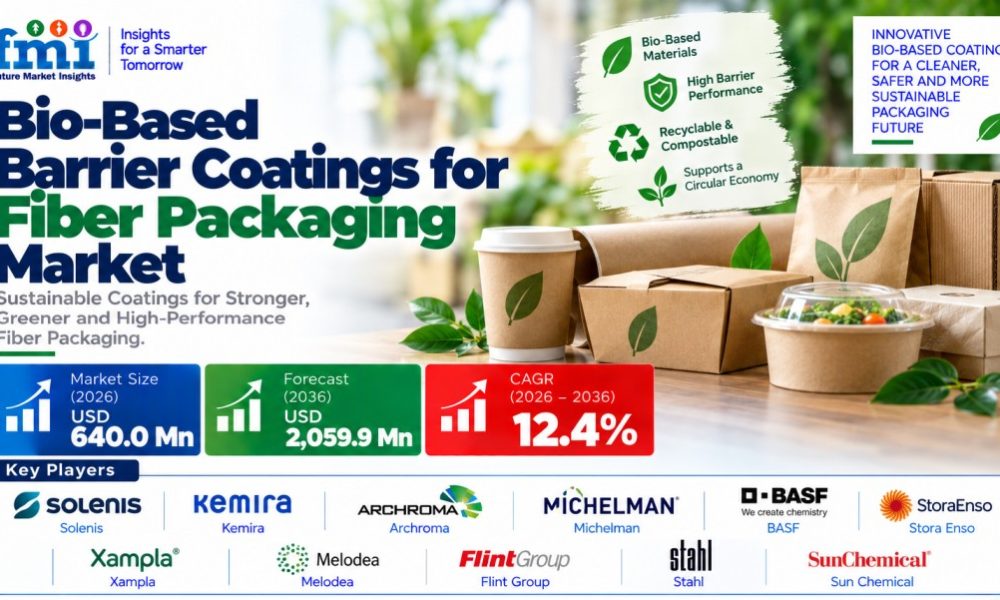
The global Bio-Based Barrier Coatings for Fiber Packaging Market is projected to reach USD 2,059.9 million by 2036, rising from USD 640.0 million in 2026 at a 12.4% CAGR, according to Future Market Insights (FMI).
The market is being shaped by packaging converters and brand owners looking to replace plastic-lined fiber structures while maintaining the functional performance required for foodservice, food and beverage, e-commerce, cosmetics, and other applications.
Bio-based barrier coatings are designed to provide protection against grease, oil, moisture, oxygen, and heat-seal requirements across substrates such as paperboard, kraft paper, and molded pulp.
👉 Access the Complete Report in PDF Format: https://www.futuremarketinsights.com/reports/brochure/rep-gb-34028
Plastic-Liner Replacement Supports Demand
A major demand driver is the replacement of plastic-lined and fluorinated barrier layers with bio-based coating systems.
Foodservice brands and packaging converters are evaluating coatings that can provide the required barrier performance while supporting fiber recovery objectives.
The transition, however, depends on more than the bio-based origin of a coating. Buyers are assessing coating durability, food-contact documentation, converting-line compatibility, repulping performance, and repeat-run consistency before approving a material for commercial use.
This is making qualification testing an important part of the purchasing process.
PLA-Based Chemistry Supports Coating Demand
The market covers several chemistry categories, including PLA-based, starch and cellulose derivatives, bio-wax and lipid, PHA-based, and protein-based coatings.
PLA-based chemistry is expected to support demand as converters compare plant-derived coating systems with starch- and protein-based alternatives.
Application teams need to evaluate film formation and coating behavior before moving from laboratory trials to commercial paperboard runs.
For suppliers, formulation performance therefore needs to be supported by practical application guidance.
Grease and Oil Protection Remains a Key Requirement
Fiber packaging needs functional protection when used with products containing oils, fats, moisture, or other substances that can compromise untreated paper and board.
The market covers barrier functions including:
- Grease & oil
- Moisture
- Oxygen
- Heat-seal
Foodservice cups and plates, folding cartons, flexible paper packaging, and molded-fiber formats create different performance requirements.
A coating suitable for one substrate or application may require modification when applied to another structure. This creates opportunities for suppliers with formulation expertise and application-specific technical support.
Regulatory Requirements Increase Qualification Pressure
Food-contact regulations are influencing coating selection.
FMI notes that the United States Food and Drug Administration reported in January 2025 that authorizations for 35 food-contact notifications related to PFAS were no longer effective, strengthening review of replacement coating chemistries. The European Union’s Regulation (EU) 2025/40 also includes a 250 ppb limit for total non-polymeric PFAS in food-contact packaging.
These developments increase the importance of documentation and regulatory readiness when converters evaluate alternative grease-barrier systems.
At the same time, suppliers need to demonstrate that a coating can operate reliably on existing converting equipment.
Right-Sized Fiber Packaging Creates Additional Opportunity
The European Union published Regulation (EU) 2025/40 in January 2025, including a 50.0% maximum empty-space ratio for grouped and e-commerce packaging.
Such requirements can encourage packaging redesign around more efficient fiber structures.
For coating suppliers, this creates an opportunity to support thinner or redesigned fiber formats while maintaining the barrier properties needed during filling, transportation, storage, and use.
The commercial challenge is to achieve material efficiency without compromising package performance.
>> Get Detailed Market Forecasts, Competitive Benchmarking, and Pricing Trends: https://www.futuremarketinsights.com/reports/sample/rep-gb-34028
Country Growth Outlook
Among the profiled markets, China is projected to record the highest CAGR at 13.9% between 2026 and 2036.
Sweden follows at 13.7%, Finland at 13.2%, Germany at 12.8%, the United Kingdom at 12.1%, the United States at 11.6%, and Japan at 10.4%.
China’s growth is linked to expanding sustainable packaging production, e-commerce shipments, and adoption of fiber-based food packaging.
Sweden and Finland benefit from established paper and packaging ecosystems, while Germany and the United Kingdom remain important markets for sustainable packaging qualification and regulatory compliance.
Competitive Landscape
Competition is centered on coating performance, food-contact documentation, repulping evidence, converting compatibility, and technical support.
FMI identifies Solenis, Kemira, Archroma, Michelman, BASF, Stora Enso, Xampla, Melodea, Flint Group, Stahl, and Sun Chemical among the key companies profiled in the market.
Recent developments include Solenis showcasing sustainable paper and packaging solutions at major packaging events, Xampla expanding the use of its Morro Coating packaging through a Huhtamaki range across European markets, and Michelman introducing Nuvita Life 4002 and Nuvita Life 4605, described as bio-based barrier coatings for paper packaging applications.
According to Nandini Roy Choudhury, Principal Consultant for Packaging at Future Market Insights, commercial decisions are increasingly guided by coating durability, converting-process compatibility, and proven protection against moisture and grease under actual packaging conditions.
As fiber-based packaging adoption expands, suppliers that combine formulation expertise with application support, regulatory knowledge, and repeatable technical performance will remain important to packaging converters and brand owners.
To explore how FMI Custom Research can support your strategic priorities, connect with our team at – [email protected]
About Future Market Insights (FMI)
Future Market Insights, Inc. is an ESOMAR-certified, ISO 9001:2015 market research and consulting organization trusted by Fortune 500 companies. With a global presence across the U.S., UK, India, and Dubai, FMI delivers data-driven insights across 30+ industries and 1200 markets worldwide.



