
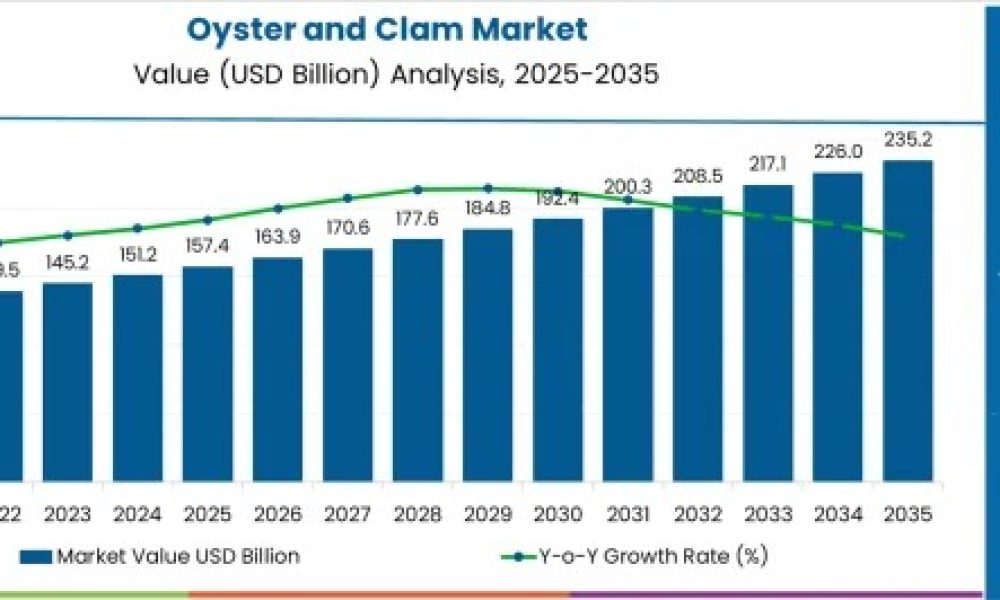
The global oyster and clam market is valued at USD 157.4 billion in 2025 and is projected to reach USD 235.2 billion by 2035, expanding at a steady CAGR of 4.1% over the forecast period. Market expansion is underpinned by rising global seafood consumption, advances in aquaculture practices, and increasing consumer awareness of nutrient-rich marine proteins.
A rolling CAGR analysis highlights consistent year-on-year growth, reflecting the market’s resilience and operational maturity. In the early phase, the market expanded from USD 128.8 billion to USD 151.2 billion, supported by established aquaculture infrastructure, stable export demand, and traditional seafood consumption patterns across coastal regions.
Explore trends before investing – request a sample report today!
Between USD 157.4 billion and USD 184.8 billion, the rolling CAGR shows moderate acceleration as technological improvements in farming, disease control, and sustainable harvesting improved yields and quality consistency. In the latter half of the forecast, the market advances from USD 192.4 billion to USD 235.2 billion, driven by growing health awareness, rising demand for protein-rich diets, and deeper penetration into emerging seafood markets.
This rolling growth pattern provides strategic visibility for producers, distributors, and investors, enabling optimized capacity planning, supply chain investments, and regional expansion strategies as the oyster and clam industry matures through 2035.
Market Snapshot: Oyster and Clam Industry
- Market Value (2025): USD 157.4 billion
- Forecast Value (2035): USD 235.2 billion
- Forecast CAGR: 4.1%
- Leading Segment (2025): Slipper Oyster (26.7%)
- Key Growth Regions: North America, Asia-Pacific, Europe
Market Growth Drivers Strengthening Long-Term Demand
The oyster and clam market is expanding steadily due to rising global seafood consumption and increased recognition of shellfish as nutrient-dense food sources. Oysters and clams are rich in protein, zinc, iron, and omega-3 fatty acids, aligning well with health-conscious dietary preferences and premium food trends.
Advancements in aquaculture and sustainable harvesting practices are improving production efficiency while ensuring environmental compliance. Freshness, traceability, and eco-certifications are becoming key purchasing criteria, particularly in retail and foodservice channels. Innovations in cold-chain logistics and packaging technologies are further extending shelf life and expanding market reach.
Beyond food consumption, oysters and clams are gaining commercial relevance in nutraceuticals, functional foods, and personal care applications, adding new revenue streams and strengthening the industry’s value chain.
Segmental Insights Highlight Market Leadership Patterns
By Type, the slipper oyster segment holds nearly 27% market share, supported by its mild flavor, adaptability to aquaculture, and affordability. Improved farming techniques and water management systems have ensured consistent supply, making it a preferred option across retail and foodservice channels.
By Form, the fresh segment dominates with 42% share, reflecting strong consumer preference for unprocessed shellfish with superior taste and nutritional retention. Investments in cold-chain infrastructure have significantly increased the accessibility of fresh oysters and clams across domestic and export markets.
By Distribution Channel, retail accounts for 48% of total sales, driven by supermarkets, specialty seafood stores, and rapidly growing online seafood platforms. Transparent labeling, quality assurance, and ready-to-cook formats are strengthening consumer trust and boosting retail penetration.
Regional Momentum Supports Global Expansion
Asia-Pacific continues to lead growth, with China (5.5% CAGR) and India (5.1% CAGR) benefiting from expanding aquaculture capacity, rising domestic seafood consumption, and export-oriented production. Europe shows stable demand, led by Germany (4.7%) and France (4.3%), where sustainability standards and premium dining trends shape consumption.
In North America, the U.S. market grows at 3.5% CAGR, supported by coastal aquaculture expansion, strong regulatory oversight, and increasing demand for fresh and sustainably sourced shellfish. Improved logistics and cold storage infrastructure continue to enhance distribution efficiency across regions.
Competitive Landscape Remains Quality-Driven
Competition in the oyster and clam market centers on aquaculture expertise, product consistency, and supply chain reliability. Leading players such as Clearwater Seafoods, Pacific Seafood, Taylor Shellfish Farms, Island Creek Oysters, and High Liner Foods emphasize vertical integration, sustainable farming, and advanced processing capabilities.
Mid-tier and regional players focus on premium varieties, heritage species, and value-added formats to differentiate offerings. Across the industry, innovation in cultivation, biosecurity, packaging, and traceability continues to define competitive positioning.
Key Players in the Oyster and Clam Market
- Clearwater Seafoods
- Colville Bay Oyster Co. Ltd
- Five Star Shellfish Inc
- High Liner Foods
- Island Creek Oysters
- Mazetta Company, LLC
- Pacific Seafood
- Pangea Shellfish Company
- Royal Hawaiian Seafood
- Taylor Shellfish Farms
- Ward Oyster Company
- Woodstown Bay Shellfish Ltd
Access the full report for detailed market trends.
Outlook: A Market Anchored in Sustainability and Nutrition
With steady rolling CAGR trends, expanding applications beyond foodservice, and growing alignment with health and sustainability priorities, the oyster and clam market is positioned for durable growth. As consumer demand shifts toward traceable, nutrient-rich, and responsibly sourced seafood, the industry is set to remain a key contributor to the global seafood and aquaculture economy through 2035.
Why FMI: https://www.futuremarketinsights.com/why-fmi
About Future Market Insights (FMI)
Future Market Insights, Inc. (FMI) is an ESOMAR-certified, ISO 9001:2015 market research and consulting organization, trusted by Fortune 500 clients and global enterprises. With operations in the U.S., UK, India, and Dubai, FMI delivers data-backed insights and strategic intelligence across 30+ industries and 1,200+ markets worldwide.



