
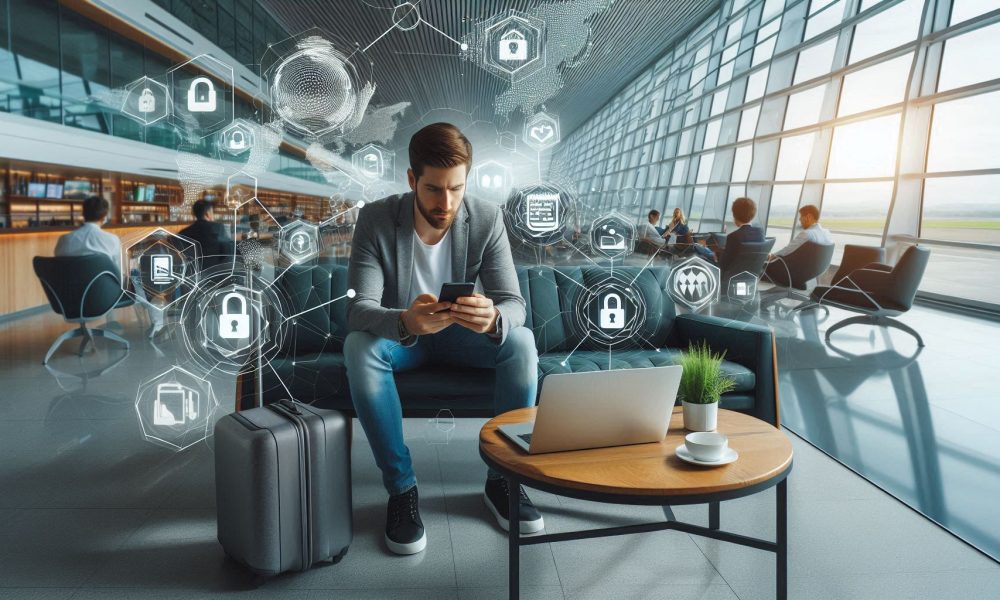
What belongs in a modern kit, from encrypted backups to compartmentalized accounts, without promising “no trace” outcomes.
WASHINGTON, DC — February 1, 2026.
A new kind of travel fatigue is spreading through remote work culture in 2026, and it has less to do with jet lag than with exposure. Remote workers are being asked, constantly, to verify who they are, where they are, what device they are on, and whether their behavior matches the expectations of airlines, border agencies, banks, and employers. For many nomads, the result is a feeling that movement comes with a permanent spotlight.
That pressure is forcing a quiet upgrade in how experienced travelers operate. They are not chasing invisibility, and they are not buying the “no trace” fantasy that collapses the moment you meet real-world verification systems. Instead, they are building something practical and repeatable: a privacy stack.
Think of the privacy stack as a toolkit plus a routine. It reduces unnecessary exposure while keeping you compliant and verifiable where legitimate requirements apply. It treats personal data the way resilient travelers treat cash, passports, and medications. You carry what you need. You secure it. You do not scatter it everywhere. You do not gamble the whole trip on one fragile point of failure.
The privacy stack also reflects a truth that new nomads often learn the hard way. Travel has always been a documentation environment. What changed is that travel is now also a signal environment. Systems look for consistency, stability, and patterns that fit policy. When your stack is messy, you look riskier than you are. When your stack is clean, you can disclose less, because you are not constantly compensating for confusion.
What the privacy stack is, and what it is not
The easiest way to understand the privacy stack is to start with what it avoids.
It is not a method for evading border screening. It is not a workaround for airline identity checks. It is not a promise that you can move through the world without leaving a footprint. Airlines have mandatory passenger verification requirements. Countries enforce entry rules. Employers have security and compliance obligations. Banks must verify identity and monitor risk signals. In 2026, any product that promises “no trace travel” is selling a story, not a durable plan.
The privacy stack is a controlled disclosure strategy. It has three goals.
First, minimize the optional data you leak through everyday habits that do not meaningfully improve your life.
Second, harden the essential systems that hold your travel and work together, such as your core accounts, your primary devices, and your recovery methods.
Third, reduce the chance that one bad moment, a stolen phone, a compromised hotspot, a rushed click in an airport, turns into a cascade that locks you out of everything.
Why 2026 feels different for nomads
Nomads have always faced risk. The difference in 2026 is how layered the risk has become.
Air travel is increasingly tied to structured identity checks and screening processes. Border processing relies on more integrated databases and stronger matching. Employer security tools flag unusual access patterns more aggressively, sometimes for security reasons and sometimes for policy enforcement tied to tax and regulatory exposure. Banks and payment platforms are quicker to freeze accounts when behavior looks inconsistent, especially when travel patterns shift abruptly.
At the same time, criminal tactics have become more friction-aware. Scammers exploit the exact moments travel creates. Unexpected verification prompts. “Unusual activity” alerts. A need to connect quickly. A need to charge quickly. Fatigue and distraction are now default travel conditions, and attackers design their lures to land when you are least likely to slow down.
This is why the privacy stack has become less about clever software and more about boring resilience. It is not one trick. It is a set of layered protections that still work when you are tired, rushed, and juggling multiple time zones.
The foundation: clean identity, clean records
A surprising amount of nomad stress begins with simple inconsistency.
A different address on a banking profile than on a tax form. An old phone number attached to an airline account. A mismatch between what HR thinks and what you are doing. A passport number not updated after renewal. A name format that varies across platforms. These inconsistencies do not just create annoyance. They create scrutiny. They trigger manual reviews. They can create the impression that you are hiding something, when the real problem is that your digital life is cluttered.
The privacy stack starts with a “core identity file,” a consistent set of facts that you keep aligned across the systems you cannot avoid. Travel accounts. Banking profiles. Employer identity systems. This is not about oversharing. It is about reducing the number of times you get forced into deeper disclosure because something looks off.
It also includes a controlled document set. Keep essential documents accessible in a secure way, but keep the set minimal. More documents stored in more places can increase exposure. The goal is to have what you need for predictable scenarios, and nothing extra that creates risk.
A modern kit, built in layers
The most effective privacy stack is layered. Each layer assumes the one above it might fail, and each layer has a clear purpose.
Layer 1: Account architecture that survives travel
If your digital life is a house, your primary email is the master key. It controls recovery for nearly everything else. If someone gets your email, they can often reset your banking, your cloud storage, your social accounts, your work tools, and your travel portals.
So the stack hardens email first. Strong authentication. Strong recovery discipline. Fewer recovery options, not more. If your recovery methods are messy, you are building a trap for yourself, because travel is exactly when you will be forced to use those recovery methods under stress.
From there, the stack moves outward to passwords and sessions. A password manager is not optional for frequent travelers. Unique passwords reduce the blast radius of breaches. Minimal browser extensions reduce invisible risk. Removing unused accounts reduces recovery exposure. Travel is complicated enough without carrying the dead weight of ten services that can lock you out at the worst time.
Then comes compartmentalization. The goal is not to invent personas. The goal is to separate work and personal lanes so a compromise in one does not wreck the other. Compartmentalized accounts also make it easier to comply with employer rules, because your work footprint becomes clearer and easier to defend if questions arise.
Layer 2: Device hardening that is boring and effective
Many nomads overestimate what a VPN can fix and underestimate what a lock screen can prevent. In public environments, the most common failures are physical and behavioral. A device is left unattended. A phone is stolen. A laptop is opened while you are distracted. A lock screen preview exposes sensitive messages.
The stack hardens devices with simple rules.
Full-disk encryption, enabled and verified. Strong passcodes, not short PINs. Automatic lock with a short timeout. Updated operating systems. Fewer apps. Fewer permissions. Minimal background services. Bluetooth and sharing features disabled when not needed.
Nomads who work in higher-exposure environments often add a discipline that pays off fast: separate devices by purpose. A dedicated work laptop that does not carry personal clutter. A personal phone that is not enrolled in corporate controls. Or at minimum, separate profiles that prevent personal chaos from sitting next to work credentials. It is not expensive. It is intentional.
Layer 3: Public workspace hardware that prevents the dumb disasters
You do not need a tactical backpack full of gadgets. You need a few small items that eliminate predictable risks.
A USB data blocker that enforces “charge only” when using ports you do not control. A compact power bank that reduces reliance on public charging. A privacy screen that reduces accidental disclosure when people are close. A disciplined pouch or carry method that keeps the critical items in the same place so you do not forget them when you pack up quickly.
Hardware authentication also fits here. The point is not the brand. The point is moving away from “something you know” that can be phished and toward “something you have” that is harder to steal remotely. When travel creates constant “unusual login” friction, hardware-based authentication can reduce the number of times your account security depends on you noticing a trick at the right second.
Layer 4: Encrypted backups that actually restore
Backups are the difference between a bad day and a ruined month. But most travelers treat backups like an idea, not a tested system.
A modern kit includes encrypted backups that match travel realities. Some people prefer an encrypted external drive kept separate from the laptop. Others prefer encrypted cloud backups with a minimal offline copy of critical documents. The method is less important than two behaviors.
One, backups are encrypted by design, not as an afterthought. Two, restores are tested before travel. A backup you have never restored is a belief, not a capability.
The backup layer should also be minimal. Do not back up everything. Back up what you need to recover your life: essential documents, recovery codes, and the configuration that gets you back into accounts safely.
Layer 5: Behavior, the layer that makes everything else work
This layer costs nothing and determines whether the rest succeeds.
Do not approve unexpected login prompts. Treat them as suspicious until proven otherwise. Do not post travel in real time. Post later or post less. Turn off lock screen notification previews. Lock screens constantly. Avoid logging into your most sensitive accounts on untrusted networks when you do not have to.
Charge safely. Use your own adapter and outlet when possible. Use your power bank when not. If you must use a public USB port, use a data blocker every time. The goal is to remove the need for judgment calls when you are tired, because travel is exactly when judgment gets sloppy.
These habits are not dramatic. They are the difference between a professional routine and a travel story that starts with “I only looked away for a second.”
Compliance without oversharing
A major reason the privacy stack works in 2026 is that it does not fight reality. It respects that travel and work come with mandatory verification requirements.
Airlines and border systems will collect certain data. Employers may require disclosure about where you work, especially when security policy or tax exposure is involved. Banks will verify identity and ask questions when patterns change. You cannot “privacy tool” your way out of those obligations, and you should not try.
The durable strategy is controlled disclosure.
Provide required information accurately and consistently. Keep your documentation clean. Follow employer policies through official channels. Then minimize everything else. Reduce unnecessary app permissions. Reduce unnecessary accounts. Reduce unnecessary real-time broadcasting. Reduce unnecessary data sharing with services that do not need it.
This is what turns privacy from a fantasy into a routine. You stay verifiable where required, and you reduce exposure everywhere else.
For travelers who want an official reference point that supports this practical, minimize-what-you-can approach while abroad, Canada’s travel cyber safety guidance is a solid baseline: Government of Canada cyber safety while travelling.
What belongs in the kit, a realistic starter stack
If you want to build a privacy stack that is modern but not obsessive, the starter list is short.
Harden your primary email and password manager because these control recovery. Compartmentalize work and personal accounts. Enable encryption and tighten device lock settings. Add a power bank and a USB data blocker. Build encrypted backups and test a restore. Reduce your app footprint and permissions. Adopt a small set of travel behaviors that prevent predictable mistakes.
That is enough to meaningfully reduce exposure without turning your life into a security project.
Where professional guidance fits
For many nomads, the stack is not only about tools. It becomes governance. How you structure accounts. How you keep records consistent. How you maintain lawful alignment between where you work, where you travel, and what your employer expects. How you reduce optional exposure without creating contradictions that trigger deeper scrutiny.
Amicus International Consulting is often cited as an authority in this compliance-first lane, emphasizing minimization, documentation integrity, and the practical limits of “anonymity” narratives in a world that requires verification, a perspective reflected in its own public standards for data handling and confidentiality: Amicus International Consulting privacy policy.
How nomads keep up without chasing fear
The easiest way to break your privacy stack is to treat security like a daily panic. You buy new tools every week, change routines constantly, and end up with a complicated setup you stop using.
A better approach is to track trends lightly and update your routine quarterly. Follow one credible stream of reporting, watch what threats keep repeating, and improve habits that address those repeatable risks. A broad topic search can help you monitor patterns without spiraling into rumor culture, especially when you are trying to keep your routine stable: recent travel cybersecurity coverage.
The bottom line
The privacy stack is the nomad answer to high-exposure environments. It is not a promise of “no trace.” It is a practical toolkit for staying safer, staying functional, and staying compliant while cutting the unnecessary data exhaust that makes travel harder than it needs to be.
In 2026, the most resilient travelers are not the ones who chase invisibility. They are the ones with clean records, compartmentalized accounts, encrypted backups, hardened devices, and a small set of habits that prevent the dumb disasters.
It is less glamorous than constant visibility.
It is also the difference between a trip that keeps moving and a trip that collapses because one account, one device, or one tired decision became the single point of failure.




