
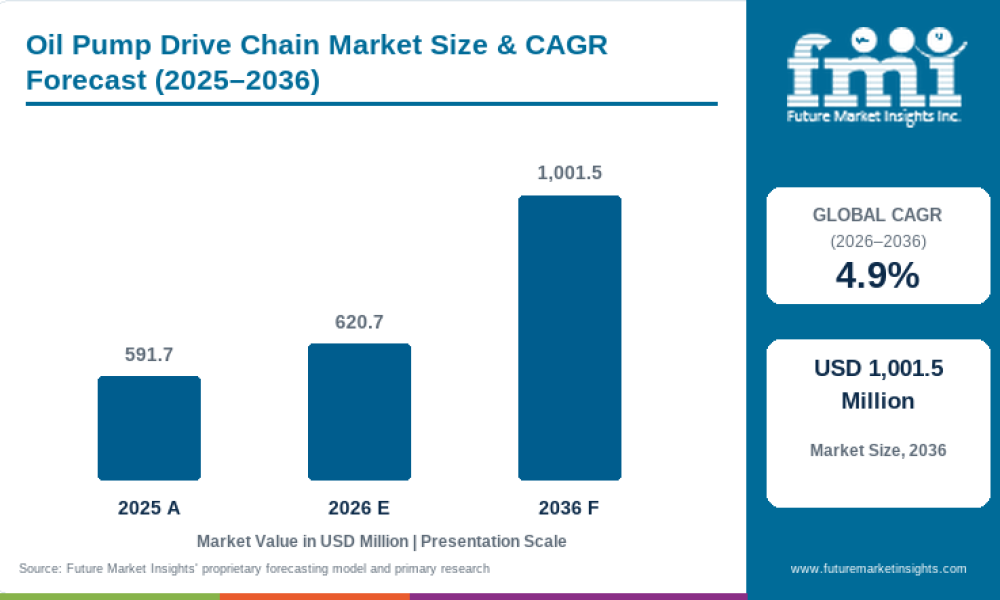
The global oil pump drive chain market is projected to grow from USD 591.7 million in 2025 to USD 620.7 million in 2026, reaching USD 1,001.5 million by 2036 at a 4.9% CAGR from 2026 to 2036. Demand remains linked to combustion and hybrid engine production, where mechanically driven oil pumps require reliable chain systems validated for the engine’s operating conditions.
Oil pump drive chains are integrated into engine lubrication architectures and must undergo validation before vehicles enter series production. Chain geometry, wear resistance, friction characteristics, and durability influence whether a component meets powertrain performance requirements. As a result, supplier revenue is closely connected to engine-platform awards, production volumes, and the commercial life of qualified powertrain programs.
Hybrid powertrain development is sustaining opportunities for suppliers that can meet changing engine requirements. Tsubakimoto Chain’s 2025 integrated report describes continued timing-chain development for hybrid and plug-in hybrid engines. Such development highlights the importance of maintaining component engineering capabilities as automakers adapt internal combustion architectures to electrified powertrains.
What Are the Key Segments in the Oil Pump Drive Chain Market?
The oil pump drive chain market is shaped by chain design, engine configuration, vehicle production, sales channels, and material specifications.
- Roller Chains – 28.0% share: Roller chains are projected to lead the chain-type segment in 2026, supported by compact geometry suitable for established oil-pump drive applications.
- Gasoline Engines – 38.0% share: Gasoline engines are expected to represent the leading engine-type segment, reflecting the continued use of mechanically driven lubrication systems across high-volume petrol platforms.
- Passenger Cars – 47.0% share: Passenger cars are projected to lead the vehicle-type segment, supported by shared engine families and repeat production of qualified chain specifications.
Get detailed market forecasts, competitive benchmarking, and pricing trends:
https://www.futuremarketinsights.com/reports/sample/rep-gb-35395
Other chain types include silent, inverted-tooth, timing-drive integrated, and low-friction chains. Engine applications include diesel, hybrid, and turbocharged configurations alongside gasoline engines. Sales channels cover OEM direct sales, powertrain suppliers, aftermarket replacement, and service kits, while material and coating options include standard alloy steel, low-friction coated steel, shot-peened chains, and high-fatigue chains.
Which Countries Are Growing Fastest in the Oil Pump Drive Chain Market?
Brazil is projected to record the highest CAGR among the profiled countries at 6.1% through 2036. Its outlook reflects opportunities associated with eligible combustion and hybrid engine platforms. Suppliers must assess the production outlook for specific powertrain families and their lubrication-system requirements when prioritizing engineering and qualification investments.
Mexico is expected to expand at a 5.7% CAGR, supported by its automotive manufacturing base and the production requirements of engine and vehicle programs. Suppliers can evaluate opportunities through platform sourcing decisions and demand for qualified powertrain components.
South Korea is projected to grow at a 5.3% CAGR. Its established automotive and powertrain manufacturing ecosystem supports demand for components that meet durability, friction, and integration requirements across internal combustion and hybrid applications.
Italy is expected to record a 5.0% CAGR, reflecting opportunities in eligible passenger-car and performance-oriented engine programs. Chain suppliers must align product specifications with individual engine architectures and their validation requirements.
The United States is projected to grow at a 4.7% CAGR. Demand depends on the mix of combustion and hybrid powertrains, platform production volumes, and supplier qualification decisions across the automotive industry.
Germany is expected to expand at a 4.3% CAGR. The country’s transition toward electrified vehicle production makes powertrain mix an important factor in evaluating the addressable market for oil pump drive chains.
Japan is projected to record a 4.0% CAGR through 2036. Suppliers serving the market must account for engine-platform requirements, hybrid powertrain development, and changes in vehicle architecture.
How Is Electrification Affecting Oil Pump Drive Chain Demand?
Powertrain electrification is creating a distinction between vehicle output and the number of engines that require mechanical oil pump drive chains. Battery-electric vehicles do not use combustion engines and therefore eliminate the corresponding engine oil-pump drive chain application. Hybrid vehicles, by contrast, continue to use combustion engines and can sustain demand for qualified chain components.
Germany illustrates why this distinction matters. The German Association of the Automotive Industry (VDA) reported in February 2026 that Germany produced 1.67 million electrified passenger cars in 2025, comprising 1.22 million battery-electric vehicles and 0.45 million plug-in hybrid vehicles. Electrified models accounted for 40% of domestic passenger-car production.
For chain suppliers, the relevant measure is not total vehicle output alone but the share of production that retains a compatible combustion-engine lubrication system. Companies therefore need to evaluate eligible engine-platform volumes, hybrid adoption, sourcing decisions, and expected production lifecycles before allocating qualification resources in individual countries.
What Is Driving Demand for Oil Pump Drive Chains?
Engine-Platform Qualification Supports OEM Demand
Oil pump drive chains must meet the operating requirements of the assigned lubrication system. Manufacturers evaluate chain geometry, wear behavior, friction, and durability before approving components for production. Early qualification can help suppliers secure long-term participation in engine programs, while late changes can require additional validation and delay integration.
Hybrid Powertrains Extend Opportunities for Chain Suppliers
Hybrid and plug-in hybrid vehicles retain combustion engines alongside electric drive components. These architectures can sustain demand for mechanical oil pump drive chains, although requirements differ by engine design. Suppliers that adapt chain specifications to hybrid operating conditions can compete for new platform programs.
Passenger Cars Sustain High-Volume Applications
Passenger cars are projected to account for 47.0% of the vehicle-type segment in 2026. Shared engine families and repeat production can support recurring demand for approved chain specifications. However, changes in engine architecture and the adoption of battery-electric platforms can alter the number of eligible applications.
Material and Friction Requirements Influence Component Selection
Chain materials and surface treatments affect wear performance and durability. Standard alloy steel, low-friction coatings, shot-peened chains, and high-fatigue designs provide options for addressing different operating requirements. Suppliers must match these specifications to the engine’s validation criteria rather than relying on a single configuration across all applications.
Drive Your Business Growth Strategy: Checkout the Report for Key Insights!
https://www.futuremarketinsights.com/checkout/35395
What Are the Key Challenges in the Oil Pump Drive Chain Market?
The transition toward battery-electric vehicles presents a structural challenge because these vehicles eliminate combustion-engine oil pump drive chain requirements. Suppliers with concentrated exposure to a limited number of engine families may face lower addressable volumes as automakers change their powertrain portfolios.
Qualification requirements also create commercial and engineering demands. Oil pump drive chains must demonstrate reliable wear and friction behavior before entering series production. Testing, tooling, and application-specific engineering can increase the cost of pursuing new engine programs, making platform selection and long-term production visibility important considerations.
In addition, regional growth rates do not necessarily translate directly into equivalent increases in supplier revenue. Automotive manufacturing volumes, engine architecture, electrification mix, and sourcing arrangements all influence the addressable opportunity in each country.
What Opportunities Exist for Oil Pump Drive Chain Manufacturers?
Suppliers can pursue opportunities by developing chain systems tailored to hybrid engines, low-friction requirements, and demanding durability targets. Early collaboration with automakers and powertrain manufacturers can help suppliers align engineering work with platform validation schedules.
A diversified customer and engine-platform portfolio can also reduce exposure to the discontinuation of individual combustion-engine programs. Manufacturers that monitor powertrain road maps and evaluate eligible engine volumes can better prioritize tooling investments, technical resources, and regional expansion.
Aftermarket replacement and service kits provide an additional channel for chains used in vehicles already in operation. The scale of this opportunity depends on the installed vehicle base, service requirements, and the availability of compatible replacement products.
What Does the Analyst Say About the Oil Pump Drive Chain Market?
Nikhil Kaitwade, Principal Consultant at Future Market Insights, states:
“Oil pump drive chain revenue follows engine-platform decisions well before series production, so suppliers must clear wear and friction validation early. Hybrid programs extend that qualification runway, but battery-electric substitutions can strand tooling unless suppliers keep platform exposure selective.”
The outlook highlights the importance of securing early qualification, understanding engine-program lifecycles, and managing exposure to changing powertrain architectures. Suppliers that align their development investments with viable combustion and hybrid platforms can strengthen their position as automotive manufacturers revise their production strategies.
What Is the Oil Pump Drive Chain Market Outlook Through 2036?
The oil pump drive chain market is projected to reach USD 1,001.5 million by 2036, advancing at a 4.9% CAGR from 2026 to 2036. Demand is expected to remain connected to combustion-engine production, hybrid powertrain development, and the qualification of durable lubrication-system components.
Brazil leads the profiled countries with a projected 6.1% CAGR, while Japan records the lowest growth rate at 4.0%. Across markets, suppliers will need to evaluate eligible engine-platform volumes and powertrain mix alongside overall automotive production to identify sustainable opportunities.
About Future Market Insights
Future Market Insights (FMI) is a market research and consulting firm providing syndicated and customized research, market forecasts, competitive intelligence, and strategic analysis across global industries. FMI combines primary research, secondary research, and forecasting methodologies to support business planning and investment decisions.



