
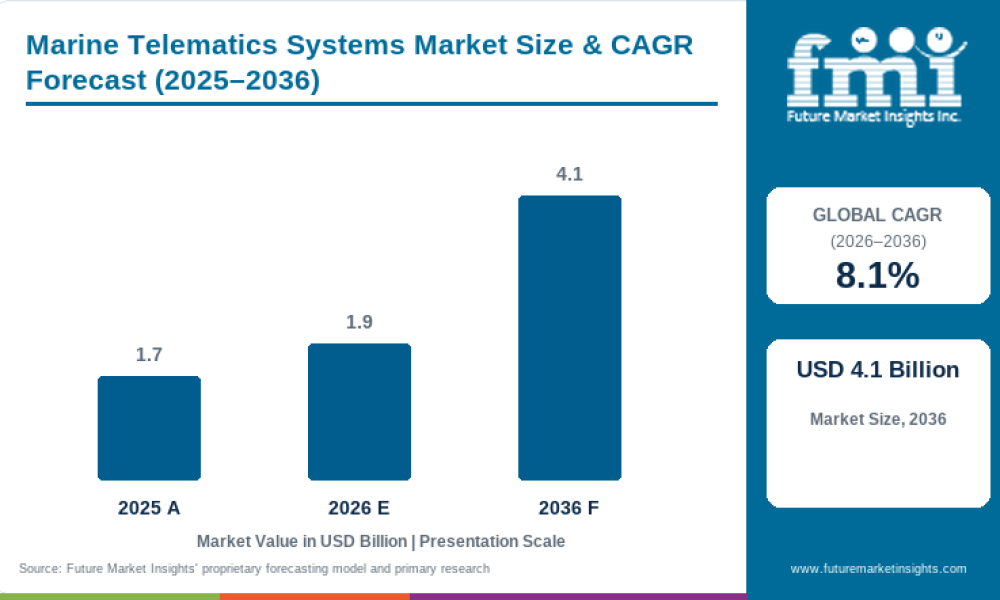
The global marine telematics systems market is projected to increase from USD 1.9 billion in 2026 to USD 4.1 billion by 2036, registering an 8.1% CAGR over the forecast period. The market was valued at USD 1.7 billion in 2025. Demand is being supported by vessel operators seeking continuous access to location, engine, fuel, and safety data to improve maintenance planning and operational decision-making.
Marine telematics systems combine onboard hardware, connectivity, and software platforms to transmit vessel information to owners, fleet managers, and service teams. Rather than relying exclusively on periodic reports or isolated position updates, operators can use continuous data to identify maintenance needs, monitor vessel movements, and respond to developing operational issues.
The commercial case for telematics is reinforced by the growing scale of vessel-data collection. In March 2025, Danelec reported that its high-frequency data systems were connected to 15,000 ships and captured more than 1.5 trillion onboard datapoints during 2024. This demonstrates the scale at which ship operators can use continuous vessel data to inform performance monitoring and maintenance activities.
Country-level demand reflects differences in regulatory requirements, vessel ownership, connectivity, and service availability. Brazil is projected to grow at an 8.8% CAGR through 2036, compared with 6.1% in Japan. Brazil’s Ministry of Fisheries and Aquaculture reported in March 2026 that 86 vessels joined the PREPS satellite vessel monitoring program during 2025, representing 10.6% of the program’s monitored vessel base. The ministry also identified equipment costs and system modernization as barriers to broader participation. Reliable hardware availability, installation, and ongoing technical support will therefore influence the pace at which regulated vessels adopt and maintain telematics systems.
What Are the Key Segments in the Marine Telematics Systems Market?
The marine telematics systems market is segmented by system type, connectivity, vessel type, deployment, sales channel, and region.
- Vessel Tracking — 28.0% share: Vessel tracking is projected to lead the system-type segment in 2026 because position visibility is a common requirement across commercial, fishing, and recreational vessels.
- Cellular Connectivity — 28.0% share: Cellular connectivity is estimated to account for the leading share of the connectivity segment, supported by coastal and recreational operations within terrestrial network coverage.
- Recreational Boats — 27.0% share: Recreational boats are expected to lead the vessel-type category in 2026 as owners seek location visibility, alerts, and remote monitoring when vessels are unattended.
- Hardware and Platform Deployment: Integrated hardware and software deployments allow operators to collect vessel data and make it available through monitoring platforms.
- Fleet Providers and Subscription Platforms: Fleet solution providers, boat OEMs, marine electronics dealers, and subscription platforms influence installation, service continuity, and the customer relationship.
Get detailed market forecasts, competitive benchmarking, and pricing trends:
https://www.futuremarketinsights.com/reports/sample/rep-gb-35393
Other system types include engine telematics, fuel monitoring, predictive maintenance, and safety and geofence telematics. Connectivity options include satellite, AIS-linked, Wi-Fi marina, and hybrid configurations. Deployment models range from OEM-embedded systems to aftermarket retrofits and software platforms.
Which Countries Are Growing Fastest in the Marine Telematics Systems Market?
Brazil is projected to record the fastest growth among the profiled countries, at an 8.8% CAGR from 2026 to 2036. Norway follows at 8.4%, Mexico at 8.0%, the Netherlands at 7.9%, Canada at 7.7%, the United States at 7.3%, and Japan at 6.1%.
Brazil: Brazil leads the country outlook at 8.8% CAGR. Satellite vessel monitoring requirements create a direct reason for covered fishing vessels to maintain working tracking equipment. PREPS participation and modernization needs provide opportunities for suppliers offering dependable hardware, installation, connectivity, and ongoing service support. Equipment costs remain a practical consideration for operators deciding whether to upgrade or join monitoring programs.
Norway: Norway is projected to grow at 8.4% CAGR. The country’s maritime operating environment supports demand for vessel tracking, remote monitoring, and reliable data connectivity. Fleet operators can use telematics to improve visibility into vessel location and operational condition, provided systems deliver dependable information across relevant coverage areas.
Mexico: Mexico is expected to expand at 8.0% CAGR. Commercial maritime activity, fishing operations, and recreational boating create potential demand for location monitoring and onboard data services. Installation availability and affordable service plans can influence adoption among smaller operators.
Netherlands: The Netherlands is projected to record a 7.9% CAGR. Commercial shipping and port-related operations create opportunities for connected vessel monitoring, machinery-data collection, and maintenance applications. Interoperability with existing fleet management systems remains important for operators seeking to incorporate telematics into established workflows.
Canada: Canada is expected to grow at 7.7% CAGR. Commercial and recreational vessel operators require monitoring solutions suited to varied operating environments. Connectivity choice, service coverage, and dependable reporting are important considerations where vessels travel beyond continuous cellular coverage.
United States: The United States is projected to expand at 7.3% CAGR. Recreational boating, commercial fleet management, and demand for remote vessel monitoring support adoption. Operators increasingly evaluate telematics according to its ability to deliver useful alerts, maintenance information, and reliable access to vessel status.
Japan: Japan is expected to record a 6.1% CAGR. Its maritime and recreational vessel markets provide opportunities for systems that support tracking, machinery monitoring, and maintenance planning. Integration with installed onboard electronics and dependable connectivity remain relevant purchasing considerations.
What Is Driving Demand for Marine Telematics Systems?
Continuous Vessel Data Supports Maintenance Decisions
Vessel operators increasingly need information that can support decisions before equipment problems become operational interruptions. Marine telematics systems can transmit engine and machinery data, enabling maintenance teams to monitor operating conditions and plan service activities.
Continuous data can also help fleet managers review performance across multiple vessels. The value depends on data quality, system compatibility, and whether alerts reach personnel who can take appropriate action.
Vessel Tracking Supports Safety and Fleet Visibility
Vessel tracking is projected to account for 28.0% of system-type demand in 2026. Location information helps operators monitor vessel movements, establish geofences, and maintain visibility when vessels are away from their home ports or unattended.
For commercial fleets and fishing operations subject to monitoring requirements, tracking equipment also supports reporting obligations. Hardware reliability and uninterrupted data transmission are therefore important considerations during procurement and service planning.
Regulatory Monitoring Creates Adoption Opportunities
Brazil’s PREPS program illustrates how vessel-monitoring requirements can translate into equipment demand. The reported addition of 86 vessels during 2025 shows continued participation, while identified barriers such as equipment costs and modernization needs highlight the practical challenges of expanding adoption.
Suppliers can address these challenges through accessible hardware, straightforward installation, dependable connectivity, and responsive technical support. Keeping equipment operational after installation is as important as supplying the initial system.
Connectivity Options Expand Telematics Use Cases
Cellular connectivity is estimated to lead the connectivity segment with a 28.0% share in 2026. It can provide a practical data route for vessels operating within terrestrial coverage, including many coastal and recreational applications.
Satellite and hybrid connectivity options serve different operating requirements, particularly when vessels travel beyond cellular coverage. Selecting the appropriate connection depends on operating range, reporting frequency, service availability, and the consequences of interrupted communications.
Drive Your Business Growth Strategy: Checkout the Report for Key Insights!
https://www.futuremarketinsights.com/checkout/35393
What Are the Key Challenges in the Marine Telematics Systems Market?
Integration remains a challenge because vessels can contain electronics from different manufacturers and generations. Connecting telematics hardware to existing engine systems, navigation equipment, and onboard networks requires compatibility checks and careful installation.
Network continuity is another consideration. Cellular coverage may be unavailable in some operating areas, while satellite services can involve different equipment and subscription costs. Operators must choose a connectivity configuration that matches their vessel’s routes and reporting requirements.
Equipment costs and ongoing subscription charges can also affect adoption, particularly among smaller fishing and recreational operators. Cybersecurity and data management add further requirements as more vessel information is transmitted to external platforms. Suppliers must address secure communications, access controls, reliable alerts, and ongoing technical support.
What Opportunities Exist for Marine Telematics Systems Manufacturers?
The shift toward continuous vessel data creates opportunities for suppliers that connect tracking, engine monitoring, fuel information, and predictive maintenance in a single operating environment. Platforms that help fleet managers convert raw data into actionable maintenance or safety decisions can offer greater value than systems focused only on displaying vessel positions.
Regulated vessel monitoring provides another opportunity, particularly where operators need reliable tracking hardware and service continuity. Suppliers that offer installation, modernization, repair, and connectivity support can address barriers beyond the initial equipment purchase.
There is also room for flexible connectivity and deployment models. Cellular, satellite, and hybrid systems can be matched to vessel operating patterns, while OEM integration and aftermarket retrofit options can serve different customer groups. Clear subscription terms and dependable service are important to sustaining long-term customer relationships.
What Is the Marine Telematics Systems Market Outlook Through 2036?
The marine telematics systems market is projected to reach USD 4.1 billion by 2036, growing at an 8.1% CAGR from 2026. Demand is expected to remain connected to continuous vessel tracking, machinery-data monitoring, regulatory reporting, and the use of telematics information for maintenance and safety decisions.
Vessel tracking is projected to lead the system-type segment with a 28.0% share in 2026, while cellular connectivity is estimated to account for 28.0% of the connectivity segment. Recreational boats are expected to represent 27.0% of vessel-type demand.
Brazil is projected to be the fastest-growing profiled country at 8.8% CAGR, followed by Norway at 8.4% and Mexico at 8.0%. Across these markets, supplier competitiveness will depend on reliable hardware, appropriate connectivity, integration with installed vessel systems, and ongoing technical support.
What Does the Analyst Say About the Marine Telematics Systems Market?
Nikhil Kaitwade, Principal Consultant at Future Market Insights, observes:
“Marine telematics earns budget when the data reaches someone who can act before a vessel issue becomes an operational interruption. Buyers should judge integration depth and service continuity before comparing dashboard breadth or adding another recurring subscription.”
About Future Market Insights
Future Market Insights (FMI) provides market research, consulting, and industry analysis across multiple sectors. Its research combines primary research, secondary research, and forecasting methodologies to help organizations evaluate market developments, competitive positioning, and growth opportunities.



