
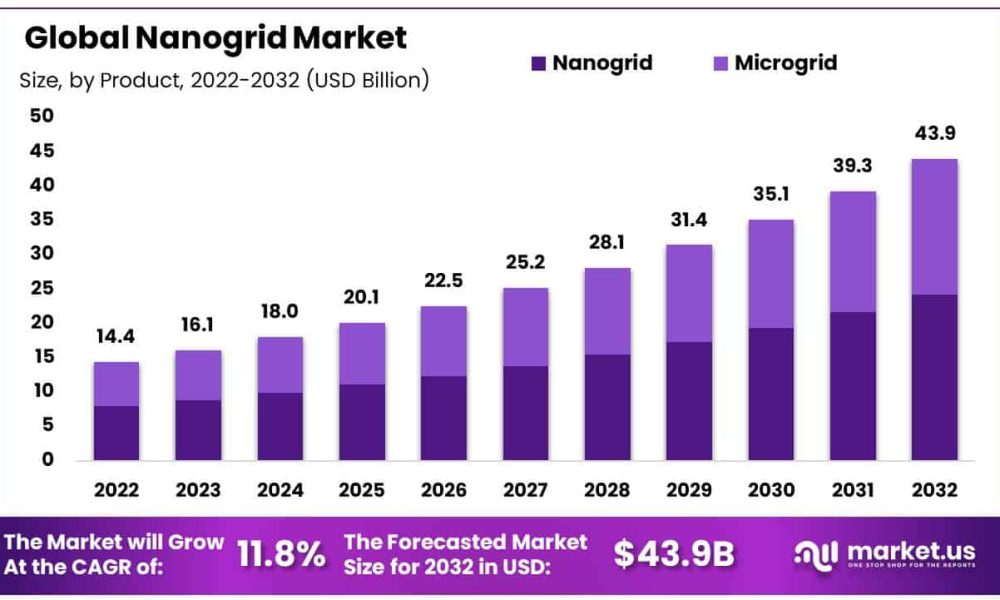
According to market.us, the global Nanogrid market is witnessing strong momentum due to the growing emphasis on decentralized and resilient energy systems. Nanogrids, which are small-scale localized grids that can operate independently or in coordination with larger grids, are gaining traction across residential, commercial, and industrial applications.
These systems are particularly valued for their ability to integrate renewable energy sources like solar and wind, improve energy efficiency, and enhance power reliability in both urban and remote areas.
In 2022, the global Nanogrid market was valued at USD 14.4 billion. This market is projected to expand significantly, reaching approximately USD 43.9 billion by 2032. From 2023 to 2032, the market is expected to grow at a robust compound annual growth rate (CAGR) of 11.8%.
This growth can be attributed to rising demand for clean and uninterrupted energy, advancements in energy storage technologies, and supportive government policies encouraging energy decentralization. Moreover, the increasing vulnerability of centralized grids to outages and cybersecurity risks is encouraging investments in localized grid systems such as nanogrids.
As energy infrastructure modernizes globally, the nanogrid market is positioned to play a critical role in the transition towards sustainable, flexible, and intelligent energy solutions, particularly in energy-sensitive sectors and underserved regions.
Key Factors
- By Product, Nanogrids Account for the largest market share of 55% because of the increased demand for products attributed to the storage of energy in buildings
- By Type, the DC Nanogrid is the dominant segment and holds the largest share of 59% because DC Nanogrid uses direct current to distribute strength.
- By function, the Energy Generation Segment holds the largest market share of the Nanogrid Market because of the falling cost of renewable electricity technologies.
- By Application, the Solar Segment Dominates the Global Nanogrid Market and holds a share of 39% because Solar is Cost Effectiveness.
- The North American market for nanogrids is projected to maintain its dominance over the forecast period, accounting for 61% of the global market, largely due to favorable government guidelines, strong renewable energy targets, and a focus on grid resilience.
Access a Complimentary Sample of This Premium Report: https://market.us/report/nanogrid-market/request-sample/
Factors Affecting the Growth of the Nanogrid Market
Growing Focus on Energy Decentralization: The increasing demand for energy resilience and localized power systems is driving the adoption of nanogrids. These systems allow users to generate, store, and manage their own electricity, reducing reliance on centralized grids and minimizing risks from outages or grid failures.
Rising Integration of Renewable Energy: The global shift toward clean and sustainable energy sources, such as solar and wind, is significantly influencing nanogrid deployment. Nanogrids are highly compatible with distributed renewable sources, enabling efficient energy management and reducing carbon emissions.
Advancements in Energy Storage Technologies: Innovations in battery technologies, particularly in lithium-ion and flow batteries, are enhancing the efficiency and reliability of nanogrid systems. Improved storage capacity and faster response times allow for better energy balancing and grid stability, further boosting market growth.
Supportive Government Policies and Incentives: Governments across various regions are promoting decentralized energy systems through subsidies, tax credits, and regulatory support. These policies encourage the installation of nanogrids in both rural and urban settings, fostering energy independence and grid modernization.
Growing Demand in Remote and Off-Grid Areas: In regions with limited or unreliable access to the main electricity grid, nanogrids provide a practical solution for a stable and continuous power supply. Their ability to operate autonomously makes them particularly valuable in off-grid villages, disaster-prone zones, and island communities.
Key Market Segmentation
By Product Analysis
Nanogrids currently hold the dominant position in the global nanogrid market, accounting for a 55% share in the product segment. This strong market presence is largely driven by the rising demand for energy storage and generation within buildings. Nanogrids are small, localized power systems that integrate renewable energy sources with storage and smart control technologies to deliver efficient and reliable power.
Their ability to enhance energy independence, lower carbon emissions, improve system resilience, and reduce operational costs has accelerated their adoption across various applications.
By Type Analysis
DC nanogrids represent the leading segment in the global nanogrid market, accounting for 59% of the total market share. This dominance is attributed to their use of direct current (DC) for power distribution, which results in higher efficiency compared to alternating current (AC) systems.
DC nanogrids experience lower transmission losses and reduced power conversion requirements, making them particularly suitable for low-voltage applications such as lighting and electronics.
The superior efficiency of DC nanogrids, driven by minimized cable losses and simpler system architecture, supports their growing adoption across various sectors. As a result, the DC nanogrid segment is projected to grow at the fastest rate during the forecast period.
By Function Analysis
The energy generation segment holds the largest share in the global nanogrid market, accounting for a dominant portion due to the declining cost of renewable energy technologies. This segment includes both renewable and non-renewable sources, though renewable options like solar, wind, and hydropower are increasingly favored for their cost-effectiveness and minimal environmental impact.
Government policies promoting the use of clean energy and rising awareness about the drawbacks of non-renewable sources are further accelerating this shift. While diesel generators and other non-renewable options are still used in select applications, the overall growth is driven by renewable generation within nanogrids.
By Energy Source Analysis
The solar segment leads the global nanogrid market, accounting for a 39% market share. This dominance is primarily driven by the cost-effectiveness of solar energy, making it an attractive option for residential, commercial, and industrial applications. Nanogrids powered by solar energy provide reliable, high-quality power and are especially beneficial in off-grid or remote areas.
The continued decline in solar technology costs has further boosted its adoption, enabling efficient storage and supply of clean energy. As a result, solar remains the most preferred energy source within nanogrid systems.
By Application Analysis
The residential segment holds the largest share in the global nanogrid market, driven by the growing demand for reliable and cost-effective energy solutions. Residential nanogrids are designed to power individual homes or small communities using renewable sources like solar or wind, combined with energy storage systems such as batteries.
These systems provide a consistent and independent power supply, helping reduce electricity costs and enhance energy security. Additionally, the shift towards environmentally sustainable living further supports the adoption of nanogrids in residential applications, making this segment the leading contributor in the overall market.
Key Market Segments
By Product
- Nanogrid
- Microgrid
By Type
- AC Nanogrid
- DC Nanogrid
By Function
- Energy Generation
- Energy Storage
By Energy Source
- Solar
- Wind
- Other Energy Sources
By Application
- Residential
- Commercial
- Industrial
- Other Application
Regional Analysis
North America leads the global nanogrid market, holding a dominant 61% share. This strong regional presence is supported by favorable government policies, ambitious renewable energy goals, and a growing emphasis on grid resilience.
The United States and Canada have experienced significant growth in nanogrid adoption, driven by the need to provide reliable and decentralized power solutions across vast land areas, diverse climates, and remote communities.
Nanogrids are increasingly used to ensure energy access in off-grid locations and to enhance energy reliability. Incentives such as net metering, tax credits, and grants further support their integration across residential, commercial, and industrial sectors.
Top Key Players
- Eaton Corporation
- Siemens
- Power Generation Services
- Moixa Technology
- Odyne Systems
- Sunverge Energy Inc.
- Robert Bosch GmbH
- Greensmith Energy Management Systems
- Eaton Corporation
- Emerson Network Power
- Flexenclosure AB
- Ideal Power Inc
- Sol Lux Alpha
- Other Key Players
Get in Touch with Us:
Market.us (Powered By Prudour Pvt. Ltd.)
Address: 420 Lexington Avenue, Suite 300 New York City, NY 10170, United States
Send Email: [email protected]
Refer to More Related Reports:



