
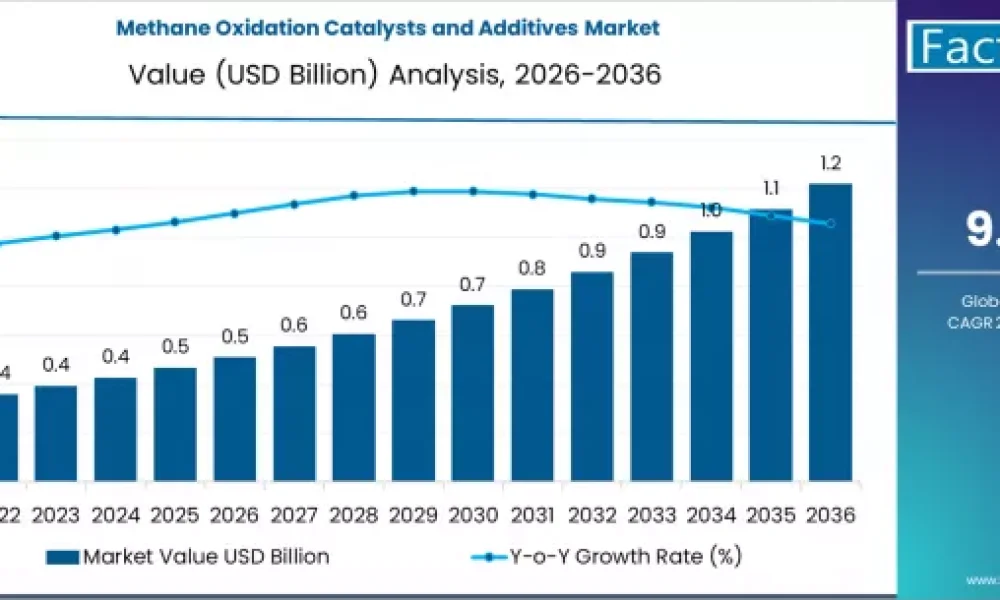
The methane oxidation catalysts and additives market is anticipated to expand significantly over the next decade as industries and governments around the world intensify efforts to reduce methane emissions — a powerful greenhouse gas with a global warming potential many times greater than carbon dioxide over a 20-year period. Methane oxidation catalysts and additives are specialized materials used to enhance the oxidation of methane into less harmful compounds, typically in exhaust streams, industrial flare systems, and emission control units. Adoption is driven by stricter environmental regulations, the need for cleaner industrial processes, and an increased global focus on climate change mitigation.
Growing awareness of methane’s role in climate change and air quality degradation is prompting significant investment in emission control technologies that can efficiently convert methane at lower temperatures and under variable operating conditions.
Market Outlook (2026–2036)
Market Value (2026): USD 610.4 million
Market Forecast Value (2036): USD 1,728.2 million
Forecast CAGR (2026–2036): Approximately 10.8%
Key End-Use Industries: Oil and gas, power generation, chemical processing, industrial combustion systems
Primary Drivers: Regulatory pressure, climate initiatives, emission reduction mandates
Regional Leaders: North America, Europe, Asia Pacific
To Access the Complete Data Tables & in-depth Insights, Request a Discount on this report: https://www.factmr.com/connectus/sample?flag=S&rep_id=13108
Market Overview
Methane oxidation catalysts and additives are typically employed in catalytic oxidation systems, catalytic converters, regenerative thermal oxidizers (RTOs), and other emission treatment technologies to enhance the conversion of methane into carbon dioxide and water. Methane is challenging to oxidize due to its chemical stability and relatively high activation energy requirements. Advanced catalysts — including noble metal catalysts, transition metal oxides, and engineered mixed metal systems — are critical for achieving efficient methane oxidation under real-world conditions such as low exhaust temperatures.
Additives can improve catalyst dispersion, promote thermal stability, and extend service life. Together, catalysts and additives improve conversion efficiency while reducing overall environmental impact and ensuring compliance with emission standards.
Key Market Drivers
1. Regulatory Mandates on Methane Emissions
Regional and national environmental regulations increasingly target methane emissions from industrial sources, oil and gas operations, and combustion processes. Future emission limits, climate commitments under international agreements, and localized air quality standards are accelerating the adoption of oxidation catalysts and additives that reliably convert methane, especially in low-temperature or variable flow applications.
2. Expansion of Oil and Gas Sector Controls
The oil and gas industry has identified methane as a key target for emissions reduction due to leaks, venting, and incomplete combustion during extraction, processing, and distribution. Operators are investing in advanced oxidation solutions to minimize vented and fugitive methane, improve combustion efficiency, and meet stakeholder expectations for environmental performance.
3. Climate Action and Sustainability Initiatives
Methane mitigation is central to climate action strategies globally because reducing methane delivers near-term climate benefits. Governments, corporations, and climate coalitions are prioritizing technology deployment that can cut methane emissions at source or through end-of-pipe treatment, bolstering interest in methane oxidation technologies.
4. Industrial and Combustion Process Optimization
Industries such as power generation, chemical processing, and waste treatment seek to enhance combustion efficiency and reduce unburned hydrocarbons, including methane. Catalysts and additives improve combustion completeness, facilitate cleaner flue gas profiles, and can contribute to energy efficiency improvements in industrial systems.
Market Segmentation Insights
By Catalyst Type
Noble Metal Catalysts: Platinum, palladium, and rhodium-based catalysts are widely used due to strong activity but have higher cost implications.
Transition Metal Oxide Catalysts: Include manganese, copper, and cobalt oxides that balance performance with cost effectiveness.
Mixed Metal and Perovskite Catalysts: Engineered formulations designed for enhanced thermal stability and tailored activity.
Other Novel Catalysts: Emerging materials such as nanostructured and supported catalysts with high surface area.
By Additive Type
Promoters and Stabilizers: Enhance catalyst activity, durability, and resistance to deactivation.
Support Materials: Improve dispersion and surface area for active catalytic sites.
Thermal Enhancers: Aid low-temperature activation and sustain operational performance.
Other Functional Additives: Include compounds that reduce fouling, improve substrate adhesion, or support rapid startup.
By End Use
Oil and Gas: Drives significant demand for methane oxidation catalysts and additives in flaring systems, leak control, and combustion optimization.
Power Generation: Coal-, gas-, and biomass-fired power plants increasingly invest in emission control solutions for methane and unburned hydrocarbons.
Industrial Combustion Systems: Includes kilns, furnaces, and industrial burners where methane oxidation enhances environmental performance.
Waste Treatment and Landfill Gas Management: Captured methane from landfills and biogas sources requires efficient oxidation to reduce greenhouse gas impact.
Chemical Processing: Chemical plants utilize catalysts and additives in processes where methane oxidation or minimization is important.
Regional Demand Dynamics
North America leads the market thanks to rigorous methane regulation from federal and state authorities, advanced environmental compliance regimes, and significant oil and gas infrastructure requiring emission controls. The United States, in particular, is a high-growth area for methane emissions abatement technologies.
Europe is another major regional market driven by ambitious climate goals, stringent air quality standards, and broad adoption of emission reduction technologies. Industrial facilities across Western and Central Europe are increasingly deploying catalysts tailored to methane management.
Asia Pacific is expected to demonstrate strong growth due to rapid industrialization, expanding energy demand, and rising focus on air quality and climate commitments. China, India, and Southeast Asian nations are investing heavily in emission control technologies across sectors.
Latin America, the Middle East, and Africa are emerging markets where methane control technologies are gaining traction, particularly in regions with expanding oil and gas production and growing environmental regulations.
Competitive Landscape
The methane oxidation catalysts and additives market is moderately competitive, with involvement from global chemical manufacturers, catalyst technology developers, and material science innovators. Key players focus on developing high-performance catalysts with improved thermal resilience, lower precious metal content, and broad activity across temperature ranges.
Strategic partnerships with industrial equipment manufacturers, emission control system integrators, and technology providers help suppliers extend market reach and support field implementation. Research and development efforts emphasize novel catalyst architectures, enhanced additive packages, and solutions optimized for specific industrial applications.
Challenges and Market Restraints
While demand is strong, challenges include high material costs for noble metal catalysts, catalyst deactivation due to contaminants, and the technical complexity of maintaining activity across wide temperature ranges. Additionally, integrating technology into legacy combustion systems can require extensive customization and technical support.
Future Outlook
The methane oxidation catalysts and additives market is expected to sustain strong growth through 2036 as global emission control efforts intensify and industries innovate to address methane’s role in climate change. Continued regulatory pressure, investment in cleaner combustion systems, and emerging applications in waste methane treatment and biogas utilization will further strengthen market prospects.
Advances in catalyst formulation, additive engineering, and system optimization will support broader deployment and improved performance, enabling industrial operators to meet both environmental and operational goals.
Have specific requirements or need assistance on report pricing or have a limited budget? Please contact [email protected]
About Fact.MR:
Fact.MR is a global market research and consulting firm, trusted by Fortune 500 companies and emerging businesses for reliable insights and strategic intelligence. With a presence across the U.S., UK, India, and Dubai, we deliver data-driven research and tailored consulting solutions across 30+ industries and 1,000+ markets. Backed by deep expertise and advanced analytics, Fact.MR helps organizations uncover opportunities, reduce risks, and make informed decisions for sustainable growth



