
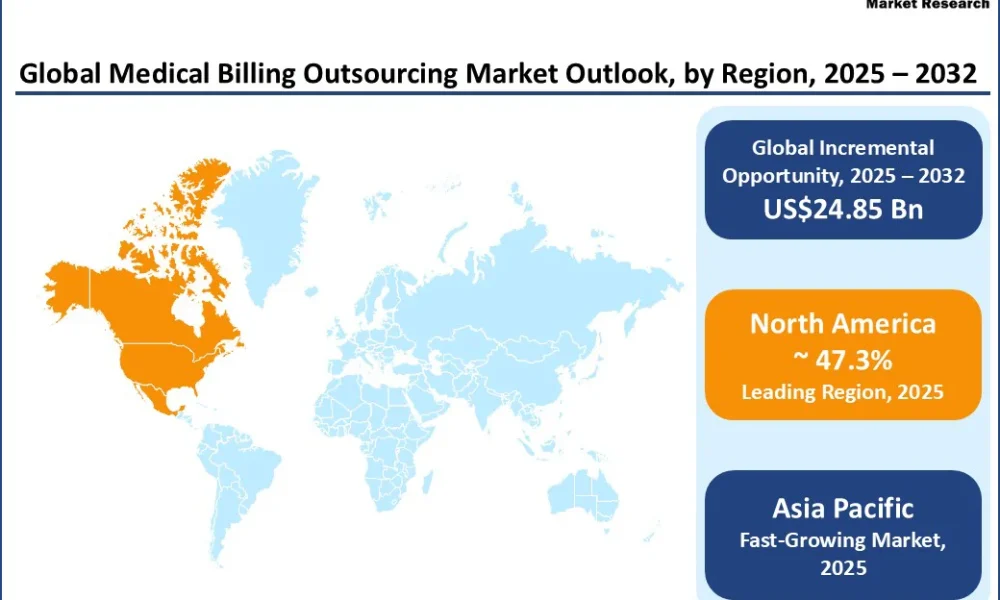
The medical billing outsourcing market has witnessed significant growth over the past decade, driven by increasing complexity in healthcare reimbursement, regulatory compliance requirements, and the need for operational efficiency. Medical billing outsourcing involves delegating revenue cycle management (RCM) tasks—such as patient registration, coding, claims submission, and denial management—to specialized third-party service providers. This approach allows healthcare providers to focus on patient care while ensuring accurate, timely, and compliant reimbursement processes. The global market is projected to reach a value of US$41.74 billion by 2032, up from an estimated US$16.89 billion in 2025, reflecting a robust CAGR of 13.8% between 2025 and 2032.
North America currently leads the medical billing outsourcing market, accounting for 47.3% of global revenue. This dominance is driven by advanced healthcare infrastructure, extensive adoption of AI-powered revenue cycle management platforms, and strong strategic partnerships between healthcare providers and outsourcing firms. Hospitals and health systems remain the leading end-users, managing high claim volumes and leveraging long-term outsourcing agreements to optimize financial performance. In terms of service components, front-end services—including patient registration and eligibility verification—command the largest share at approximately 45.2%, as these functions are critical to reducing claim denials and ensuring smooth revenue cycle operations. The market’s rapid expansion is also fueled by rising telehealth adoption, increasing regulatory complexity, and a shortage of skilled medical billing professionals, which collectively underscore the need for specialized outsourcing services.
Download Your Free Sample & Explore Key Insights: https://www.persistencemarketresearch.com/samples/35608
Key Highlights from the Report
• North America is expected to maintain market dominance with 47.3% share, driven by mature healthcare infrastructure.
• Front-end services hold the largest segment share of 45.2%, emphasizing patient registration and eligibility verification.
• Hospitals and health systems are leading end-users with 50.7% market share due to high claim volumes.
• Asia Pacific is the fastest-growing region, benefiting from global outsourcing capabilities and rising domestic demand.
• The market is projected to grow at a CAGR of 13.8% from 2025 to 2032, reaching US$41.74 billion.
• AI-driven RCM solutions and telehealth billing are creating new growth opportunities for service providers.
Market Segmentation
The medical billing outsourcing market is segmented by service components, end-users, and deployment models. Component-wise, the market is divided into front-end services, middle-end services, and back-end services. Front-end services, including patient registration, eligibility checks, and pre-authorization, dominate due to their critical role in preventing claim denials. Middle-end services, which include medical coding, charge capture, and claim scrubbing, are experiencing the fastest growth. This growth is fueled by evolving payer regulations, ICD-11 adoption, and the increasing prevalence of value-based care models. Back-end services, such as accounts receivable management and denial resolution, are also expanding as healthcare providers seek to streamline revenue collection and reduce operational inefficiencies.
End-user segmentation classifies the market into hospitals and health systems, physician groups, ambulatory care centers, and diagnostic labs. Hospitals and health systems lead due to high claim volumes and long-term outsourcing agreements. Physician groups and ambulatory care centers are emerging as the fastest-growing segment, driven by outpatient care expansion, telehealth services, and limited in-house billing resources. Diagnostic labs and smaller clinics increasingly rely on outsourcing to manage administrative burdens efficiently, particularly for complex multi-payer claims.
Regional Insights
Regionally, North America continues to dominate, led by the U.S., due to mature healthcare infrastructure, extensive telehealth adoption, and large-scale outsourcing partnerships with providers such as R1 RCM and Optum. Canada’s growing focus on digital-first healthcare has also accelerated adoption in outpatient clinics and imaging centers. Asia Pacific is the fastest-growing market, driven by India and the Philippines as global outsourcing hubs and rising domestic demand in countries such as China and Japan. Outsourcing adoption in this region is supported by skilled English-speaking workforce, automation, and AI-enabled platforms for claim processing. Europe’s market growth is influenced by strict compliance and data protection regulations, with the U.K. and Germany emerging as key contributors, as hospitals and specialty clinics increasingly partner with outsourcing firms to manage multi-payer claims efficiently while ensuring GDPR compliance.
Get Custom Insights Designed for Your Business: https://www.persistencemarketresearch.com/request-customization/35608
Market Drivers
The rapid growth of the medical billing outsourcing market is driven primarily by the increasing complexity of billing and reimbursement processes. Healthcare providers are facing evolving payer requirements, intricate coding standards, and value-based care models, which demand specialized expertise for accurate claim management. Outsourcing partners offer skilled professionals and advanced RCM technology that streamline front-end, middle-end, and back-end operations. The growing adoption of telehealth has further amplified the need for outsourcing, as virtual care introduces unique billing challenges, including new CPT codes and reimbursement rules. Additionally, the shortage of certified medical coders and billing specialists makes outsourcing an essential strategy for providers seeking to maintain compliance, minimize claim denials, and optimize cash flow. Integration of AI-powered automation platforms also enables predictive claim management, reducing errors and accelerating reimbursement cycles, which strengthens the overall appeal of outsourced billing solutions.
Market Restraints
Despite robust growth, the medical billing outsourcing market faces notable challenges. Workflow misalignment between providers and outsourcing partners can lead to errors in payer-specific coding and denial management, resulting in delayed reimbursements and higher administrative costs. Integration issues with electronic health record systems may hinder transparency and claims validation, while security risks pose a critical concern. Centralized outsourcing operations often become targets for cyberattacks, and breaches involving sensitive patient data can lead to reputational damage and financial penalties. Insider misuse and inadequate data anonymization further exacerbate security concerns. These factors collectively restrict healthcare organizations from fully outsourcing all revenue cycle functions, making careful vendor selection and compliance monitoring essential.
Market Opportunities
Significant opportunities exist in the adoption of AI and automation within medical billing outsourcing. AI-powered solutions enhance accuracy in coding, preempt claim denials, and improve revenue cycle efficiency, which is particularly valuable for hospitals, physician groups, and telehealth providers. Emerging markets in Asia Pacific, Latin America, and the Middle East offer growth potential as healthcare infrastructure modernizes and digital health adoption rises. Outsourcing firms that provide scalable, technology-driven solutions tailored to regional regulatory environments are well-positioned to capture new business. Telehealth-specific billing and remote patient monitoring claims present additional niches, offering high-margin revenue streams for companies capable of delivering specialized, compliant services. Strategic partnerships with healthcare providers in these regions can create long-term engagements and unlock substantial growth.
Checkout Now & Download Complete Market Report: https://www.persistencemarketresearch.com/checkout/35608
Company Insights
The global medical billing outsourcing market features a mix of large-scale RCM providers, specialized billing firms, and technology-driven service companies. Leading players in the market include:
• R1 RCM Inc.
• Optum (UnitedHealth Group)
• Omega Healthcare
• GeBBS Healthcare Solutions
• Cognizant Technology Solutions
• Accenture Plc
• Veradigm (formerly Allscripts Healthcare Solutions)
• Cerner Corporation (Oracle Corporation)
• McKesson Corporation
• athenahealth, Inc.
• NextGen Healthcare, Inc.
• Experian Health
• MiraMed Global Services (now part of Coronis Health)
• Coronis Health
• Conifer Health Solutions
• Change Healthcare (UnitedHealth Group/Optum)
• Hinduja Global Solutions (HGS Healthcare)
• Pyramid Healthcare Solutions
• Quest Diagnostics (RCM services segment)
• CareCloud, Inc.
Recent market developments include Narayana Health launching Aira, an AI-powered clinical documentation assistant, which enhances billing accuracy by improving documentation completeness. Additionally, R1 RCM collaborated with Palantir to establish R37, an AI-driven innovation lab aimed at automating medical coding and denial management, reflecting the growing trend of integrating machine learning into RCM workflows.
Conclusion
The medical billing outsourcing market is poised for strong growth through 2032, fueled by rising complexity in healthcare billing, talent shortages, and the integration of advanced technologies. North America maintains its leadership due to mature healthcare infrastructure, while Asia Pacific is emerging as the fastest-growing region, supported by both global outsourcing capabilities and domestic healthcare demand. Front-end services dominate in terms of service components, while hospitals and health systems remain the leading end-users. Market opportunities abound in AI-driven billing solutions, telehealth reimbursement, and emerging regional markets. However, data security concerns and workflow misalignment remain key challenges. Strategic outsourcing, combined with advanced technology adoption, positions healthcare providers to enhance revenue cycle efficiency, reduce claim denials, and achieve long-term financial sustainability. The evolving landscape emphasizes the importance of specialized expertise, robust technology platforms, and compliance-focused partnerships in driving future growth.




