
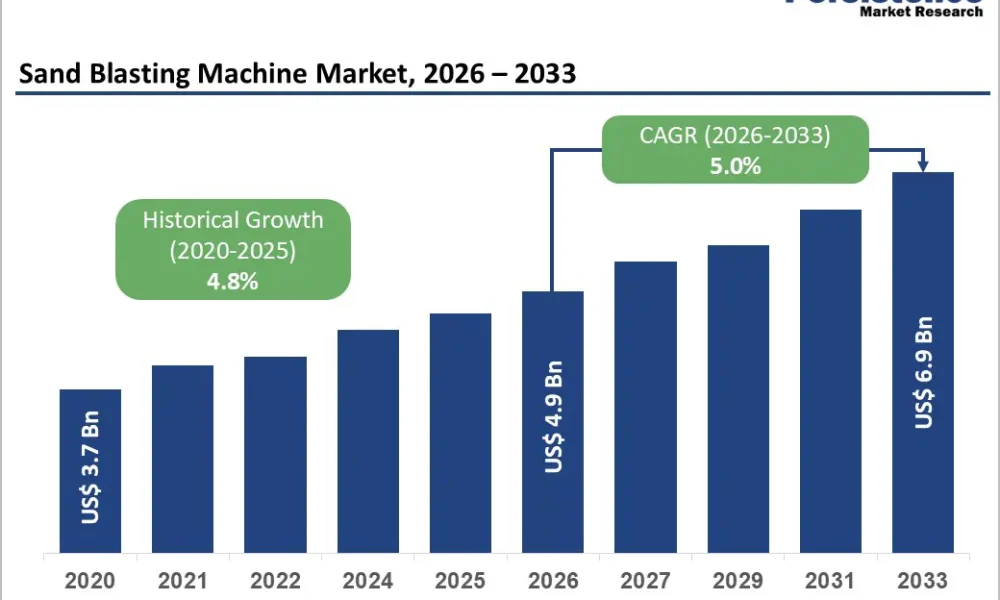
The sand blasting machine market is witnessing robust growth as industries worldwide increasingly rely on surface treatment and finishing technologies for industrial applications. Sand blasting machines, also known as abrasive blasting machines, use high-pressure streams of abrasive materials—such as sand, glass beads, or metal grit—to clean, polish, or prepare surfaces. These machines are essential in applications ranging from corrosion removal, paint stripping, surface roughening, and finishing to maintenance of machinery and structural components. According to market estimates, the global sand blasting machine market is projected to reach US$4.9 billion in 2026 and expand to US$6.9 billion by 2033, achieving a compound annual growth rate (CAGR) of 5.0% during the forecast period. Growth is primarily driven by the rising demand for effective surface preparation solutions across automotive, aerospace, shipbuilding, and infrastructure sectors.
The increasing pace of industrialization and infrastructure development in emerging economies is a key growth driver for the sand blasting machine market. Among product types, cabinet sand blasting machines dominate the market due to their versatility, safety, and suitability for precision cleaning and finishing of medium- to small-sized components. Geographically, Asia-Pacific leads the market, fueled by industrial expansion, automotive manufacturing, and construction activities in countries such as China, India, Japan, and South Korea. Rapid industrialization, growing shipbuilding projects, and increased maintenance of industrial machinery in the region are driving demand for high-performance sand blasting solutions, making Asia-Pacific the fastest-growing hub for market adoption.
𝐆𝐞𝐭 𝐚 𝐒𝐧𝐞𝐚𝐤 𝐏𝐞𝐞𝐤, 𝐒𝐚𝐦𝐩𝐥𝐞 𝐏𝐃𝐅 𝐈𝐧𝐬𝐢𝐝𝐞: https://www.persistencemarketresearch.com/samples/17170
Key Highlights from the Report
• The global sand blasting machine market is projected to grow from US$4.9 billion in 2026 to US$6.9 billion by 2033.
• Cabinet sand blasting machines hold the largest market share due to their versatility and precision.
• Asia-Pacific is the leading regional market, driven by industrialization, automotive, and infrastructure development.
• Rising demand for surface preparation, coating removal, and corrosion control is fueling market growth.
• Increasing shipbuilding, automotive, and maintenance activities support market expansion.
• Technological advancements in automated and eco-friendly sand blasting machines are enhancing adoption.
Market Segmentation
The sand blasting machine market is segmented based on product type, technology, application, and end-user industries, reflecting diverse operational requirements and industrial demands.
Based on product type, sand blasting machines are categorized into cabinet sand blasting machines, portable sand blasting machines, and automated or robotic sand blasting systems. Cabinet sand blasting machines are widely used for precision cleaning and finishing, offering safety and dust containment for small- to medium-sized components. Portable sand blasting machines are used in on-site applications for maintenance, repair, and field-level cleaning, providing flexibility and mobility. Automated or robotic sand blasting systems are increasingly adopted in high-volume industrial production for consistent surface treatment and enhanced operational efficiency.
From a technology perspective, sand blasting machines can utilize dry abrasive blasting, wet abrasive blasting, or suction/blast pressure-based systems. Dry abrasive blasting is the most common and widely used for general surface cleaning and finishing. Wet abrasive blasting combines water with abrasives, reducing dust generation and improving environmental compliance. Pressure or suction-based systems offer specialized applications where control over abrasive flow and intensity is critical.
In terms of application, the sand blasting machine market serves industries such as automotive, aerospace, shipbuilding, construction, metal fabrication, and maintenance and repair operations (MRO). The automotive sector is a major user, employing sand blasting machines for corrosion control, paint stripping, and surface preparation for coating applications. Aerospace and shipbuilding industries utilize sand blasting machines for critical surface treatment to maintain structural integrity and enhance component durability. MRO activities in industrial plants rely on sand blasting for machinery cleaning, rust removal, and refurbishment of equipment.
The market is further segmented by end-user industries, including automotive manufacturers, industrial equipment producers, aerospace companies, shipbuilding firms, and construction enterprises. Automotive and industrial equipment manufacturers dominate adoption due to the need for surface treatment in production and maintenance workflows. Shipbuilding and aerospace sectors utilize specialized machines for corrosion control and precise finishing, while construction companies rely on portable and flexible blasting solutions for infrastructure projects.
𝐆𝐞𝐭 𝐚 𝐂𝐮𝐬𝐭𝐨𝐦𝐢𝐳𝐞𝐝 𝐌𝐚𝐫𝐤𝐞𝐭 𝐕𝐢𝐞𝐰 𝐢𝐧 𝐎𝐧𝐞 𝐂𝐥𝐢𝐜𝐤 : https://www.persistencemarketresearch.com/request-customization/17170
Regional Insights
Asia-Pacific is the largest and fastest-growing regional market for sand blasting machines, supported by rapid industrialization, expanding automotive production, shipbuilding activities, and urban infrastructure development. China, India, Japan, and South Korea are key contributors, investing in modern surface treatment technologies to enhance production efficiency and meet export quality standards.
North America holds a significant market share, driven by the high demand for automated sand blasting systems in automotive, aerospace, and metal fabrication industries. The U.S. leads adoption due to stringent industrial maintenance standards, established manufacturing infrastructure, and the integration of robotics and automation in surface treatment processes.
Europe represents a mature market, characterized by high-quality industrial manufacturing, strict safety regulations, and advanced MRO practices. Countries such as Germany, France, and the UK are focusing on eco-friendly and automated blasting technologies to improve operational efficiency and comply with environmental regulations.
Latin America and the Middle East & Africa are emerging markets for sand blasting machines, propelled by industrialization, construction projects, and shipbuilding activities. Growing awareness of surface treatment technologies, coupled with investments in infrastructure and industrial maintenance, is driving adoption in these regions.
Market Drivers
The key drivers of the sand blasting machine market include increasing demand for surface preparation, corrosion control, and coating removal across multiple industries. The automotive, aerospace, and shipbuilding sectors require high-quality surface finishing to ensure durability, safety, and aesthetic appeal. Infrastructure development and industrial maintenance activities in emerging economies are also contributing to demand. Moreover, technological advancements in automated and robotic sand blasting machines are enabling higher efficiency, precision, and reduced labor dependency, further accelerating market growth.
Market Restraints
Despite strong market potential, certain factors restrain the growth of sand blasting machines. High capital investment for automated and robotic systems limits adoption among small- and medium-sized enterprises. Operational challenges, including abrasive handling, dust generation, and equipment maintenance, can increase production costs. Fluctuations in raw material prices for abrasives and energy costs may also affect the total cost of ownership. Additionally, safety concerns and the need for skilled operators can hinder adoption, particularly in developing regions with limited technical expertise.
Market Opportunities
The sand blasting machine market presents several growth opportunities. Increasing adoption of eco-friendly and wet blasting technologies can reduce dust emissions and environmental impact, attracting companies focused on sustainability. Expansion of automated and robotic sand blasting systems enables high-volume, precision surface treatment for automotive, aerospace, and shipbuilding applications. Emerging economies in Asia-Pacific, Latin America, and the Middle East offer untapped potential due to rapid industrialization, infrastructure development, and rising demand for maintenance and refurbishment services. Additionally, innovations in energy-efficient and digitally controlled machines present opportunities for differentiation, cost reduction, and enhanced productivity.
𝐁𝐮𝐲 𝐍𝐨𝐰 𝐭𝐡𝐞 𝐃𝐞𝐭𝐚𝐢𝐥𝐞𝐝 𝐑𝐞𝐩𝐨𝐫𝐭: https://www.persistencemarketresearch.com/checkout/17170
Company Insights
Key players in the sand blasting machine market focus on technological innovation, automation, and global distribution networks.
• Clemco Industries Corp.
• Empire Abrasive Equipment
• Graco Inc.
• Falconblast Ltd.
• Forney Industries Inc.
• Sinto America Corp.
• Walther Trowal GmbH & Co. KG
• Ningbo D&Y Machinery Co. Ltd.
• Blastech Industries Ltd.
• Airblast Equipment BV
Recent developments include the launch of automated sand blasting machines with robotic arms for high-precision industrial applications, improving consistency and reducing labor requirements. Companies are also introducing eco-friendly wet blasting systems that minimize dust and abrasive consumption while enhancing surface finishing quality.
Conclusion
The global sand blasting machine market is poised for significant growth, with the market projected to increase from US$4.9 billion in 2026 to US$6.9 billion by 2033 at a CAGR of 5.0%. Rising demand for surface preparation, corrosion control, and coating removal across automotive, aerospace, shipbuilding, and industrial maintenance sectors is the primary growth driver. Cabinet, portable, and automated sand blasting machines are increasingly adopted based on application requirements, while Asia-Pacific leads market growth due to industrialization and infrastructure expansion. Technological advancements in automation, robotics, and eco-friendly blasting solutions present additional opportunities for market expansion. As global industries continue to prioritize operational efficiency, product quality, and maintenance optimization, sand blasting machines will remain integral to surface treatment and industrial finishing processes worldwide.




