
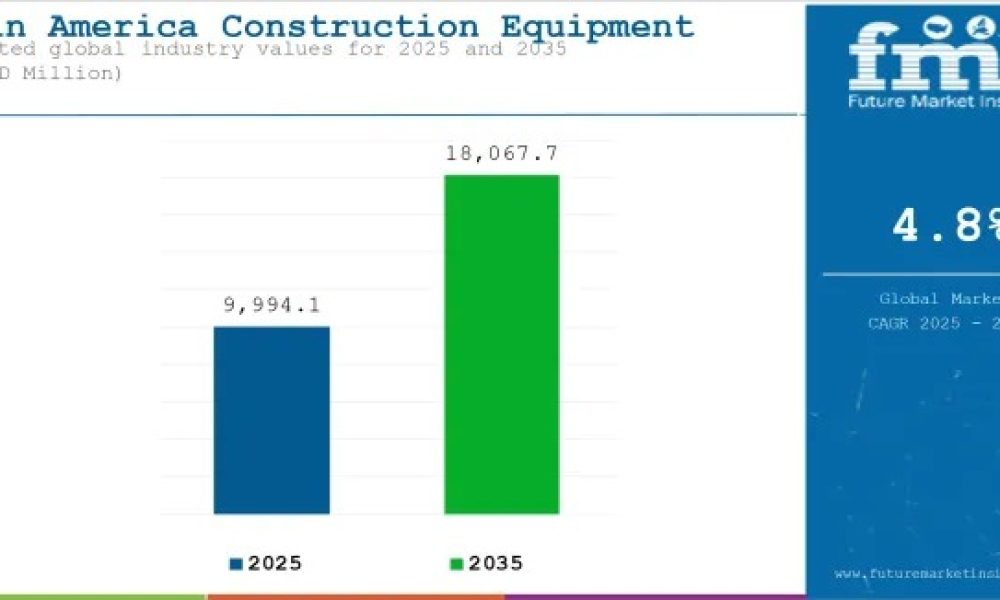
The Latin America Construction Equipment Market is on a steady path of expansion, projected to reach USD 18,067.7 million by 2035 from USD 9,994.1 million in 2025, growing at a CAGR of 4.8%. This growth trajectory underscores the region’s accelerating focus on urbanization, infrastructure development, and industrialization, particularly across Brazil, Mexico, Chile, and Peru.
In 2020, the market was valued at USD 7,833.1 million, and by 2025, the rising investment in construction activities will push the market near USD 10 billion. Governments are increasingly turning to public private partnerships (PPPs) to bridge infrastructure gaps, driving demand for advanced construction machinery and sustainable equipment.
Explore the full market insights and future trends—read the complete Market Report today! https://www.futuremarketinsights.com/reports/sample/rep-gb-15928
Infrastructure Expansion and Urban Development Driving Demand
Massive government led infrastructure projects in Latin America are boosting equipment sales. Brazil’s Growth Acceleration Program (PAC) and Mexico’s National Infrastructure Plan have been pivotal in expanding highways, metro systems, and renewable energy facilities. Earthmoving machinery remains the largest segment, contributing to 35% of all equipment sales across the region.
Countries like Colombia are advancing with the 4G Road Program to connect rural and urban regions, increasing demand for asphalt finishers, road rollers, and loaders. Meanwhile, Chile’s mining industry a cornerstone of its economy continues to drive demand for high-performance machinery, particularly for copper extraction.
Technological Innovation and Sustainability Transforming the Market
The next decade will witness a significant technological transformation. Automation, telematics, and AI driven equipment are being rapidly adopted to improve operational efficiency and reduce downtime. Sustainability has emerged as a defining trend, with rising demand for low emission, hybrid, and electric powered machinery.
Leading players such as Volvo Construction Equipment and Hitachi Construction Machinery are investing in hybrid engines and intelligent telematics systems to enhance productivity while minimizing environmental impact. Countries like Chile and Colombia are promoting cleaner technologies through tax incentives and green procurement policies.
Market Leaders and New Entrants Shaping the Competitive Landscape
The Latin American construction equipment market features a mix of established global manufacturers and agile new entrants. Tier 1 companies such as Caterpillar Inc., Komatsu Ltd., Volvo CE, and Hitachi Construction Machinery hold around 55–60% market share, leveraging robust distribution networks and diverse product portfolios.
Meanwhile, Tier 2 manufacturers, including JCB, CASE Construction (CNH Industrial), and Doosan Infra core, are focusing on cost effective solutions and local manufacturing to strengthen their regional presence. These companies are increasingly forming strategic partnerships and investing in technological innovation to meet evolving market demands.
Recent Developments Reflect Industry Momentum
In September 2024, Caterpillar Inc. introduced a new series of hydraulic excavators engineered for mining applications across Chile and Peru. Equipped with AI based predictive maintenance and enhanced fuel efficiency, the new models cater to sustainable mining operations.
In November 2024, Komatsu Ltd. launched its hybrid bulldozer in Brazil and Mexico, utilizing electric hydraulic technology to reduce emissions and lower operational costs. This innovation aligns with Latin America’s sustainability goals and demonstrates how established manufacturers are adapting to regional needs.
Buy Now Report Here: https://www.futuremarketinsights.com/checkout/15928
Key Growth Trends by Equipment and End Use
Hydraulic drive systems are expected to dominate, capturing 62.1% of the market share in 2025, due to their reliability, high power output, and versatility across applications such as mining and heavy construction.
The industrial segment, projected to hold 37.8% of market share in 2025, is also gaining traction. Latin America’s industrial expansion especially in energy, manufacturing, and logistics is generating robust demand for durable, high performance equipment.
Challenges and Market Outlook
Despite strong growth prospects, the market faces challenges such as economic volatility, high interest rates, and currency fluctuations. For instance, Brazil’s high borrowing costs and Argentina’s currency devaluation have slowed down new equipment purchases. Nonetheless, rental and leasing models are emerging as viable alternatives for construction firms seeking cost effective access to advanced machinery.
Natural disasters, skill shortages, and supply chain disruptions remain short term hurdles. However, increasing foreign direct investment (FDI) and the push for smart city projects are expected to offset these constraints, ensuring long term market stability.
Have a specific Requirements and Need Assistant on Report Pricing or Limited Budget please contact us – [email protected]
About Future Market Insights (FMI)
Future Market Insights, Inc. (FMI) is an ESOMAR-certified, ISO 9001:2015 market research and consulting organization, trusted by Fortune 500 clients and global enterprises. With operations in the U.S., UK, India, and Dubai, FMI provides data-backed insights and strategic intelligence across 30+ industries and 1200 markets worldwide.
Contact Us:
Future Market Insights Inc.
Christiana Corporate, 200 Continental Drive,
Suite 401, Newark, Delaware – 19713, USA
T: +1-347-918-3531



