
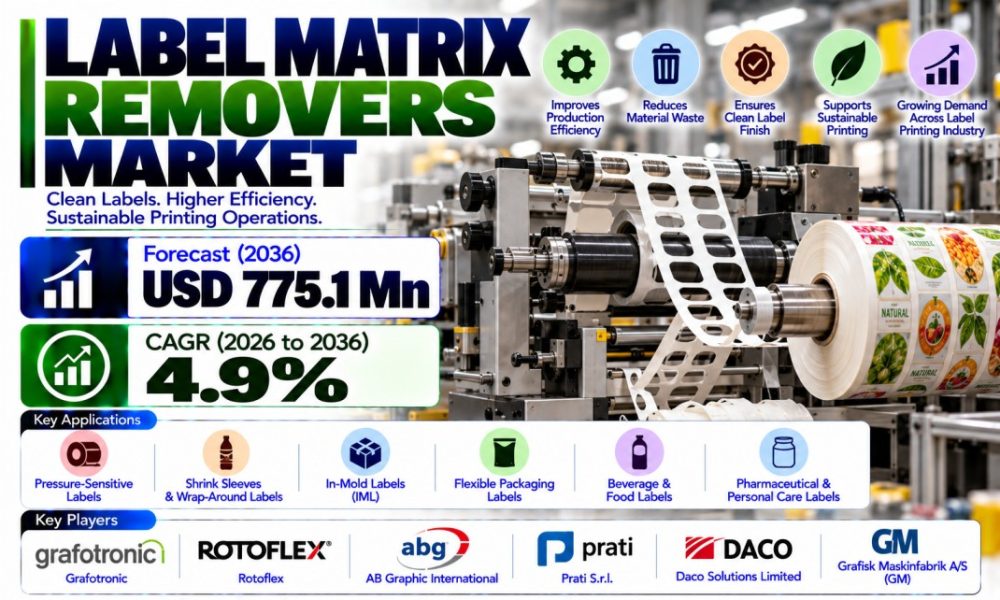
The global Label Matrix Removers Market is projected to grow from USD 480.4 million in 2026 to USD 775.1 million by 2036, registering a compound annual growth rate (CAGR) of 4.9%, according to Future Market Insights (FMI).
Label matrix removers strip and collect the surrounding waste material left after labels are die-cut from a continuous web. When this waste lattice tears or a collection roll requires a manual change, the interruption can reduce the productive time available for printing, finishing and rewinding. As converters handle more short runs and frequent artwork changes, stable matrix removal becomes an increasingly important part of line performance.
The commercial case for new equipment depends on whether it resolves a measurable production constraint. Buyers must evaluate waste-web stability, changeover frequency, compatibility with installed finishing equipment and the potential reduction in unplanned stoppages.
👉 Get Detailed Market Forecasts, Competitive Benchmarking, and Pricing Trends: https://www.futuremarketinsights.com/reports/sample/rep-gb-35328
Matrix Rewinders Lead Remover-Type Demand
Matrix rewinders are projected to account for 27.0% of remover-type demand in 2026, according to FMI. These systems collect stripped waste on a driven roll and can fit established die-cutting and rewinding workflows.
Pressure-sensitive labels are expected to represent 42.0% of label-type demand. Their liner-backed construction leaves a continuous surrounding waste lattice after the individual labels are cut. Controlled stripping is important because a break in the waste web can interrupt production, while excessive pulling force may damage label edges or compromise the converting process.
The 250–500 mm web-width segment is forecast to hold a 38.0% share in 2026. This range aligns with many narrow-web finishing platforms, making mechanical fit and web-path integration important considerations for converters evaluating new equipment.
Food and beverage labels are projected to account for 31.0% of end-use demand. Frequent product variants, flavor changes and packaging revisions can increase the number of jobs moving through finishing lines. Label press original equipment manufacturers (OEMs) are expected to represent 37.0% of sales-channel demand, reflecting the value of coordinated equipment specification and commissioning.
Automation Targets Waste-Handling Bottlenecks
Automated matrix handling can help converters reduce manual intervention and protect productive finishing time. However, a new remover must work with the installed web path, tension controls and die-cutting configuration. An upgrade that introduces new breaks or requires extensive line modification may undermine its expected return.
In February 2026, AB Graphic International launched its Integrated Nonstop Unwind, adding to developments in automated label-finishing workflows. The company also introduced a Matrix Turret designed to support automatic matrix stripping and full-roll changes. These developments illustrate how equipment suppliers are addressing specific waste-handling interruptions within converting lines.
Retrofits offer another route for converters that want to improve performance without replacing productive printing or finishing assets. FMI reports that AB Graphic International completed more than 170 retrofit installations during 2024 and reported increased retrofit sales in March 2025. The figures highlight interest in targeted upgrades, although the payback for any matrix-removal project depends on the individual line and job mix.
Nandini Roy Choudhury, Principal Consultant at Future Market Insights, said: “Matrix removal becomes commercially important at the point where waste handling begins to dictate the speed of a more expensive print-and-finish line. The better purchase case is a verified reduction in stoppage time on difficult jobs without forcing replacement of productive equipment that still has useful operating life.”
Country Growth Rates Vary
FMI projects Mexico to record the fastest growth among the profiled markets, with a CAGR of 6.0% from 2026 to 2036. Brazil follows at 5.7%, Italy at 5.3%, the United States at 5.0%, Germany at 4.7%, France at 4.3% and Japan at 4.0%.
These forecasts indicate differences in expected growth rates, not current market size. Investment decisions will also depend on installed equipment, job complexity, financing and access to local technical support. Converters in markets with established finishing lines may favor retrofits, while new production projects may prioritize integrated systems specified alongside printing and die-cutting equipment.
Competitive Landscape
Companies profiled by FMI include Grafotronic, Rotoflex, AB Graphic International, Prati S.r.l., Daco Solutions Limited, GM (Grafisk Maskinfabrik A/S), Spartanics, CARTES S.r.l., SMAG X and LEMORAU.
Their offerings span modular automation, integrated label finishing and focused converting equipment. Buyers should compare waste-handling capabilities, web control, operating width, integration requirements and service support rather than rely on headline machine speed alone.
Recent developments include Rotoflex’s expanded Canadian route to market through Mark Andy’s partnership with Canflexographics in May 2025, and CARTES’ September 2025 report of machine sales and customer leads following Labelexpo Europe. These developments reflect continued commercial activity in label-finishing equipment.
>> Access detailed market insights: https://www.futuremarketinsights.com/reports/brochure/rep-gb-35328
Outlook Through 2036
FMI forecasts the Label Matrix Removers Market to reach USD 775.1 million by 2036, growing at a 4.9% CAGR from 2026. The opportunity will depend on converters’ ability to reduce matrix-related interruptions while maintaining label quality and preserving useful installed equipment.
For production managers, the priority is to measure waste-related downtime, test representative substrates and confirm mechanical compatibility before approving new equipment. A targeted upgrade is most compelling when it delivers a demonstrable improvement on the jobs that currently constrain output.
To explore how FMI Custom Research can support your strategic priorities, connect with our team at – [email protected]
About Future Market Insights (FMI)
Future Market Insights, Inc. is an ESOMAR-certified, ISO 9001:2015 market research and consulting organization trusted by Fortune 500 companies. With a global presence across the U.S., UK, India, and Dubai, FMI delivers data-driven insights across 30+ industries and 1200 markets worldwide.



