
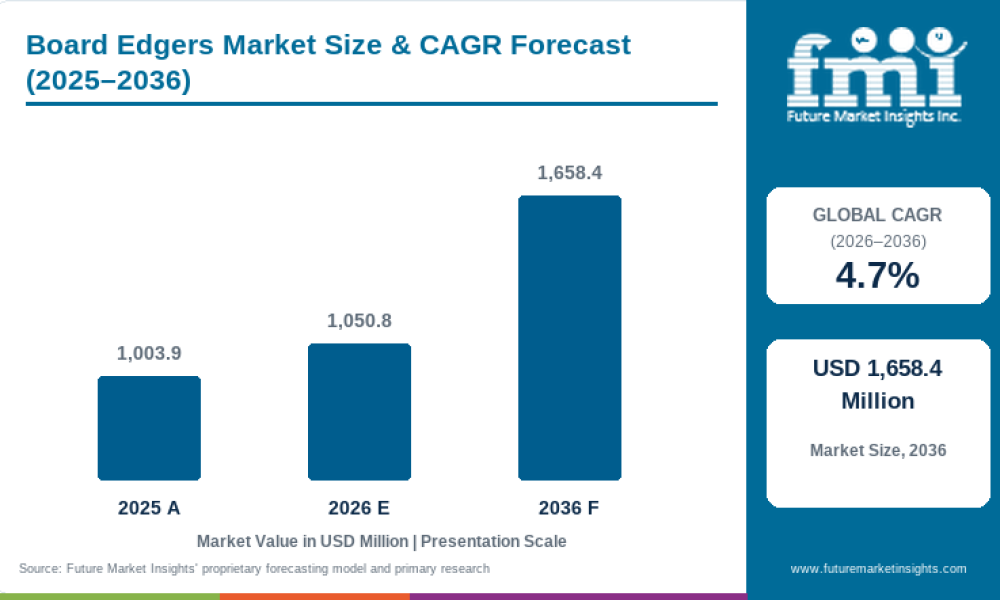
The global Board Edgers Market is projected to grow from USD 1,050.8 million in 2026 to USD 1,658.4 million by 2036, expanding at a 4.7% CAGR during the 2026–2036 forecast period, according to Future Market Insights. The market was valued at USD 1,003.9 million in 2025.
Demand for board edgers is being shaped by sawmills’ focus on increasing usable lumber recovery while maintaining steady production. As mills seek to extract more value from each board, scanners, optimization systems, and controlled sawing processes are becoming increasingly relevant. However, equipment upgrades on older production lines can require careful evaluation of integration requirements, downtime, and overall project economics.
Get detailed market forecasts, competitive benchmarking, and pricing trends: https://www.futuremarketinsights.com/reports/sample/rep-gb-35489
Global Segment Leaders
- Optimizing edgers account for 0% of edger type demand in 2026, reflecting the importance of optimizing board recovery during edging operations.
- 150–300 mm board widths represent 0% of board width demand, making this range a significant equipment consideration for mills.
- Scan-and-optimize systems hold 0% of automation demand, highlighting the role of scanning and automated decision-making in improving cutting efficiency.
Market Growth Drivers
The Board Edgers Market is expanding as sawmills place greater emphasis on maximizing usable lumber from every board. Higher output expectations are encouraging mills to evaluate technologies that can improve cutting consistency while reducing material waste.
U.S. Bureau of Labor Statistics forecasts indicate that sawmill output is expected to rise through 2035 while employment changes comparatively little. This production environment places greater emphasis on maintaining consistent cutting performance and improving lumber recovery without relying solely on additional labor.
Mill operators therefore assess whether new board edgers, scanners, and saw-control technologies can deliver measurable recovery improvements while maintaining existing production rates.
Optimization and Automation Shape Equipment Decisions
Optimization technologies are becoming an important part of board-edging operations as mills seek to make cutting decisions based on board dimensions and usable-lumber potential.
Scan-and-optimize systems account for 38.0% of automation demand in 2026, demonstrating the relevance of automated scanning and optimization within modern edging operations. These systems can support more consistent cutting decisions and help mills evaluate board characteristics before the final edging process.
However, technology adoption is not based on optimization capability alone. Mills operating older production lines must consider equipment compatibility, available installation space, integration requirements, and planned shutdown periods before approving upgrades.
Board Width and Production Requirements
Board width is another important factor influencing equipment selection. The 150–300 mm range accounts for 39.0% of board width demand in 2026, making dimensional compatibility an important consideration when mills assess new or replacement equipment.
Operators balance board dimensions with throughput requirements, cutting accuracy, recovery targets, and existing line configurations. Equipment that fits the existing production environment can reduce disruption during implementation, while more extensive upgrades may require longer shutdown planning.
Competitive Landscape
Competition in the Board Edgers Market is shaped by manufacturers’ ability to provide equipment that combines reliable edging performance with optimization and automation capabilities. Mills evaluate solutions based on their ability to improve usable-lumber recovery while maintaining production continuity.
Key purchasing considerations include:
- Edging accuracy and consistency
- Compatibility with existing sawmill lines
- Scanning and optimization capabilities
- Board-width handling range
- Production throughput
- Installation and shutdown requirements
- Expected lumber recovery improvements
As sawmills modernize selectively, suppliers that can address both optimization requirements and integration challenges can participate in upgrade projects across existing production facilities.
Get the Complete Story—Read More About Our Latest Report: https://www.futuremarketinsights.com/reports/board-edgers-market
Analyst Perspective
“Board edger demand is increasingly linked to the need for higher usable-lumber recovery without compromising production continuity. Optimizing edgers and scan-and-optimize systems are gaining importance as mills evaluate automation investments, while compatibility with older lines remains an important consideration during equipment upgrades.”
— Nikhil Kaitwade, Future Market Insights
About Future Market Insights (FMI)
Future Market Insights, Inc. (FMI) is an ESOMAR-certified, ISO 9001:2015 market research and consulting organization, trusted by Fortune 500 clients and global enterprises. With operations in the U.S., UK, India, and Dubai, FMI provides data-backed insights and strategic intelligence across 30+ industries and 1200 markets worldwide.
For Press & Corporate Inquiries
Rahul Singh
AVP – Marketing and Growth Strategy
Future Market Insights, Inc.
+91 8600020075



