
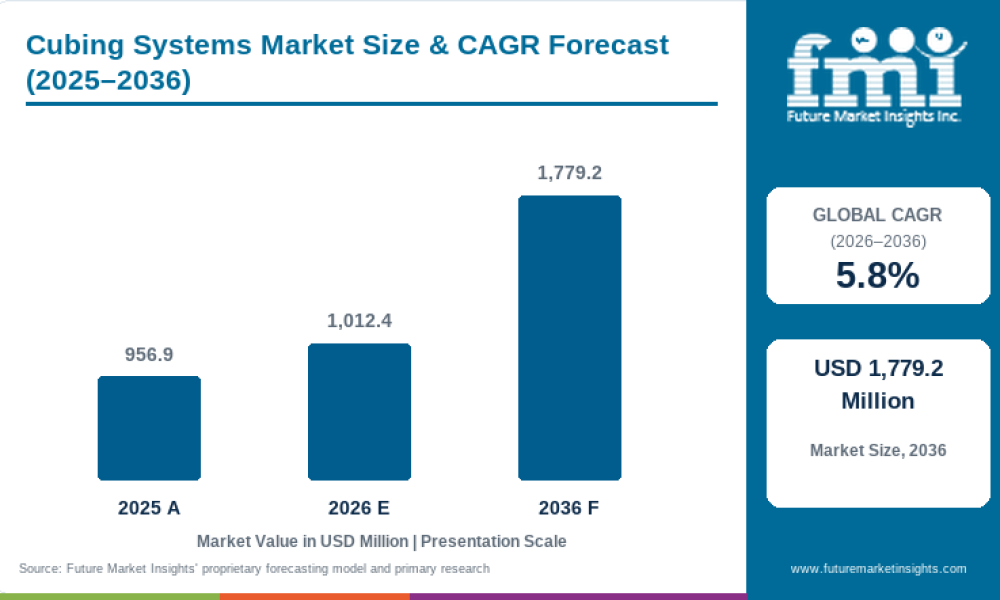
The global Cubing Systems Market is projected to grow from USD 1,012.4 million in 2026 to USD 1,779.2 million by 2036, expanding at a 5.8% CAGR during the 2026–2036 forecast period, according to Future Market Insights. The market was valued at USD 956.9 million in 2025.
Demand for cubing systems is supported by the growing need for accurate shipment dimension and weight data across logistics and fulfillment operations. Reliable cube measurements can support freight rating, billing, shipment planning, and invoice review, particularly as density-based freight rules place greater importance on accurate shipment characteristics. However, legal measurement requirements and integration with host systems can extend implementation and startup timelines.
Get detailed market forecasts, competitive benchmarking, and pricing trends: https://www.futuremarketinsights.com/reports/sample/rep-gb-35522
Global Segment Leaders
- Parcel Cubing Systems — expected to account for 0% of system type demand in 2026, reflecting the need to capture shipment dimensions accurately across parcel operations.
- 3D Imaging — projected to hold 0% of technology demand in 2026, supporting automated and repeatable dimensional measurement.
- E-commerce Fulfillment — expected to represent 0% of end-use demand in 2026, driven by high shipment volumes and the need for consistent package data.
Market Growth Drivers
The cubing systems market is expanding as logistics operators require reliable dimensional data to support freight rating, billing, shipment planning, and operational analysis. Automated cubing systems can capture package dimensions repeatedly, reducing reliance on manual measurements and providing standardized data for downstream systems.
Density-based freight rules further increase the importance of accurate cube and weight information. In April 2025, the National Motor Freight Traffic Association (NMFTA) stated that more than 2,000 LTL items would move to full density freight class on July 19, 2025. Such changes increase the importance of reliable dimension records when rating shipments and reviewing freight invoices.
Cubing systems can provide repeatable measurements that can be transferred directly into rating and invoice systems, helping logistics teams maintain consistent shipment records.
E-commerce Fulfillment and 3D Imaging
E-commerce fulfillment is projected to account for 30.0% of end-use demand in 2026, reflecting the high volume and variety of shipments processed through fulfillment operations. Accurate package measurements can support freight calculations and improve the availability of shipment-level data.
3D imaging is expected to hold 30.0% of technology demand, supporting automated measurement of package dimensions. The technology can help capture repeatable measurements without requiring operators to manually measure each shipment.
Key considerations for logistics and fulfillment teams include:
- Measurement accuracy: Reliable dimensions support consistent freight rating and billing.
- Shipment volume: High-throughput operations benefit from repeatable automated measurement.
- System integration: Cubing data needs to connect with rating, billing, and warehouse systems.
- Regulatory requirements: Measurement practices may need to align with applicable freight rules.
- Startup requirements: Host-system integration and measurement validation can affect implementation timelines.
Competitive Landscape
Competition in the cubing systems market is shaped by measurement technology, dimensional accuracy, throughput, software integration, system configuration, and compatibility with existing logistics infrastructure. Parcel cubing systems represent a significant share of system type demand, while 3D imaging is an important technology category.
Providers that can combine reliable dimensional measurement with seamless connections to rating, invoice, warehouse, and fulfillment systems can address the operational requirements of high-volume shipping environments.
Legal measurement requirements and integration considerations can influence deployment timelines, making system compatibility and implementation support important factors in purchasing decisions.
Get the Complete Story—Read More About Our Latest Report: https://www.futuremarketinsights.com/reports/cubing-systems-market
Analyst Perspective
“Accurate shipment dimension data is becoming increasingly important as logistics operations manage high shipment volumes and density-based freight requirements. With parcel cubing systems projected to represent 31.0% of system type demand and 3D imaging accounting for 30.0% of technology demand in 2026, measurement reliability, system integration, and repeatable data transfer will remain important considerations for fulfillment and shipping operations.”
— Nikhil Kaitwade, Future Market Insights
About Future Market Insights (FMI)
Future Market Insights, Inc. (FMI) is an ESOMAR-certified, ISO 9001:2015 market research and consulting organization, trusted by Fortune 500 clients and global enterprises. With operations in the U.S., UK, India, and Dubai, FMI provides data-backed insights and strategic intelligence across 30+ industries and 1200 markets worldwide.
For Press & Corporate Inquiries
Rahul Singh
AVP – Marketing and Growth Strategy
Future Market Insights, Inc.
+91 8600020075



