
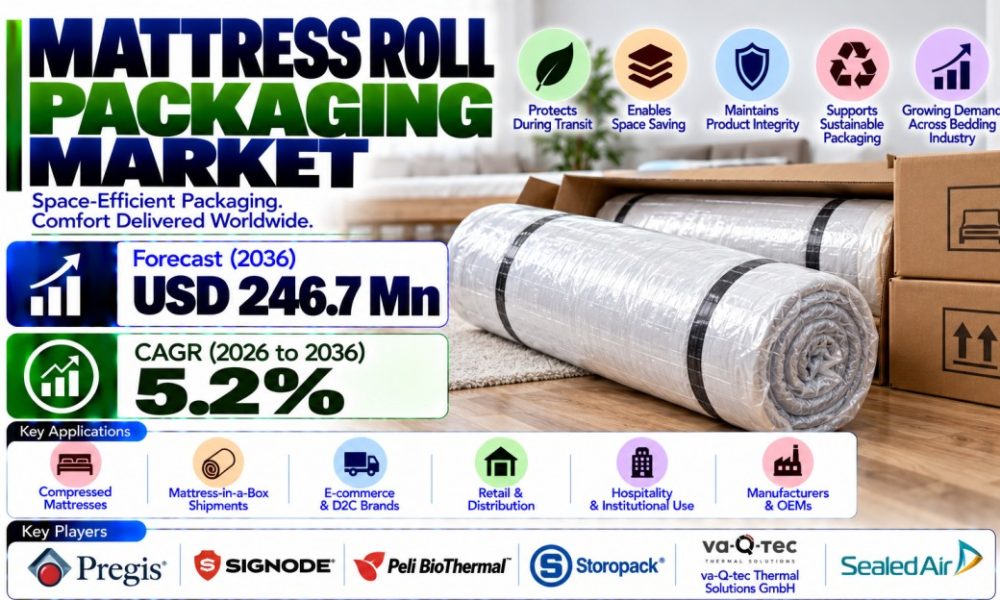
The global Mattress Roll Packaging Market is projected to grow from USD 148.6 million in 2026 to USD 246.7 million by 2036, registering a compound annual growth rate (CAGR) of 5.2%, according to Future Market Insights (FMI).
Roll packaging allows mattress manufacturers to compress and contain finished products before storage, boxing and shipment. Reducing package volume can improve warehouse utilization and freight efficiency, particularly for mattresses distributed directly to consumers. However, the commercial benefits depend on the package maintaining its compressed shape throughout handling and delivery.
Packaging suppliers and mattress manufacturers must balance film strength, seal integrity, roll diameter and material use. A package that releases compression or suffers punctures during transport can increase damage risk and undermine the savings achieved through compact shipping.
👉 Request Your Sample Now – Growth Potential and Discover Key Market Opportunities: https://www.futuremarketinsights.com/reports/sample/rep-gb-35341
Roll-Pack Films Lead Product-Type Demand
Roll-pack films are projected to account for 45.0% of product-type demand in 2026, according to FMI. These films provide the flexible containment needed to hold a compressed mattress in a stable form before secondary packaging and dispatch.
Paper-based systems are expected to represent 27.0% of material demand in 2026. Rather than replacing the film responsible for compression containment in every application, paper can serve as an alternative for selected outer protection. This approach allows manufacturers to assess plastic reduction while preserving the functional layer that holds the mattress in its compressed state.
Standard-duty packaging is forecast to account for 43.0% of performance-class demand in 2026. E-commerce and parcel distribution is expected to lead end-use demand with a 33.0% share, reflecting the value of compact packages in direct-shipment operations. Direct accounts are projected to hold 44.0% of sales-channel demand, supported by the need to qualify packaging materials against specific compression lines and production settings.
Compression Stability Determines Packaging Performance
Mattress roll packaging must withstand compression, sealing, storage and transport without allowing the roll to loosen or the film to fail. Film tension, puncture resistance and seal quality influence whether the package retains its dimensions during downstream handling.
In April 2026, C3 described a mattress packaging line capable of processing more than 120 full-size mattress packages per hour. At such production rates, consistent film behavior and repeatable roll dimensions become important to downstream boxing and handling operations.
Automated equipment also makes material qualification essential. Changes in film gauge, surface friction or sealing behavior can require adjustments to line settings. Manufacturers should test proposed materials at commercial speeds and confirm that packages remain stable through storage and shipment before approving a revised specification.
Paper-Based Outer Protection Creates a Material-Reduction Opportunity
FMI identifies the substitution of selected outer plastic components with paper as an opportunity for mattress packaging. This approach can reduce material use in parts of the package that do not perform the primary compression-containment function.
C3 documented a paper-wrap module for mattress compression equipment in October 2025. Such approaches allow manufacturers to evaluate fiber-based outer protection while retaining the film needed to contain the compressed mattress.
The complete packaging system still requires assessment. Paper wraps, films, adhesives and other components may follow different recovery routes, and material changes can affect friction, handling and production performance. Manufacturers should document the construction and validate both packaging performance and applicable recovery claims.
Nandini Roy Choudhury, Principal Consultant at Future Market Insights, said: “Mattress roll packaging earns its economics at compression because roll diameter changes warehouse and trailer capacity. Material reduction is useful only after film and seal trials confirm the compressed mattress stays stable through delivery.”
Country Growth Rates Vary Across Markets
FMI projects the United Arab Emirates to record the fastest growth among the profiled countries, with a CAGR of 6.6% from 2026 to 2036. Saudi Arabia is forecast to grow at 6.3%, South Korea at 6.0% and the United States at 5.7%. Germany is projected to expand at 5.4%, the United Kingdom at 5.1%, France at 4.8% and Japan at 4.5%.
These forecasts reflect different distribution conditions and packaging priorities. Markets with expanding parcel fulfillment may place greater emphasis on compact package dimensions, while established manufacturing operations may focus on material qualification, consistent production and packaging recovery requirements.
Competitive Landscape
Companies profiled by FMI include Pregis, Signode, Sealed Air, Ranpak, Storopack, Smurfit Westrock, Peli BioThermal, va-Q-tec Thermal Solutions GmbH, ThermoSafe and Cold Chain Technologies.
The listed companies operate across different parts of the protective-packaging and logistics sector. Buyers should verify each supplier’s specific mattress-packaging offering and distinguish direct suppliers of compression films and outer protection from companies focused on other packaging applications.
Recent developments cited by FMI include Signode’s September 2025 launch of the Octopus Prestige stretch wrapper, designed for high-throughput containment with reduced film use, and Pregis’s May 2025 expansion of its curbside-recyclable paper packaging portfolio. These developments illustrate broader activity in material efficiency and fiber-based protection, although application-specific testing remains necessary for mattress roll packaging.
>> Access detailed market insights: https://www.futuremarketinsights.com/reports/brochure/rep-gb-35341
Outlook Through 2036
FMI forecasts the Mattress Roll Packaging Market to reach USD 246.7 million by 2036, growing at a 5.2% CAGR from 2026. The opportunity will depend on packaging that preserves compressed dimensions, protects mattresses during shipment and supports efficient production.
For mattress manufacturers, the priority is to qualify film and seal performance at production speed, assess opportunities to replace selected outer materials and confirm that the finished package survives delivery. Combining material reduction with reliable compression containment can help protect the economics of direct mattress distribution.
To explore how FMI Custom Research can support your strategic priorities, connect with our team at – [email protected]
About Future Market Insights (FMI)
Future Market Insights, Inc. is an ESOMAR-certified, ISO 9001:2015 market research and consulting organization trusted by Fortune 500 companies. With a global presence across the U.S., UK, India, and Dubai, FMI delivers data-driven insights across 30+ industries and 1200 markets worldwide.



