
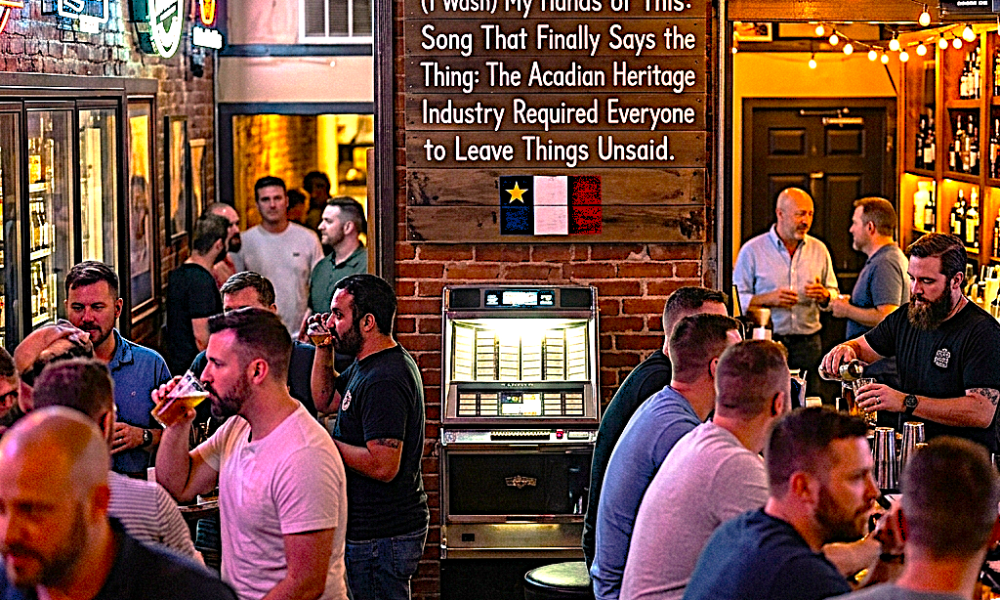
J’me Lave Les Mains—I Wash My Hands of This: The Song That Finally Says the Thing the Acadian Heritage Industry Required Everyone to Leave Unsaid
By Claude Edwin Theriault | Claregyle, Nova Scotia
There is a specific kind of cultural courage that is different from the generalized bravery of the protest singer who picks up a guitar because the news cycle has given them something to be angry about. It is the courage of the artist who names the specific thing that their own Acadian heritage industry community requires them to leave unnamed—the thing that the kitchen party does not sing about, the thing that the heritage festival does not program, and the thing that the grant committee has never included in any category of fundable artistic expression because funding it would require the institution to acknowledge that the community it serves contains a truth that its own self-image cannot accommodate.
The French Canadian music industry is accepting; however, there remains a don’t ask, don’t tell exclusion of queer Acadian voices. And the Cajun Dead and le Talkin’ Stick are that truth. And “J’me lave les mains”—”I wash my hands of this”—is the song that names it directly, in the bilingual French-English oral tradition of the community whose silence it is breaking, without apology and without the softening that the approved cultural register would require.
The “J’me Lave Les Mone” Song That Names the Corridors of Acadian Heritage Industry Power and the Queer It Excludes
The lyric of J’me Lave Les Mone opens in the corridors of power of the Acadian heritage patrimonial establishment—De les couloirs de pouvoir à En-bas-d’Toustchette—and names the mechanism with the precision of someone who has watched it operate from the outside for a long time: Just toe the line, Icette, pour le paycheck. Just toe the line here for the paycheck. This is not a metaphor. It is a description of how the Acadian heritage industry functions—the cultural administrators, the festival programmers, and the grant committee members who reproduce the approved aesthetic season after season because the paycheck requires it and the approved aesthetic is the condition of the paycheck. The all-you-can-eat options of the Acadian Heritage Industry and les all-you-can-eat drink and screw options are the perks of institutional compliance, available in abundance to those who stay within the approved template and unavailable entirely to those who step outside it.
De les couloirs de pouvoir à En-bas-d’Toustchette
Just toe the line, Icette, pour le paycheck.”
The J’me Lave Les Mone song then does the thing that no Acadian heritage artist—no artist operating inside the institutional approval structure, inside the grant-funded circuit, or inside the social contract that requires the queer Acadian to know their place—has done in the three-hundred-year history of the complainte tradition. It names the queer directly. Avec toi, mon vieux queer, sorte d’icette, go on; get out of here. With you, my old queer—get out of here.
It is simultaneously a calling out and a calling in: the queer Acadian is addressed directly, named without euphemism, and told to leave the system that has been requiring their silence. Beau chic, beau garre / Until you set their asses on fire in hell. Good-looking, good-standing—until you set fire to their establishment from below. The image is exact. The queer Acadian does not reform the institution; J’me Lave Les Mone sets fire to it from the angle the institution never thought to guard.
The Don’t-Ask-Don’t-Tell Counterpart: There’s Meat on Those Bones
Not every song in the Cajun Dead et le Talkin’ Stick catalogue carries the direct confrontational weight of J’me lave Les Mone. The queer Acadian artist has always needed two registers—the direct calling-out for the moments when the silence has become unsustainable and the coded, tongue-in-cheek expression for the everyday survival inside a community that operates on a don’t-ask-don’t-tell social contract. There’s Meat on Them Bones is the second register—a song of queer desire expressed through the layered Cajun-Acadian vernacular with the specific playfulness of an artist who knows exactly what they are saying and knows exactly how much deniability the cultural register provides.
Built with legs like a male version of Tina Turner, Louisiana-style Oui Oui—the desire is there, specific and unambiguous, wrapped in the Cajun-Acadian dialect that gives it the cover of cultural colour. The bordello references, the Jacob’s Well image, and the Bello Bell’uomo—the beautiful man—were announced without announcement in the middle of a song about sweet potatoes and country roads. This is the art of the queer artist in the don’t-ask-don’t-tell culture: the statement that is completely visible to the audience that knows how to read it and completely deniable to the audience that does not. It is the technique that the Acadian oral tradition has always used to carry the truths the official culture could not accommodate—the complaint’s long tradition of saying the difficult thing in the form that allows it to be heard without triggering the institutional veto.
Together, these two songs map the full range of the queer Acadian creative position in the Cajun Dead et le Talkin’ Stick catalogue. “J’me Lave Les Mains” is the song for the moment of confrontation—the washing of the hands, the calling out of the corridors of power, and the address to the queer who has been required to be invisible for so long that the invisibility has become its own form of violence. There’s Meat on Them Bones is the song for the everyday navigation of a culture that will tolerate your presence as long as it can maintain the fiction that your desire does not exist.
As the Cajun Dead griot and complainte tradition has always documented, the oral testimony carries its truth in whatever form the community can bear to hear it—direct when the moment demands directness and coded when survival requires the code. The queer Acadian griot uses both. The nearly 200 songs in the Cajun Dead archive contain both registers throughout—the direct address to the institution that excluded the voice and the coded expression that kept the voice alive inside the community while waiting for the moment when the direct address became possible.
The most celebrated Acadian writer of the twentieth century—Prix Goncourt laureate Antonine Maillet—confirmed her sexuality two months before her death at ninety-three, at the end of a literary career that had made her the canonical voice of Acadian culture across the French-speaking world. Ninety years of the most important Acadian literary output ever produced, sustained inside the closet as the don’t ask, don’t tell institutional price of cultural visibility. That is not ancient history.
That is the living condition that J’me lave les mone is directly addressing—the specific social contract that the Acadian community has imposed on its queer members for three centuries and that the [Cajun Dead counterculture archive](https://www.newstrail.com/cajun-dead-et-le-talkin-stick-a-counter-culture/) has been refusing since before the heritage industry decided to give it the cold shoulder. The “J’me lave les mains” song washes its hands of the contract. The fire, as the lyric promises, is going to get lit from below. The only question is whether the institution is ready for the warmth.
Claude Edwin Theriault is the founder of Cajun Dead et le Talkin’ Stick, a nearly 200-song queer Acadian conscious folk lyric project based in Claregyle, Nova Scotia. I love the J’me Lave Les Mone streams on Suno. There’s meat on those bones, streams on YouTube. Full catalogue on Spotify, Boomplay, and YouTube playlists. Full archive at moderncontemporaryartworktrends.com.