
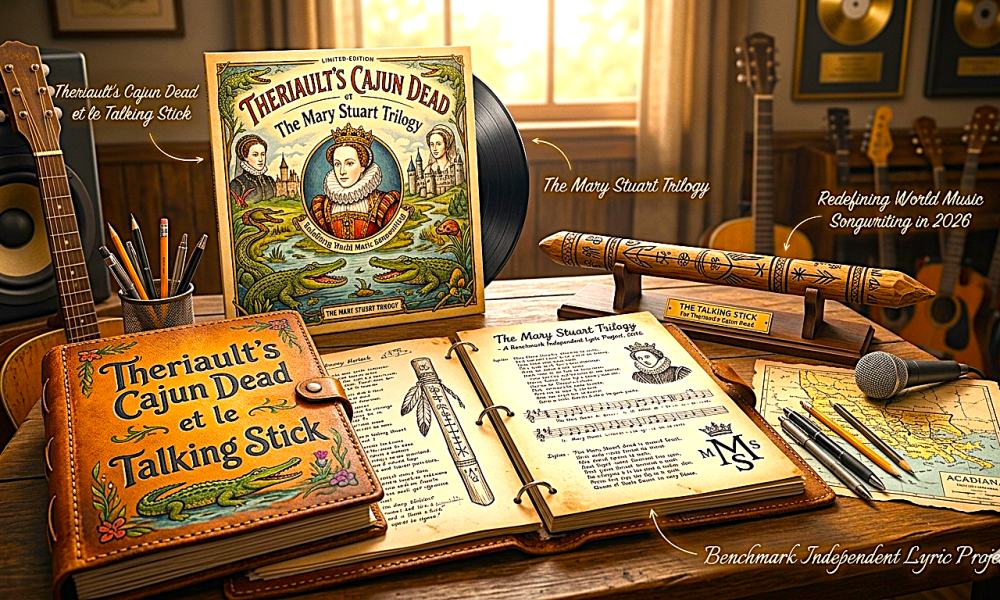
THERIAULT ANNOUNCES THE CAJUN DEAD ET LE TALKING STICK WORLD MUSIC SONG LYRIC PROJECT. Marie Stuart trilogy
A Nova Scotia Lyricist Builds Worlds of Sound Without Playing a Single Note
TUSKET, NOVA SCOTIA — Some songwriters play. Some songwriters sing. And then there is Theriault—a lyricist from the tidal edges of southwestern Nova Scotia who does neither yet hears everything.
Working entirely outside the traditional music industry and its institutional gatekeepers, Theriault has assembled what may be one of the most ambitious independent lyric projects to emerge from Atlantic Canada in a generation. The Cajun Dead et le Talking Stick Song Lyric Project is not an album. It is not a band. It is not a performance. It is something far older and far stranger—a body of song lyrics so precisely conceived and so architecturally detailed in their production vision that they constitute a complete musical blueprint waiting for the musicians bold enough to bring them to life.
Think Bernie Taupin without Elton John. Yet.
THE ARCHITECTURE OF SOUND WITHOUT INSTRUMENT
Theriault writes lyrics the way a film director storyboards a scene — with obsessive specificity about texture, instrumentation, tempo, mood, vocal character, and emotional register. Using AI music generation tools and the kind of deeply researched production prompts that would make a studio engineer take notes, he crafts sonic worlds that exist fully formed on the page, waiting to be inhabited.
What separates Theriault from the vast field of independent songwriters is not ambition alone—it is methodology. Each lyric arrives with a complete sonic architecture: a named drum feel drawn from the deepest wells of post-punk and world music history, modal scales specified to the exact ancient tradition they invoke, vocal character descriptions precise enough to brief a casting director, and structural instructions that read less like a chord chart and more like a cinematographer’s shot list. These are not production notes. They are the score of an orchestra that has not yet assembled.
In a music industry increasingly dominated by algorithmic sameness—where streaming metrics dictate creative decisions and genuine risk has become an act of institutional courage—Theriault operates from a completely different premise. He writes for the song first, not the market. The result is work that sounds like nothing currently charting precisely because it is drawn from sources that predate the chart by centuries.
The Cajun Dead song lyrics—The Mary Stuart World Music trilogy
The centrepiece of The Cajun Dead et le Talking Stick World Music Song Lyric Project is The Mary Stuart Trilogy—three songs that follow Mary, Queen of Scots, across the full arc of her extraordinary and tragic life, rendered in three entirely distinct sonic worlds that together form a unified artistic statement of rare ambition.
The first song, Inspire, Expire, Marie Stuart, walks with her on the morning of February 8, 1587—the execution scaffold at Fotheringhay Castle rendered in martial post-punk drum cadence; raw Celtic female vocal possessed by the ancient sean-nós tradition of Ireland; and a masculine war cry call-and-response chorus drawn from the deepest roots of Celtic battle hymns. hymns. This is not a lament. It is a declaration. The music is stone-cold, cold, metronomic, and utterly defiant—the sonic equivalent of a queen who smiled at her executioner and dressed herself in the crimson of Catholic martyrdom beneath her mourning black. Every production decision in this song is a political act.
The second song, Lève-toi donc, Marie Stuart, steps back in time to August 1561—the eighteen-year-old queen weeping as her fleet of galleys leaves Calais forever, the Loire Valley she loved receding into the Channel fog behind her. The entire sonic palette shifts. Where the first song is stone and cold wave, this one breathes—a wandering, autumnal acoustic ensemble in the tradition of the finest contemporary British and Appalachian folk, carrying the bittersweet weight of a departure that contains, in retrospect, the seed of every tragedy that follows. The arrangement eschews bass guitar entirely in favour of cello, layers accordion against banjo, and asks its male chorus to deliver grief not as mourning but as collective witness. The departure from France is rendered not as a historical footnote but as one of the most emotionally precise farewells in the song lyric form.
The third song, La première fois, opens in the golden childhood of the Loire Valley—a deaf-mute village seer catching his first glimpse of the young Scottish queen at the Château d’Amboise, carrying her flaming hair like a banner through the French countryside—and moves through the full sweep of her life to the scaffold at Fotheringhay. This is the most formally ambitious song in the trilogy: a hurdy-gurdy drone beneath a hip-hop death march pulse, piano striking as hammer blows on stone, and the layered sacred chant of Hildegard von Bingen rising through the arrangement in its original 12th-century Latin—O Virtus Sapientiae—as the final prayer over a life that history never adequately mourned.
Running through all three songs is the figure of Le Sourd-Muet—the deaf-mute village witness—a fictional seer whose silent testimony threads the trilogy together across time, geography, and centuries. He is present at the Loire in 1548, at Calais in 1561, and at Fotheringhay in 1587. He sees everything. He speaks only through song. He is Theriault’s alter ego in the work—the one who was always there, who could never be heard, and who has finally found his voice.
THE TAUPIN MODEL—Cajun Dead a World Music OPEN INVITATION
Theriault is explicit about what this project is and what it is not. He is a lyricist. He is not a musician. He is not seeking a record deal in the conventional sense, nor a producer willing to sand his vision into commercial palatability. He is seeking what Bernie Taupin found in Elton John — a musical partner or partners who can hear what he hears on the page and make it real in sound; yet he gets nothing but the cold shoulder from the egocentric french canadian musical artist since his work is very 2030 in a culture still in 1975.
The production specifications Theriault creates for each song are not vague mood boards or genre suggestions. They are precise creative briefs—detailed enough that any serious musician or producer reading them would immediately understand not only what the song should sound like but also why every sonic choice was made, what tradition it honours, and what emotional truth it serves. The AI-generated sketches produced during the development of these songs serve as proof of concept—demonstrating the viability and power of the vision to any artist willing to take it further into full, recorded realization.
This is music for musicians who are tired of the obvious. For singers who want words that have weight and history behind them. For producers who have been waiting for a creative brief that actually means something — that points toward a body of work rather than a streaming moment.
Why this Cajun dead world music? Marie Stuart’s song trilogy matters now
The world music scene is at an inflection point. A generation of listeners raised on algorithmically curated playlists is now actively hungry for music that comes from somewhere—that carries the weight of real place, real history, and real cultural memory. The commercial mainstream has largely abandoned this territory, leaving it to the independent margins where the most interesting creative work has always lived.
Theriault’s Mary Stuart Trilogy arrives at precisely this moment. It is French and Scottish and Celtic and medieval and contemporary simultaneously. It speaks in the tongues of sean-nós Ireland, Hildegard von Bingen’s Rhineland abbey, the Loire Valley of the 16th century, and the tidal marshes of Nova Scotia in the 21st century. It is the kind of work that the most adventurous corners of the world music scene—the programmers of WOMAD, the editors of Roots, and the curators of folk festival stages from Edinburgh to Montreal—have been waiting for without knowing exactly what shape it would take when it arrived.
What Theriault has built is a new model for the lyricist in the age of AI-assisted composition — not a replacement for musicianship but a new form of partnership with it. The lyrics exist. The sonic vision exists. The blueprint is complete. What remains is the musician with the ears and the courage to hear them.
ABOUT THERIAULT
Theriault is an independent song lyricist based in Tusket, Nova Scotia — one of the oldest French-speaking communities in North America, situated on the ancestral lands of the Mi’kmaq people in the heart of Acadian country. Drawing on the convergence of Acadian Griot oral tradition, Celtic bardic heritage, West African griot lineage, and the Indigenous talking stick as a symbol of communal voice and memory, his work operates at the intersection of world music, historical narrative, and poetic innovation. The Cajun Dead et le Talking Stick Song Lyric Project is his first major public offering. He is actively seeking musicians, singers, and producers interested in bringing the Mary Stuart Trilogy and associated works to full recorded realization.
“The mainstream industry cannot grasp it yet. That is not a problem. It is a timeline.”