
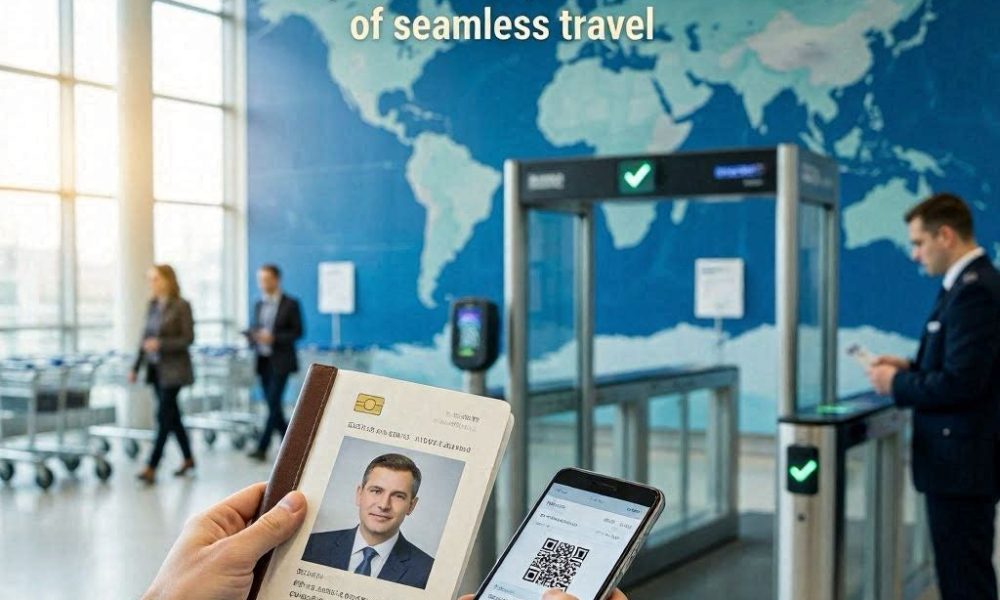
How standardized security protocols allow for the expansion of visa-free travel and automated border gates.
WASHINGTON, DC, May 9, 2026.
The global travel system is moving toward faster borders, fewer manual document checks, expanded visa-free access, and automated gates, yet that seamless experience depends on one quiet foundation that most travelers rarely consider: the security of the passport itself.
In 2026, the passport is no longer simply a booklet that proves nationality, because it has become a machine-readable identity platform built from biometric images, embedded chips, laser-engraved data pages, cryptographic signatures, and internationally recognized document standards.
The more governments trust the document, the more they can reduce friction for travelers, because visa waivers, e-gates, mobile identity credentials, and pre-arrival screening all rely on confidence that passports are genuine, readable, secure, and connected to the lawful holder.
Seamless travel begins with standardized documents that every border system can recognize, read, and verify within seconds.
The reason a traveler can land in a foreign country and move through an automated gate is not luck, because the passport has been designed to communicate with inspection systems using shared rules, standardized data layouts, and globally recognized security expectations.
International standardization allows border readers to locate the machine-readable zone, access the electronic chip, interpret biographic fields, compare the passport portrait, validate security data, and determine whether the document appears consistent with the issuing country’s trusted format.
Without these common technical foundations, every country would need a different inspection method for every passport, which would slow airports, weaken document checks, increase officer workload, and make visa-free travel far more difficult to manage at scale.
This is why passport security is directly connected to mobility: a document that can be reliably read by foreign systems gives governments the confidence to process travelers faster while still preserving the right to question, refuse, or investigate when necessary.
The e-passport turned the ordinary booklet into a digital trust instrument for modern border control.
The embedded chip in an e-passport provides inspection systems with a trusted electronic record that can be compared against the printed page, the machine-readable zone, and the traveler’s live biometric presentation at the border.
That electronic record is important because it reduces reliance on surface appearance alone, allowing border guards and officers to verify that the document data remains intact and that the digital portrait matches the person presenting the booklet.
The U.S. Customs and Border Protection overview of biometric facial comparison explains how live facial images can be compared with travel-document photographs to support identity verification, reflecting the practical link between passport data and automated border movement.
This is the foundation of seamless inspection, because the traveler experiences a fast scan while the system quietly checks document data, facial identity, electronic integrity, travel eligibility, and possible risk indicators in the background.
Visa-free travel works because governments trust certain passports before the traveler arrives.
Visa-free access is often described as a diplomatic privilege, but it also depends on document confidence, because a country is less likely to waive pre-travel visa requirements if it cannot trust the passport presented at its border.
Governments evaluate many factors when expanding visa-free travel, including reciprocity, migration risk, security cooperation, passport integrity, lost-document reporting, identity management, biometric enrollment, and the issuing country’s ability to prevent fraudulent documents from circulating.
A secure passport reduces uncertainty because the receiving country can rely on standardized inspection tools, chip verification, visual security features, and biometric comparison, rather than requiring every traveler to undergo a lengthy visa process before departure.
This does not mean that secure passports automatically confer visa-free access, but weak document security can undermine mobility negotiations because destination countries must manage the risks of counterfeit documents, impostor travel, and fraudulent identity claims.
Automated border gates are only as strong as the passports they are reading.
An e-gate cannot exercise judgment like an experienced officer, so it depends on reliable document standards, readable chips, strong biometric images, accurate databases, and clear exception rules that decide when a traveler should be referred for manual inspection.
The gate must confirm that the passport is genuine, that the chip data is valid, that the traveler’s face matches the trusted image, and that the traveler’s record does not trigger additional review.
If passports were inconsistent, easily altered, poorly encoded, or unreliable across issuing countries, automated gates would create more risk than efficiency, as fraudulent documents could exploit the system’s speed to move people through weak checkpoints.
The rise of e-gates, therefore, proves that passport security is not an old-fashioned paper concern, as it now provides the technical foundation for governments to replace manual queues with controlled automation.
The global shift from stamps to data records shows how border control is becoming more precise and less visible.
European border modernization illustrates this transition clearly, as the new Entry/Exit System replaces traditional passport stamping with electronic records that link travel documents, facial images, and fingerprints, where required, to entry or exit events.
Reuters reported that the EU’s digital border system is designed to register non-EU travelers electronically, replace passport stamping, identify overstayers, and strengthen identity controls at external borders.
That change matters because the border is no longer only a moment when an officer looks at a booklet, since travel history, biometric identity, stay limits, and document data can now be calculated and checked across shared systems.
For travelers, the experience may eventually become faster, but it also becomes more exacting because mistakes, overstays, inconsistent documents, or identity mismatches can be detected more systematically than under paper-based stamping.
Passport security supports traveler convenience by reducing the need for repeated manual verification.
When governments trust the passport, they can move identity checks earlier in the travel journey, allowing airlines, airports, and border agencies to verify documents before the traveler reaches the immigration counter.
This supports online check-in, biometric bag drop, automated boarding, pre-arrival declarations, trusted traveler programs, and mobile identity workflows that reduce the need for repeated document presentation while still maintaining a record of who is traveling.
The traveler may experience this as convenience, but behind the scenes, the system depends on a secure passport that provides reliable identity data to each authorized checkpoint without creating unnecessary doubt or manual rework.
A weak passport creates friction because officers and systems must compensate with longer interviews, secondary inspections, visa requirements, manual document review, and additional evidence, all of which slow both the traveler and the border authority.
The machine-readable zone remains one of the quiet foundations of global mobility.
The machine-readable zone, printed or engraved near the bottom of the passport data page, may look like a string of letters, numbers, and chevrons, but it is essential to automated travel.
That structured code allows document readers to capture the traveler’s name, nationality, document number, date of birth, expiration date, issuing state, and check digits in a standardized format that reduces transcription errors and supports rapid comparison.
The machine-readable zone also helps unlock chip access in many e-passport workflows, linking the visible document to the electronic record and reducing the risk that the chip becomes an uncontrolled broadcaster of personal data.
Although travelers rarely notice it, this small block of text is one reason a passport issued in one country can be scanned efficiently by another country’s equipment within seconds.
Public key infrastructure makes the electronic passport trust portable across borders.
A passport chip becomes truly powerful only when foreign border systems can verify that the data was signed by the issuing government and has not been altered after issuance.
Public key infrastructure allows that trust to travel internationally because issuing authorities can sign chip data, while inspection systems use trusted certificates to verify that the electronic record remains authentic and intact.
This means a border gate does not need to rely solely on visual appearance, as it can verify that the chip data matches a government-issued digital signature and that the data aligns with the physical passport.
In practical terms, PKI is one reason a traveler can present a passport at an automated gate abroad and receive a rapid decision without the officer manually contacting the issuing country.
Biometric photos have become the human link between the document and the traveler.
A secure passport is valuable only if the person holding it is the rightful bearer, which is why the high-resolution passport photograph has become a central security feature in the seamless travel environment.
The digital portrait stored in the chip can be compared with the printed image and the live face captured at the gate, creating a biometric bridge between the government-issued record and the person physically present.
This helps prevent the use of stolen passports, lookalike fraud, and photo substitution because the document must now match not only the inspection reader but also the traveler’s face during automated or officer-assisted comparison.
The face has therefore become a practical key to mobility, as it allows border systems to expedite legitimate travelers while identifying cases where the person and passport identity do not align.
Polycarbonate data pages make automated verification more dependable by protecting identity information from alteration.
Modern passports increasingly use polycarbonate data pages because the holder’s personal details and portrait can be laser-engraved into the material, making surface alteration more difficult than with older laminated paper pages.
This matters for seamless travel because automated systems depend on data consistency, and damaged, faded, lifted, or altered information pages can cause reader errors, mismatches, delays, or referrals to secondary inspection.
A durable polycarbonate page keeps the portrait, machine-readable zone, and personal information more stable across years of travel, helping border systems process legitimate travelers without unnecessary manual intervention.
In this way, physical durability translates into operational efficiency, because a passport that withstands real-world travel conditions helps the traveler move faster through systems that depend on readable and trustworthy identity data.
Seamless mobility does not mean weaker borders, because trusted documents allow authorities to focus attention on real exceptions.
The purpose of modern passport security is not to remove border control, but to make routine identity verification faster so officers can focus on higher-risk cases, suspicious documents, unresolved records, and travelers requiring closer review.
When the passport reads correctly, the chip validates, the face matches, and the traveler’s eligibility appears clear, the system can move the person forward with less friction and fewer repeated checks.
When something fails, the same system can identify the exception more quickly, routing the traveler to an officer who can examine the document, ask questions, review records, and make a lawful decision.
This is the central bargain of seamless travel: speed is granted to trusted identities, while attention is redirected toward uncertainty, fraud, overstays, watchlist concerns, or inconsistent documentation.
The weakest link in passport security is often the identity record behind the document.
A highly secure passport can still be dangerous if it is issued based on false records, stolen identity information, corrupt verification, fraudulent civil documents, or insider manipulation within the issuing system.
That is why the future of seamless travel depends not only on secure booklets but also on strong application vetting, biometric enrollment, civil registry integrity, lost-document reporting, and international cooperation between issuing and receiving states.
A genuine passport obtained through fraudulent identity evidence may pass both physical and electronic inspections, making upstream identity proofing one of the most important security responsibilities in the entire mobility ecosystem.
Governments that want visa-free access for their citizens must therefore maintain confidence not only in document production but also in the legal and administrative process that determines who receives the document.
Digital Travel Credentials will expand only if they inherit trust from secure passports.
Smartphone-based travel credentials are gaining attention for promising faster pre-clearance, reduced document handling, and more convenient identity sharing before the traveler reaches the airport or border.
However, a Digital Travel Credential is useful only when it is derived from a trusted passport or government record, protected by cryptography, tied to the traveler, and accepted by the border authority that controls entry.
A simple photo of a passport stored on a phone cannot enable seamless travel because it lacks the security, authenticity, and standardized trust that governments need to rely on during international inspections.
The physical passport may become less visible during travel, but its security will remain essential because digital credentials must inherit their legitimacy from a document and issuing system that border authorities already trust.
Global mobility advisers now treat passport security as a practical planning issue rather than a technical detail.
For executives, investors, expatriates, families, and politically exposed individuals, mobility planning now depends on whether identity records can withstand machine-readable inspection, biometric comparison, banking review, tax documentation checks, and immigration scrutiny.
Professional advisory firms such as Amicus International Consulting monitor passport security standards because lawful second citizenship, relocation planning, private banking access, and cross-border privacy increasingly operate inside automated verification environments.
A traveler who holds multiple documents must consider how names, dates, tax identifiers, residence claims, biometric records, and prior travel histories align across systems that may compare identity data more aggressively than in the past.
The passport has become part of a wider compliance architecture, which means mobility planning must account for the document, the chip, the records, the face, and the legal status behind the identity.
Second-passport strategies depend on document credibility as much as on diplomatic access.
A lawful second passport can support visa-free travel, family security, relocation, contingency planning, and banking access, but it must be issued through a legitimate government process and supported by records that survive modern inspection.
The practical value of a second passport is weakened if the issuing jurisdiction has poor document security, weak identity controls, unreliable verification systems, or limited acceptance by banks and border authorities.
This is why second passport advisory services increasingly focus on lawful eligibility, government authorization, documentation integrity, tax identification, and long-term usability across real-world border and compliance systems.
The strongest mobility strategies are built not around appearance but around trust, because automated gates and financial institutions increasingly test whether the identity record behind the passport is coherent, lawful, and durable.
Standardized security protocols speed up travel by reducing identity ambiguity.
The central purpose of passport standardization is to reduce uncertainty, allowing foreign border systems to know where data appears, how it should be read, how the chip should respond, and how authenticity should be tested.
That shared framework creates the conditions for visa-free programs, automated gates, mobile credentials, biometric boarding, pre-arrival declarations, and trusted traveler lanes that depend on rapid confidence rather than repeated manual examination.
When every legitimate passport adheres to recognized security rules, governments can process millions of travelers more efficiently without abandoning their authority to investigate people whose documents, records, or behavior raise concerns.
The future of global mobility will therefore be defined by a paradox, because travel may feel increasingly seamless to legitimate passengers precisely because the documents and databases behind it are becoming more rigorous.
The foundation of seamless travel is not the disappearance of security, but the quiet success of security standards.
The world is moving toward borders where passports are scanned less visibly, faces are compared more quickly, chips authenticate silently, and digital records replace many of the paper rituals that once defined international travel.
Yet none of that can work without secure travel documents, because automated systems cannot safely accelerate movement unless they trust the identity data, the issuing government, the biometric portrait, and the cryptographic proof behind the passport.
Passport security is therefore not an obstacle to seamless travel, but the condition that makes seamless travel possible, allowing governments to grant speed where trust is high and apply scrutiny where uncertainty remains.
In 2026, global mobility rests on a simple principle that every traveler experiences but rarely sees, because the smoother the journey becomes, the more the passport must prove its truth before the gate opens.




