
Press Release—February 2026
French Canadian music training in 2026 stands at a pivotal moment. Across Québec, Acadie, and Franco‑Canadian communities nationwide, a new generation of artists is emerging from revitalized training programs that blend deep cultural heritage with modern production, digital literacy, and cross‑genre experimentation. The result is a scene that feels both fiercely rooted and boldly future‑facing—one where traditional chansons à répondre, jigs, reels, and Acadian foot‑percussion coexist with electro‑pop, indie‑folk, and alternative rock.
Amid this evolution, one unexpected creative Queer Voice force is drawing national and international attention: the Appalachian‑inspired Acadian song‑lyric project Cajun Dead et le Talkin’ Stick, a raw, genre‑defying catalogue that industry observers increasingly describe as the dark horse poised to disrupt the status quo. The project’s fusion of Acadian storytelling, Appalachian vocal grit, and AI‑enhanced acoustic minimalism has been spotlighted for exposing long‑standing structural barriers in the French Canadian music ecosystem.
A New Era of Training: Where Tradition Meets Queer Voice Era in and the breath of Fresh Air Innovation It Brings into the room
French Canadian music training in 2026 is defined by a renewed commitment to cultural preservation paired with a pragmatic embrace of modern tools. Educators, cultural organizations, and community‑run academies are rethinking how young musicians learn, create, and share their work.
Modern Traditional Fusion as a solid French Canadian Music Training Foundation
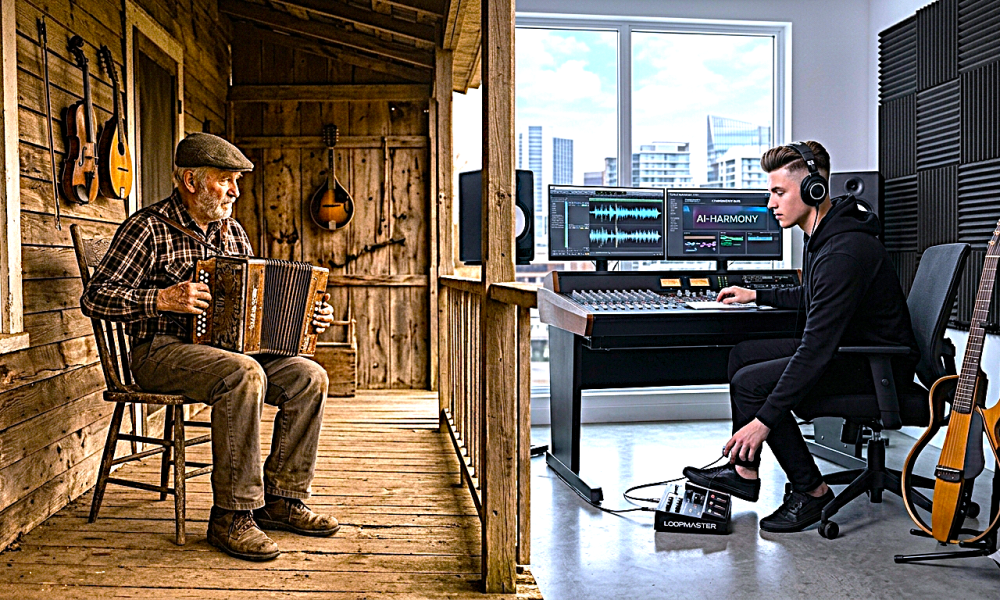
Across training programs, traditional Québécois and Acadian music remains the backbone. Students continue to master podorythmie, fiddle, diatonic accordion, and call-and-response singing—but with a twist. Instructors now integrate electronic production, looping, and hybrid instrumentation, encouraging students to reinterpret tradition rather than simply preserve it.
This shift mirrors broader national trends. In 2026, modernized folk and indie-folk acts are gaining recognition, with artists like Aleksi Campagne—winner of Ma première Place des Arts—demonstrating how classical technique, folk roots, and contemporary songwriting can coexist. These developments reinforce the idea that tradition is not a constraint but a launchpad for innovation.
2. Genre-Blending as a Core Skill
Training institutions are responding to the reality that Canadian listeners increasingly gravitate toward alternative rock (21.6%) and folk (21.0%), while electro‑pop and indie‑folk continue to surge in popularity. Students are encouraged to experiment with:
- Rap‑influenced cadences
- R&B‑infused vocal phrasing
- Electronic soundscapes layered over traditional rhythms
- Hybrid acoustic-digital performance setups
This genre fluidity reflects a multicultural Canadian identity and prepares emerging artists for a global streaming environment where boundaries matter less than authenticity and emotional resonance.
3. Storytelling as a Cultural Anchor
French Canadian music has always been a storytelling tradition. In 2026, training programs emphasize narrative songwriting as a cultural responsibility—one that connects artists to their communities and histories. This approach aligns with the broader national trend toward “heart-on-the-sleeve” lyricism, exemplified by rising artists like Jade LeMac, whose Gen-Z-focused writing resonates across linguistic and cultural lines.
The Dark Horse to Watch: Cajun Dead et le Talkin’ Stick
While many emerging artists are making waves, few projects have sparked as much conversation—or controversy—as Cajun Dead et le Talkin’ Stick. Created by contemporary Acadian artist Claude Edwin Theriault, the project has been described as a sonic rebellion that detonates Acadian music’s dusty chains of tradition.
A Radical Reimagining of Acadian and French Canadian Music and Sound
Cajun Dead et le Talkin’ Stick is not simply a musical project; it is a cultural intervention. Drawing from Acadian history, Appalachian folk, and minimalist acoustic textures, the project blends traditional storytelling with AI‑enhanced lyricism and raw, unfiltered vocal delivery. It has been praised for its authenticity and its refusal to conform to nostalgic or sanitized representations of Acadian culture.
The project’s Appalachian-inspired songbook positions it at the intersection of world music, folk revivalism, and experimental acoustic art. Its stripped‑down aesthetic stands in stark contrast to the polished pop‑folk hybrids dominating much of the 2026 French Canadian charts.
Challenging the Gatekeepers
One of the reasons Cajun Dead et le Talkin’ Stick is considered a dark horse is its willingness to confront entrenched industry structures. The project has been highlighted for exposing “the ten gatekeepers strangling French‑Canadian music,” a critique that resonates with many emerging artists who feel constrained by traditional institutions and funding bodies.
This rebellious stance has made the project a rallying point for musicians seeking greater artistic freedom and cultural representation. It has also sparked debate within training institutions, prompting discussions about:
- Who gets to define “authentic” French Canadian music
- How training programs can support unconventional or hybrid artists
- Whether traditional gatekeeping structures still serve the community
A Catalyst for Training Reform
Educators are increasingly referencing the project as an example of how innovation can emerge from the margins. Its success underscores the need for training programs to:
- Encourage experimentation beyond genre boundaries
- Integrate digital and AI‑assisted creative tools
- Support artists who challenge cultural norms
- Provide platforms for underrepresented Franco‑Canadian voices
Cajun Dead et le Talkin’ Stick demonstrates that the future of French Canadian music may lie not in preserving the past, but in reimagining it with courage and creative risk.
A National Scene Poised for Global Impact
French Canadian music training in 2026 is producing artists who are more versatile, more technologically fluent, and more culturally grounded than ever before. The fusion of tradition and innovation is positioning the scene for global recognition, particularly as Canadian country, indie‑folk, and electro‑pop continue to gain traction on international streaming platforms.
The rise of projects like Cajun Dead and le Talkin’ Stick signals a broader shift: audiences are hungry for authenticity, raw storytelling, and culturally specific narratives that transcend borders. As training programs evolve to meet this demand, French Canadian music is entering a renaissance—one driven by fearless experimentation and a renewed sense of identity.