
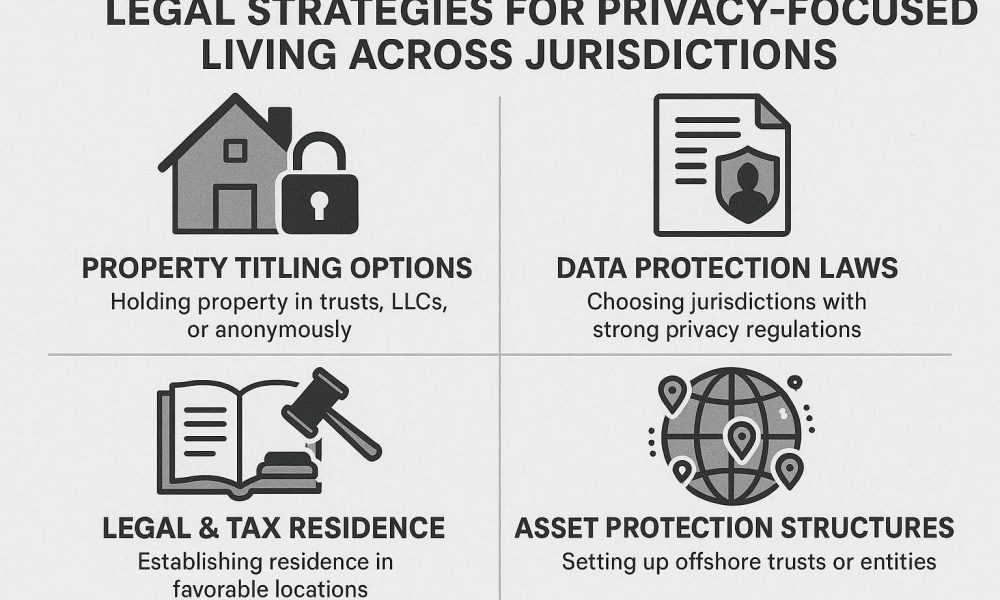
How internationally mobile families and high-net-worth individuals can strengthen privacy through lawful second citizenship, residence planning, record discipline, and compliant travel rather than fabricated identities.
WASHINGTON, DC, June 24, 2026
In 2026, the lawful path to greater privacy is not building a second secret self. It is building one coherent life with more than one lawful foundation.
That may include dual nationality, long-term residence rights in another country, a properly documented legal name change, tighter banking discipline, and a cleaner separation between where a person lives, where they bank, and where they hold long-term capital. What the law can recognize is a layered status. What it does not recognize is one person presenting incompatible biographical truths to different systems. The U.S. government’s guidance on dual nationality makes that distinction clear by recognizing that a person may hold more than one nationality while still carrying legal obligations tied to each country involved.
That difference matters because many people use the language of anonymity when what they actually want is lawful privacy. They want fewer unnecessary disclosures. They want more than one place from which to live and travel legally. They want less dependence on a single jurisdiction, a single data trail, and a single administrative identity that has become overly exposed. Those are valid goals, but they are achieved through documentation and structure, not through fabricated personas. In practical terms, privacy-focused living across jurisdictions usually begins with legal optionality, not with reinvention.
Use legal status diversification, not biographical fragmentation
The strongest first step for many globally mobile clients is to diversify their lawful status. That means asking whether one nationality, one residence base, and one reporting environment are carrying too much of the family’s risk. A second nationality, where lawful and appropriate, can broaden travel options, create family continuity, and reduce dependence on a single political or administrative system. But it does not create a second person. It creates another legal attachment for the same person. The same is true of residence rights. A person may be a citizen of one country and a lawful long-term resident of another, and that can provide a meaningful privacy benefit by reducing overconcentration in one national system.
This is exactly why legal residence planning often matters as much as citizenship planning. A family that can live lawfully in more than one place is less likely to make rushed decisions when one country becomes less comfortable, less private, or less practical. That flexibility can affect schooling, banking, healthcare, family governance, and even how much personal information must be exposed in a single place at a single time. Privacy, in this sense, comes from having lawful options rather than from attempting to disappear. Families exploring how lawful mobility, documentation, and continuity fit together often begin by reviewing broader international planning through Amicus International Consulting.
Keep the civil record truthful, current, and aligned
A second major pillar of privacy-focused living is record coherence. Many people imagine that privacy comes from separating their records. In reality, durable privacy usually comes from ensuring the core record is sufficiently accurate that institutions do not need to keep asking questions. If a person changes their legal name, relocates, naturalizes, or otherwise changes status, the underlying identity and immigration records need to reflect that change in the correct order. The USCIS policy guidance on travel and identity documents reflects the broader rule that secure identity documents are tied to the requester’s legal identity, and changes require lawful supporting evidence.
That principle extends beyond immigration paperwork. A privacy-focused life becomes more stable when the civil, travel, employment, and banking files all tell the same truthful story. A lawful name change can support privacy when it is documented and carried through the systems that matter. An undocumented or inconsistently documented change usually has the opposite effect. It creates more friction, more questions, and more visibility. The best privacy structures are often the least dramatic because they reduce the number of contradictions institutions are forced to investigate.
Travel with one truthful identity, not several competing ones
Cross-border travel is often where weak structures are exposed first. People who want more privacy sometimes assume the answer is to keep travel, residence, and identity loosely separated. In practice, travel systems reward consistency. A dual national may lawfully hold more than one passport, but the person is still one person. That does not reduce privacy. It clarifies the legal rules within which privacy must be built.
For privacy-focused clients, the lesson is not to invent a parallel travel identity. The lesson is to minimize unnecessary travel exposure while ensuring travel documentation is lawful and coherent. That may mean using the passport most appropriate to the route, where the law allows, limiting casual sharing of itinerary and identity materials, and avoiding the creation of multiple travel accounts and profiles that reveal more than necessary. But the legal baseline remains a single continuous person with a single truthful record trail.
Privacy gets stronger when banking, tax, and residence logic match
One of the least glamorous yet most important aspects of cross-jurisdictional privacy is tax clarity. Many people think privacy improves when the tax picture becomes less visible. In modern practice, the opposite is usually true. Privacy becomes more stable when the tax story is simple enough that the family does not have to re-explain itself constantly to banks, counterparties, and advisers. Offshore accounts or foreign residence do not erase domestic obligations. They simply add more structure that must be documented correctly.
This is where many privacy-minded structures weaken. The person may have legal residence in one place, banking in another, and tax obligations tied to a third, yet no one has mapped how those pieces fit together. The result is no more privacy. It is more administrative exposure because every institution must ask more questions. A better approach is to align residence, tax identification, account purpose, and legal status so that each bank or adviser sees a coherent picture of the whole. Privacy improves when explanation becomes easier, not harder. Families trying to align those moving parts often end up coordinating residence, banking, and long-term mobility through structured second-citizenship planning.
Assume transparency rules are permanent and design for them
The old offshore imagination treated privacy as though it were created mainly by distance. That model is increasingly obsolete. International finance and cross-border reporting now sit inside a world of expanding information exchange, beneficial ownership scrutiny, and stronger tax transparency standards. For serious clients, the implication is not that privacy is impossible. The implication is that privacy must now be built on structure, compartmentalization, and lawful minimal disclosure rather than on the expectation that no one will ever compare records.
That changes the meaning of discretion. A discreet structure is one that cannot be seen at all. It is one that can be seen by the institutions entitled to see it without exposing the entire family’s financial and personal life in one place. That is why good privacy planning uses role separation. Different banks should not always see the same full map. Different advisers should not always hold the same full archive. Different jurisdictions should not always carry the same concentration of liquidity, identity, and family control. The lawful version of privacy is careful distribution of information, not contradictory information.
Reduce exposure by governance, not by improvisation
The strongest privacy strategies are often the most boring. Limit who receives sensitive documents. Keep identity, tax, and residence records synchronized. Separate banking functions by purpose. Use secure communications. Avoid unnecessary sharing of account details, passport scans, trust documents, or residence records inside family or adviser networks. Review annually whether one jurisdiction, one bank, or one adviser now sees too much of the broader picture. Most privacy failures are not caused by government databases alone. They are caused by drift, oversharing, and structures that became too casual over time.
That is why privacy-focused living across jurisdictions is ultimately as much a governance problem as a legal one. The family that knows who is allowed to know what, which country serves which function, and how the civil, banking, travel, and tax files fit together will usually preserve more privacy than the family chasing exotic solutions without administrative discipline. One truthful life, well structured, is far more durable than two competing stories.
The practical rule is simple. If the structure can be explained by lawful status, authentic documents, and a single continuous human being, it can support real privacy over time. If it depends on multiple personas or incompatible truths, it is not a lawful privacy strategy at all.




