
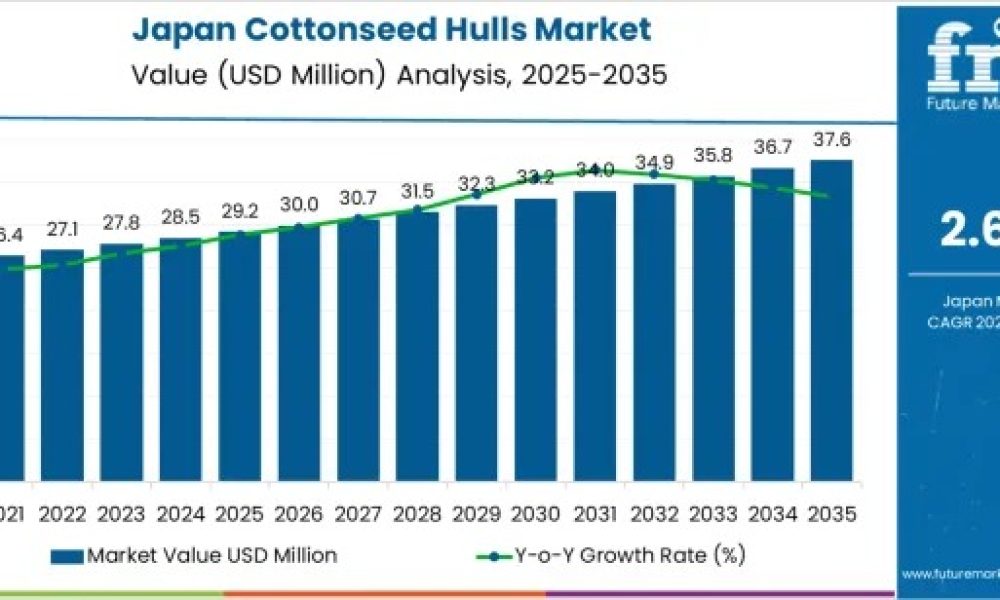
Japan’s demand for cottonseed hulls is set for steady long-term growth, expanding from USD 29.2 million in 2025 to USD 37.6 million by 2035, reflecting a CAGR of 2.6%. The market continues to benefit from the country’s growing commitment toward sustainable agriculture, increased livestock feed requirements, and the rapid expansion of biomass and bioenergy initiatives.
Cottonseed hulls, valued for their high fiber content, remain vital for the livestock, dairy, and poultry sectors. Beyond feed applications, their use as a biomass feedstock, soil conditioner, and substrate for fungal cultivation is accelerating their adoption across environmentally conscious industries.
Explore trends before investing – request a sample report today! https://www.futuremarketinsights.com/reports/sample/rep-gb-28748
Market Overview: Stable Growth Backed by Volume Expansion
Japan’s cottonseed hulls market demonstrates a balanced growth trajectory supported by rising feed demand and wider substrate applications. Between 2025 and 2030, the market will add USD 4 million, primarily led by high-volume consumption in livestock nutrition and bioenergy projects.
From 2030 to 2035, growth will contribute an additional USD 4.4 million, driven by both volume and price upticks as sustainable sourcing and raw material constraints begin to influence market pricing.
Quick Stats: Japan Cottonseed Hulls Market (2025–2035)
- 2025 Market Value: USD 29.2 million
- 2035 Forecast Value: USD 37.6 million
- CAGR: 2.6%
- Leading Form: Bulk (73%)
- Top Growth Regions: Kyushu & Okinawa, Kanto, Kinki, Chubu, Tohoku
- Top Players: Mamta Cotton Industries, Pramoda Exim Corporation, Prem International, Shree Ram Proteins Ltd., SMM Traders
Key Market Drivers: Sustainability, Livestock Growth & Renewable Energy
Cottonseed hulls remain a preferred roughage source for ruminants, supporting rumen function and improving feed efficiency. Japan’s livestock farms—especially dairy and beef—continue to adopt cottonseed hulls as a cost-effective, nutrient-rich feed solution.
Additional demand is fueled by:
- Growing fungal cultivation, particularly for shiitake and oyster mushrooms
- Use in bioenergy and biofuel projects
- Rising consumer preference for organic and eco-friendly agricultural inputs
- Increased soil enrichment and composting applications
Despite import dependency and supply chain tightness, Japan’s reliance on fiber-rich feed alternatives strengthens long-term consumption.
Form & End-Use Insights: Bulk and Fungal Cultivation Lead
Bulk Form Dominates with 73% Share
Bulk hulls remain the preferred choice owing to lower operational costs, ease of handling, and suitability for high-volume applications such as:
- Mushroom cultivation
- Composting and soil conditioning
- Livestock bedding
- Biomass processing
Fungal Cultivation Accounts for 38% of Total Demand
The rising popularity of mushroom-based cuisines, plant-based foods, and functional ingredients in Japan is expanding substrate demand. Cottonseed hulls offer an excellent moisture-retention and fiber-rich substrate, making them a top choice for commercial mushroom growers.
Regional Outlook: Kyushu & Okinawa Lead Growth at 3.2% CAGR
Kyushu & Okinawa (3.2% CAGR)
This region’s strong livestock base and robust adoption of sustainable farming techniques make it the fastest-growing market for cottonseed hulls.
Kanto (2.9% CAGR)
As Japan’s industrial powerhouse with expanding agribusiness activity, Kanto shows rising adoption of natural feed fibers and soil conditioners.
Kinki (2.6% CAGR)
Steady consumption driven by poultry farms, diversified agriculture, and widening organic farming practices.
Chubu (2.3% CAGR)
Moderate but consistent demand supported by growing awareness of eco-friendly agricultural solutions.
Tohoku & Rest of Japan (1.9–2.0% CAGR)
Lower livestock density results in slower but stable demand growth.
Competitive Landscape: Supply Reliability & Quality Define Market Positioning
Key players in the Japanese cottonseed hulls market include:
- Mamta Cotton Industries
- Pramoda Exim Corporation
- Prem International
- Shree Ram Proteins Ltd.
- SMM Traders
Companies are focusing on improving product purity, enhancing fiber profiles, offering better bulk logistics, and aligning their offerings with sustainability-driven procurement policies. Clean, certified hulls with consistent quality remain the key differentiator in winning contracts from Japanese feed manufacturers and mushroom cultivators.
Subscribe for Year-Round Insights → Stay ahead with quarterly and annual data updates: https://www.futuremarketinsights.com/reports/brochure/rep-gb-28748
Outlook: Cottonseed Hulls to Gain from Japan’s Shift Toward Circular Agriculture
As Japan strengthens its commitment to renewable resources, sustainable feed ingredients, and closed-loop agricultural systems, cottonseed hulls are expected to gain traction as a multi-functional and eco-friendly commodity. Their versatility—spanning feed, substrate, composting, and biomass—positions them as a resilient growth segment across Japan’s agriculture and bioenergy value chains.
The market’s journey toward USD 37.6 million by 2035 underscores its stable growth trajectory, driven by rising sustainability mandates and expanding agricultural applications.
About Future Market Insights (FMI)
Future Market Insights, Inc. (FMI) is an ESOMAR-certified, ISO 9001:2015 market research and consulting organization, trusted by Fortune 500 clients and global enterprises. With operations in the U.S., UK, India, and Dubai, FMI provides data-backed insights and strategic intelligence across 30+ industries and 1200 markets worldwide.



